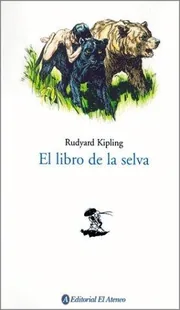
The Jungle Book
by Rudyard Kipling · 1893
Suits younger readers and families as a read-aloud, and holds up for adults too.
192 pages, about 3 to 4.5 hours.
Kipling's jungle tales: short, vivid, and nothing like the cartoon. 57% taste match
About the book
The Jungle Book is a children's story collection by Rudyard Kipling, first published in 1893. The stories are adventure fiction written for young readers, and most of them are set among the animals of the Indian jungle in the 19th century. Shere Khan the tiger and Baloo the bear are among the creatures who appear in its pages.
At the center of the collection is Mowgli, a boy known as a man-cub who grows up among wolves. The opening scene finds Father Wolf waking on a warm evening in the Seeonee hills, a place in central India that recurs throughout the book. Mowgli's life in the jungle, among its animals and their ways, runs through the stories as the thread that connects them. The book belongs to the tradition of tales about feral children and jungle animals, and it has appeared in hundreds of editions, typically running to around two hundred pages.
It was seven o'clock of a very warm evening in the Seeonee hills when Father Wolf woke up from his day's rest, scratched himself, yawned, and spread out his paws one after the other to get rid of the sleepy feeling in their tips.
Setting
India
Period
19th century
Themes
JunglesAnimalsRomans, nouvelles, etc. pour la jeunesseNovela juvenilSelvasAnimalesJungle animalsMowgli (Fictitious character)
- Want to read 458
- Reading now 38
- Read 56
Most people shelving it are saving it for later.
Of 552 readers who put it on a shelf, 83% want to read it, 7% are reading it now, 10% have finished it and 0% stopped before the end.
By the numbers
- The median edition runs 192 pages. Counting about 275 words a page and an adult reading pace of 250 words a minute, that is about 3.5 hours of reading.
- Open Library tracks 537 editions from 233 publishers, the earliest dated 1893 and the latest 2024, across 8 languages.
- On reader demand it ranks in the top 2% of the classic books in our catalog (8,749 of them).
- Libraries shelve it under Dewey 082.1 and Library of Congress class PR-4854.00000000.S27 1899.
Read it
The text of this edition is free to read online.
2 ebook providers carry it and a scanned copy is on the Internet Archive.
 BookWard’s take
Kipling's jungle tales: short, vivid, and nothing like the cartoon
The Jungle Book is a collection of short stories, a form that suits it well, and at around two hundred pages it never overstays. Mowgli, the man-cub raised by wolves, gives the stories their spine, while animals like Shere Khan and Baloo carry much of the drama. The tales move briskly and open in scene, with Father Wolf waking in the Seeonee hills. Where it falters is in its familiarity: the animal-fable form and the feral-child idea now feel well worn. The loose, episodic structure also means the book doesn't resolve the way a single novel would, so the ending lands softly. Still, Kipling's voice is unmistakable, and the Indian setting still feels distinct.
A short story collection of about two hundred pages, which sits well with BookWard's preference for tight books.
Each story moves along briskly, driven by incident rather than lingering.
It shaped a whole tradition of jungle tales, though that tradition has since become familiar.
Rhythmic and slightly elevated, but never dense or hard to follow.
Events and adventures lead, with Mowgli's growth running as a quieter thread.
Dangerous in places, but ultimately about belonging and resilience.
A linked collection of separate tales rather than one continuous novel.
Mostly earnest adventure, with only light touches of humor.
Predators and peril are present but handled with a children's-adventure restraint.
Loyalty and belonging land with feeling, without tipping into melodrama.
See all 50 dialsEvery position, side by side with this book
Where it lines up
- Authorial voiceBookWard 9 · book 9
- LengthBookWard 1 · book 2
- PaceBookWard 8 · book 7
Where it pulls apart
- Familiar tropesBookWard 10 · book 5
- OpeningBookWard 10 · book 7
- Internal logicBookWard 10 · book 7
A short story collection of about two hundred pages, which sits well with BookWard's preference for tight books.
The opening scene of Father Wolf waking on a warm evening draws you in, though not with a jolt.
Feral-child and talking-animal tales are an established tradition, and Kipling works within it, which pulls against BookWard's taste.
The jungle operates by its own consistent laws and customs, which holds together well.
Each story moves along briskly, driven by incident rather than lingering.
It shaped a whole tradition of jungle tales, though that tradition has since become familiar.
Mowgli and the animals are vividly drawn, though the stories favor clear archetypes over deep interiority.
Individual stories resolve cleanly, but the collection as a whole drifts rather than closing in one arc.
There is warmth in Mowgli's bonds with his animal family, balanced by a matter-of-fact tone.
The jungle's dangers feel real and earned within the stories, never shock for its own sake.
Kipling's storytelling voice is confident and instantly recognizable, a real strength.
These are story-led adventures, with ideas carried inside the tales rather than argued.
Jungle law and custom are woven into scenes, though the narrator sometimes explains outright.
As short tales, each one stays lively and none has time to sag.
Rhythmic and slightly elevated, but never dense or hard to follow.
Events and adventures lead, with Mowgli's growth running as a quieter thread.
Dangerous in places, but ultimately about belonging and resilience.
A linked collection of separate tales rather than one continuous novel.
Mostly earnest adventure, with only light touches of humor.
Accessible to young readers, with older language that asks only a little extra patience.
The narration stays close to Mowgli and the animals around him, with a consistent storyteller's view.
Animals talk, think, and keep laws, set against a recognizable Indian landscape.
A sizable roster of animals appears across the collection, though each is distinct.
Mostly focused on Mowgli and his jungle, with a world of its own around him.
Action and encounters dominate, with feelings shown through deeds.
Animals talk often and memorably, giving the stories a conversational feel.
Romance plays no real part in these stories.
The Indian jungle setting is vivid and likely unfamiliar to most readers.
Written in the 19th century and rooted in its time and setting.
Generations have kept coming back to Mowgli's story, which speaks to real staying power.
A trustworthy storyteller who tells it straight.
The jungle's law gives the stories a fairly clear sense of right and wrong.
The jungle, its animals, and its seasons are drawn in vivid, sensory detail.
A standalone collection, though Kipling later returned to Mowgli in a second book.
Tales follow clear arcs with a few turns, but surprises are modest.
A welcoming read that gently explores belonging and danger.
Predators and peril are present but handled with a children's-adventure restraint.
Loyalty and belonging land with feeling, without tipping into melodrama.
Any humor is dry and incidental rather than broad.
Animal threats and fights appear, kept within a children's-fiction register.
No sexual content appears.
Not a political book at its core, though it carries the assumptions of its era.
Period English with some unfamiliar jungle names, but largely readable.
Kipling's narrator has clear views on how the jungle works and says so.
A story rooted in nature and tradition, looking backward more than forward.
Loyalty, courage, and belonging are treated as real and worth the effort.
Review written by BookWard, dial version 1, November 2026.
Who is The Jungle Book right for?
Suits younger readers and families as a read-aloud, and holds up for adults too. Predators and peril appear, and as a product of its era it carries some period attitudes.
Accessible to young readers, with older language that asks only a little extra patience.
Predators and peril are present but handled with a children's-adventure restraint.
Loyalty and belonging land with feeling, without tipping into melodrama.
Animal threats and fights appear, kept within a children's-fiction register.
Book CompanionThe Jungle Book: ideas, characters, themes
A boy raised by wolves must find his place between the jungle that made him and the human world he came from.
- A collection, not a novel. The book gathers separate stories, with Mowgli as the thread that ties many of them together.
- Jungle as a society. The animals live by shared rules and customs, giving the jungle its own order.
- Seeonee hills. The Seeonee hills in central India recur throughout and anchor the setting.
- Man-cub among wolves. Mowgli's upbringing sets up his outsider status and drives much of the drama.
- Predator and protector. Shere Khan the tiger and Baloo the bear represent very different relationships to Mowgli.
Characters
Mowgli
The man-cub at the center
A boy raised by wolves in the jungle, whose life links the stories.
Shere Khan
The tiger
A dangerous presence among the jungle's animals.
Baloo
The bear
One of the creatures who shapes Mowgli's life in the jungle.
Father Wolf
Wolf of the Seeonee hills
Appears in the opening scene, waking on a warm evening.
Themes
Where one truly fits when raised between two worlds.
How shared rules keep a community, even a wild one, together.
The jungle as both home and threat.
Mowgli's journey from cub toward independence.
The bonds of family chosen rather than born.
Discussion questions
- What makes Mowgli an outsider, and does he ever stop being one?
- How does the jungle's code compare with human rules?
- Why do you think the animals are so vividly individual?
- Do the separate stories feel connected, or like standalone pieces?
- How does the 19th-century setting shape what the book assumes about the jungle and its people?
Personalize your Book Companion
This is the general edition. In BookWard, the Companion is written for you: your reading profile, your notes, and spoiler-safe to the page you are on.
Buy, listen or borrow The Jungle Book
Each link opens a search for this book on that store, in a new tab.
Read on a device
Borrow
Reviews and community
If you liked The Jungle Book
A short, sharp fable about boredom, bargains and stolen youth
What Feasts at NightT. KingfisherA short gothic chiller with a dry-witted soldier at its center
The Blue SwordRobin McKinleyA desert-frontier fantasy where an orphan finds her destiny
A Wizard of EarthseaUrsula K. Le GuinA short, sure-footed fantasy about pride and its cost
Sources: Open Library.
Track The Jungle Book and find your next favorite
Add it to your shelf, rate what you have read, and BookWard will recommend what fits you.
Free to start. No credit card needed.