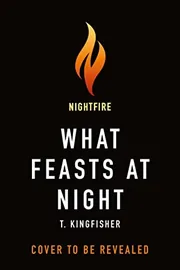
What Feasts at Night
by T. Kingfisher · 2024
Suited to adult readers who enjoy gothic horror.
176 pages, about 3 to 4 hours.
A short gothic chiller with a dry-witted soldier at its center. 68% taste match
The story
What Feasts at Night is a 2024 gothic horror novella by T. Kingfisher, the pen name of American author Ursula Vernon. It stands alone as a sequel to What Moves the Dead, published in 2022, and runs about 176 pages. The story blends historical fiction with fantasy and carries LGBT themes, and it is written for an adult audience.
Alex Easton, still recovering from the ordeal at the Usher manor, wants only rest, routine, and sunshine. Instead, Easton travels as a favor to Angus and Miss Potter to the family hunting lodge in the cold, damp forests of Gallacia, their home country. On arrival, Easton finds the caretaker dead, the lodge in disarray, and an unsettling silence over the grounds. Villagers murmur that a monster from local folklore, one said to steal breath, has settled into the house. Easton distrusts superstition, yet senses that something is wrong at the lodge and in their dreams.
Characters
Alex Easton
Themes
American literatureNew York Times bestsellerHorrorFantasyGothicNovellaLGBTHistorical
By the numbers
- The median edition runs 176 pages. Counting about 275 words a page and an adult reading pace of 250 words a minute, that is about 3.2 hours of reading.
- Open Library tracks 4 editions from 3 publishers, the earliest dated 2024 and the latest 2025.
- On reader demand it ranks in the top 17% of the recent releases books in our catalog (1,627 of them).
- Libraries shelve it under Dewey 813.6 and Library of Congress class PS-3611.00000000.I597W43 2024.
 BookWard’s take
A short gothic chiller with a dry-witted soldier at its center
Kingfisher keeps this tight: 176 pages, a cold Gallacian hunting lodge, a dead caretaker and a house gone strangely quiet. The brevity suits the story, which has no slack in it. The dread starts almost at once, and the pace stays brisk without costing the book its atmosphere. The voice is the real draw, with Easton's wry, practical narration set against the creeping horror. That blend of serious menace and a streak of humor is where this book lives. It is a standalone sequel to What Moves the Dead, so it plays best as a connected story, though newcomers can follow it without trouble. Folklore gives the monster a grounded feel rather than a generic one.
At 176 pages it is a lean novella that wastes little, which matches BookWard's love of tight books.
A novella built around a short stay at one lodge keeps momentum up, in line with BookWard's preference for speed.
A gothic sequel with an invented country and a breath-stealing folklore creature is inventive within a well-worn genre.
Clean, conversational prose with gothic mood, more plain than ornate, in the same neighborhood as BookWard.
Easton's perspective carries the tale, but a mounting mystery at the lodge shares the load.
Easton wants rest and sunshine and gets dread instead, yet the tone is wry rather than despairing.
A single linear stay at one location keeps the form conventional, slightly plainer than BookWard's middle.
Easton's dry asides leaven the horror, though the book is mainly a chiller.
Horror with a dead caretaker and breath-stealing monster is dark, but it stays measured rather than brutal.
Dread and unease drive the feeling, with Easton's dry humor keeping intensity from boiling over.
See all 50 dialsEvery position, side by side with this book
Where it lines up
- LengthBookWard 1 · book 1
- PaceBookWard 8 · book 8
- EndingBookWard 8 · book 8
Where it pulls apart
- Familiar tropesBookWard 10 · book 6
- Internal logicBookWard 10 · book 7
- OpeningBookWard 10 · book 8
At 176 pages it is a lean novella that wastes little, which matches BookWard's love of tight books.
Easton arrives to a dead caretaker and a silent estate, so the unease starts early, close to BookWard's taste for immediate hooks.
Haunted lodge and folklore monster are familiar gothic furniture, though the Gallacian setting freshens them; slightly below BookWard's high bar.
The monster comes from local folklore with its own rules, which gives the horror a coherent footing.
A novella built around a short stay at one lodge keeps momentum up, in line with BookWard's preference for speed.
A gothic sequel with an invented country and a breath-stealing folklore creature is inventive within a well-worn genre.
Easton's recovery from the previous ordeal gives the lead real weariness and personality, though the short form limits depth.
Easton's dry practicality keeps feeling in check, a restrained register BookWard tends to prefer.
The horror comes from dread and atmosphere more than gratuitous gore, so its darkness feels earned.
This is fiction, so the rigor dial does not apply.
Easton's wry, no-nonsense narration is the book's signature and clearly distinctive, matching BookWard's high weighting.
This is firmly story-led, driven by what is happening at the lodge rather than by an argument.
Folklore and backstory surface through scenes and villager talk rather than long explanation, close to BookWard's preference.
At novella length there is little room for a slack middle, and the dread builds steadily throughout.
Clean, conversational prose with gothic mood, more plain than ornate, in the same neighborhood as BookWard.
Easton's perspective carries the tale, but a mounting mystery at the lodge shares the load.
Easton wants rest and sunshine and gets dread instead, yet the tone is wry rather than despairing.
A single linear stay at one location keeps the form conventional, slightly plainer than BookWard's middle.
Easton's dry asides leaven the horror, though the book is mainly a chiller.
Short, readable and propulsive, it asks little of the reader, a touch easier than BookWard's usual.
The story follows Easton alone, so viewpoint is single and focused.
A breath-stealing folklore monster pushes this clearly into the fantastical, above BookWard's midpoint.
Everything centers on one lodge and its grounds, making this a decidedly intimate story.
Easton's dreams and doubts sit alongside external threats at the lodge, so inner and outer balance.
Romance is not the focus; the story is about the lodge, the monster and Easton's unease.
Gallacia is an invented country with its own customs and folklore, so the setting feels unfamiliar and fresh.
This is historical fiction set in the past, well away from BookWard's present-day lean.
Gothic horror with folklore roots tends to age well, though it is a recent release.
Easton tells it plainly and sensibly, so the narrator reads as reliable, unlike BookWard's lean toward unreliability.
The stakes are survival against a monstrous threat, so right and wrong are fairly clear.
Cold, damp forest and a silent lodge are central to the mood, so description is generous.
Told through Easton's own close perspective, it feels personal rather than detached.
A standalone sequel to What Moves the Dead, it connects to a world but reads on its own, a bit above BookWard's standalone lean.
A mystery of a dead caretaker and a creeping monster allows for turns, though in a short span.
A page-turning gothic with accessible themes sits on the comforting side of the dial.
Horror with a dead caretaker and breath-stealing monster is dark, but it stays measured rather than brutal.
Dread and unease drive the feeling, with Easton's dry humor keeping intensity from boiling over.
Easton's humor is dry and understated rather than broad, matching BookWard's lean.
Horror content is present but atmosphere takes priority over graphic violence.
Nothing in the story points to sexual content, which stays minimal.
Politics sits in the background; the focus is the lodge and the monster.
Plain, readable language with folklore flavor rather than dense dialect.
Easton's wry first-person commentary makes the narration clearly opinionated.
Rooted in folklore and history, it looks back more than forward.
Easton is practical and skeptical, but the book does not sink into pure cynicism.
Review written by BookWard, dial version 1, November 2026.
Who is What Feasts at Night right for?
Suited to adult readers who enjoy gothic horror. It contains horror themes including a dead caretaker and a menacing creature, so sensitive readers may want to be prepared.
Short, readable and propulsive, it asks little of the reader, a touch easier than BookWard's usual.
Horror with a dead caretaker and breath-stealing monster is dark, but it stays measured rather than brutal.
Dread and unease drive the feeling, with Easton's dry humor keeping intensity from boiling over.
Horror content is present but atmosphere takes priority over graphic violence.
Book CompanionWhat Feasts at Night: ideas, characters, themes
A weary soldier seeking rest finds their family hunting lodge haunted by a breath-stealing monster from Gallacian folklore.
- A sequel that stands alone. It follows What Moves the Dead but is built to be read as its own story.
- The lodge as a trap. A dead caretaker, a disordered house and an eerie silence set the mood on arrival.
- Folklore versus skepticism. Villagers blame a monster from legend while Easton distrusts superstition.
- Dreams as a warning. Easton senses something wrong in the home and in their dreams.
- Compact horror. At 176 pages it favors atmosphere and momentum over sprawl.
Characters
Alex Easton
Protagonist
A soldier still recovering from the ordeal at the Usher manor, who craves rest and sunshine.
Angus
Friend
One of the people for whom Easton makes the trip as a favor.
Miss Potter
Friend
The other person for whom Easton takes on the journey.
Themes
How local legends shape what people think is happening.
Trying to rest after a harrowing experience.
A familiar place turning menacing.
Doubting superstition while sensing something wrong.
Discussion questions
- Why does Easton distrust the villagers' folklore, and does the story vindicate or complicate that doubt?
- How does a familiar family lodge become frightening?
- What role do dreams play in building unease?
- Does knowing the earlier book change how you read Easton's weariness?
- What makes a short horror story effective compared with a long one?
Personalize your Book Companion
This is the general edition. In BookWard, the Companion is written for you: your reading profile, your notes, and spoiler-safe to the page you are on.
Buy, listen or borrow What Feasts at Night
Each link opens a search for this book on that store, in a new tab.
Read on a device
Borrow
Reviews and community
If you liked What Feasts at Night
A small mouse stands up to a tyrant owl
The Thief of AlwaysClive BarkerA short, sharp fable about boredom, bargains and stolen youth
Brigands & BreadknivesTravis BaldreeA cozy fantasy road trip with a foul-mouthed bookseller and a goblin
BoyRoald DahlDahl's boyhood, told as sharp, funny, unsentimental anecdotes
Sources: Open Library.
Track What Feasts at Night and find your next favorite
Add it to your shelf, rate what you have read, and BookWard will recommend what fits you.
Free to start. No credit card needed.