It suits babies, toddlers and preschoolers, and works well for early readers sounding out simple words.
32 pages, about 0.5 to 0.5 hours.
A rhyming parade of feet that teaches opposites. 56% taste match
About the book
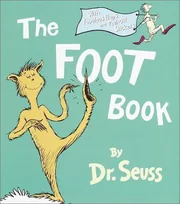
The Foot Book is a children's picture book by Dr. Seuss, first published in 1968. It is written in rhyme for the youngest readers and is designed as a beginner's text for preschool-age children. The story opens with the line "Feet in the morning," and from there the pages move through many kinds of feet in many kinds of situations. Short verses and repeated patterns carry the reader along, in the sing-song cadence that marks the author's other work for children.
The book's main idea is opposites. Each pair of feet is set against a contrasting pair, so young listeners meet ideas of polarity through pictures, sounds, and simple words, while also building familiarity with everyday English vocabulary and with synonyms and antonyms. Its subject matter is feet themselves, shown in a wide range of kinds and activities.
The title has appeared in a number of formats over the years, including board book editions suited to small hands. At about 32 pages, it is short enough for a single bedtime sitting or for repeated read-aloud sessions with a parent, teacher, or caregiver. It belongs among American children's stories in rhyme and fits readers just beginning to connect spoken language with the printed page.
Feet in the morning
Themes
Toy and movable booksChildren's stories, AmericanBoard booksStories in rhymeFootSpecimenspicture booksChildren's Books/Baby-Preschool
- Want to read 245
- Reading now 7
- Read 55
Most people shelving it are saving it for later.
Of 307 readers who put it on a shelf, 80% want to read it, 2% are reading it now, 18% have finished it and 0% stopped before the end.
By the numbers
- The median edition runs 32 pages. Counting about 275 words a page and an adult reading pace of 250 words a minute, that is about 35 minutes of reading.
- Open Library tracks 19 editions from 14 publishers, the earliest dated 1968 and the latest 2018, across 2 languages.
- On reader demand it ranks in the top 5% of the classic books in our catalog (8,749 of them).
- Libraries shelve it under Dewey [E] and Library of Congress class PZ-0008.30000000.G276 Fm 1996.
 BookWard’s take
A rhyming parade of feet that teaches opposites
The Foot Book runs 32 pages of rhyme, and it opens with the line "Feet in the morning." Everything after that is pairs of feet set against their opposites, so young listeners pick up the idea of polarity without anyone spelling it out. It is about as short as a book can be, and that suits it. It moves at once and never lingers, and a sagging middle isn't a worry at this size. There is almost no exposition: the pictures and the sing-song verse do the work. The voice is where it shines, since the cadence is unmistakably Dr. Seuss. It doesn't try to be a story with a plot, so asking about character depth misses the point, but as a read-aloud for a preschooler it is built with real care.
At 32 pages it is about as short as a book can be, which matches BookWard's taste for tight.
Short verses and repeated patterns carry the reader briskly from page to page.
The opposites-through-feet conceit is a fresh angle, even if the format is familiar.
Plain, simple words chosen for sound and for beginning readers.
There is no plot or character arc, so this dial does not apply.
Cheerful and bright from start to finish.
A straight run of paired pages, conventional for a rhyming concept book.
The rhymes and silly sights of many kinds of feet are light and playful.
Entirely gentle and safe for the youngest children.
Playful and light, with little emotional weight.
See all 50 dialsEvery position, side by side with this book
Where it lines up
- LengthBookWard 1 · book 1
- PaceBookWard 8 · book 8
- ExpositionBookWard 2 · book 2
Where it pulls apart
- Familiar tropesBookWard 10 · book 6
- Internal logicBookWard 10 · book 8
- OriginalityBookWard 9 · book 6
At 32 pages it is about as short as a book can be, which matches BookWard's taste for tight.
The first line, "Feet in the morning," starts the rhythm immediately, and the pairs of feet keep it going.
Rhyme and repetition are the standard toolkit of the picture book, though used with confidence here.
The opposites pattern is clear and consistent, and each pairing follows the rule it sets up.
Short verses and repeated patterns carry the reader briskly from page to page.
The opposites-through-feet conceit is a fresh angle, even if the format is familiar.
There are no characters to draw, only feet doing things, so this dial does not apply.
Warm and playful rather than weepy, with little pull toward sentiment.
Nothing here is dark, so there is no shock for effect to weigh.
This is a picture book, not nonfiction, so rigor does not apply.
The sing-song cadence is unmistakably Dr. Seuss, which BookWard values highly.
The book is built around one idea, opposites, more than any plot, though it never feels like a lecture.
Nothing is explained outright; pictures and rhyme carry every idea.
There is no middle to sag in 32 pages, and the rhythm holds throughout.
Plain, simple words chosen for sound and for beginning readers.
There is no plot or character arc, so this dial does not apply.
Cheerful and bright from start to finish.
A straight run of paired pages, conventional for a rhyming concept book.
The rhymes and silly sights of many kinds of feet are light and playful.
It is made for preschoolers, with short verses that need almost no effort.
The reader sees through a single, steady vantage as the pages turn.
Feet in a playful, exaggerated Seuss style, but nothing truly otherworldly.
There are no named characters, just feet, so the cast stays minimal.
A small, intimate book about feet and everyday opposites.
It is all visible doings and sights, with no interior thought.
There is no dialogue, only narration in verse.
No romance of any kind.
The setting is everyday and easy for a small child to recognize.
First published in 1968, but not tied to a particular present-day setting.
Rhyme and opposites do not date, so it still works for new young readers.
A plain, trustworthy voice walks the reader through the pages.
No moral dilemma here, just clear concepts a child can follow.
Brief rhymed lines leave the picture to do the describing.
It stands on its own as a single beginner's text.
The pattern is predictable by design, which is part of the comfort.
Gentle and comforting, made for bedtime and repeated read-alouds.
Entirely gentle and safe for the youngest children.
Playful and light, with little emotional weight.
Broad, silly fun in the Seuss tradition.
There is none.
There is none.
Entirely absent.
Simple everyday English vocabulary that suits beginners.
The narration stays neutral and just presents the feet.
It lives in the moment, looking neither back nor forward.
Cheerful and upbeat, with an open, curious view of the world.
Review written by BookWard, dial version 1, November 2026.
Who is The Foot Book right for?
It suits babies, toddlers and preschoolers, and works well for early readers sounding out simple words. Nothing in it is sensitive.
It is made for preschoolers, with short verses that need almost no effort.
Entirely gentle and safe for the youngest children.
Playful and light, with little emotional weight.
There is none.
Book CompanionThe Foot Book: ideas, characters, themes
Pairs of feet in contrasting situations introduce young children to opposites through rhyme and repetition.
- Starts in the morning. The book opens with the line "Feet in the morning," setting its rhythm right away.
- Opposites by design. Each pair of feet is set against a contrasting pair to convey polarity.
- Built for beginners. It is a preschool text with simple words that help children connect speech to print.
- Rhyme and repetition. Short verses and repeated patterns give the sing-song cadence typical of Dr. Seuss.
- Short and re-readable. At about 32 pages it suits a single bedtime or many repeat read-alouds.
Themes
Understanding a thing by seeing what it is not.
Rhyme and rhythm make words fun to hear and say.
Looking closely at ordinary things like feet.
Simple repeated text helps children link spoken and printed words.
Discussion questions
- Which pairs of feet in the book are opposites, and why?
- What do you notice about how the verses sound when read aloud?
- Can you think of other opposites you see in a day, like morning and night?
- Which repeated words or patterns did you spot?
- What other things could you pair up the way the book pairs feet?
Personalize your Book Companion
This is the general edition. In BookWard, the Companion is written for you: your reading profile, your notes, and spoiler-safe to the page you are on.
Buy, listen or borrow The Foot Book
Each link opens a search for this book on that store, in a new tab.
Read on a device
Borrow
Reviews and community
If you liked The Foot Book
A tiny vocabulary, one naughty boy, and a hug at the end
The GruffaloJulia DonaldsonA tiny mouse outwits the whole forest in rhyme
Room on the BroomJulia DonaldsonA rhyming broomstick tale where kindness gets crowded and then pays off
Goodnight MoonMargaret Wise BrownA quiet room, a rhyme, and one long goodnight
Sources: Open Library.
Track The Foot Book and find your next favorite
Add it to your shelf, rate what you have read, and BookWard will recommend what fits you.
Free to start. No credit card needed.