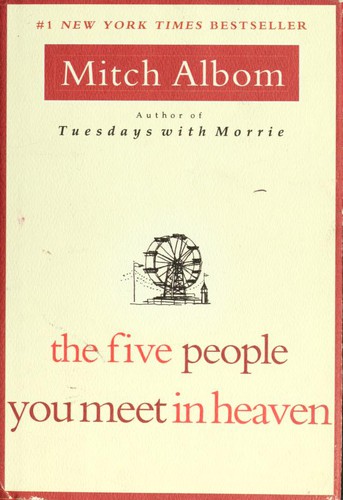
The Five People You Meet in Heaven
by Mitch Albom
★ Top 25 book of 2003 · #16 on Best Books of 2003
A 2003 novel by Mitch Albom about Eddie, a ride mechanic killed in an amusement park accident. In heaven he meets five people who had a significant impact on his life.
Best for: Readers who like gentle, reflective stories about meaning and loss.
The Five People You Meet in Heaven is #16 on BookWard's Best Books of 2003, out of 52 2003 books that cleared our data bar.
What The Five People You Meet in Heaven is about
Eddie is an old amusement park ride mechanic, and he dies on his 83rd birthday when a ride breaks down, trying desperately to save a little girl named Annie. What follows is his journey through Heaven, where he passes through five levels and meets someone at each one who changed his life, or whose life he changed. His first lesson, from the Blue Man, is that nothing happens at random and every life is connected to others.
Albom draws on Eddie's wartime past as a prisoner of war and on ordinary years that seemed to add up to little. The tone is warm, sentimental and contemplative. It will appeal to readers looking for a gentle story about forgiveness, meaning and the quiet ways lives touch one another.
The Five People You Meet in Heaven on the Best Books of 2003
The Five People You Meet in Heaven came out in 2003. Of the 52 books first published in 2003 that met BookWard's data bar, it ranks #16 on our Best Books of 2003 list.
Why it made the list: 396 readers have shelved it on Open Library; 26 are reading it right now. The list ranks each year’s books on how many readers have picked them up, how highly readers rate them, and how many are reading them right now.
Nearby on the 2003 list
- Eleven Minutes Paulo Coelho, #14
- Fire and Ice Erin Hunter, #15
- Women Who Think Too Much Susan Nolen-Hoeksema, #17
- Artemis Fowl and the Eternity Code Eoin Colfer, #18
See all Best Books of 2003 Best books by year
More years: Best Books of 2002 Best Books of 2004.
The numbers behind it
- Readers: 339 want to read it, 26 are reading it now and 31 have read it, according to Open Library.
| Signal | This book (0 to 100) | Weight |
|---|---|---|
| Reach | 71 | 55% |
| Reader love | 37 | 25% |
| Being read right now | 73 | 20% |
Questions about The Five People You Meet in Heaven
When was The Five People You Meet in Heaven published?
The Five People You Meet in Heaven by Mitch Albom was first published in 2003.
Was The Five People You Meet in Heaven one of the best books of 2003?
The Five People You Meet in Heaven is #16 on BookWard's Best Books of 2003, out of 52 2003 books that cleared our data bar. 396 readers have shelved it on Open Library; 26 are reading it right now.
Why is The Five People You Meet in Heaven on the Best Books of 2003 list?
396 readers have shelved it on Open Library; 26 are reading it right now.
More of the best books of 2003
- Harry Potter and the Order of the Phoenix J. K. Rowling, #1
- Into the Wild Erin Hunter, #2
- The Kite Runner Khaled Hosseini, #3
- Don't Let the Pigeon Drive the Bus! Mo Willems, #4
- A Short History of Nearly Everything Bill Bryson, #5
- The Da Vinci Code Dan Brown, #6
See the full Best Books of 2003, the Top 100, or new books on Rising.
How we know
This page uses public data: Open Library reader counts and ratings, and Wikipedia page views for recent years. The description is paraphrased from real source text. Rankings reflect reading interest, not quality or sales, and can be affected by data gaps. Lists update monthly.
Suits adult and older teen readers, and is easy to read in a sitting or two.
Depends on the edition you pick.
A short, warm fable that trades surprise for consolation. 53% taste match
 BookWard’s take
A short, warm fable that trades surprise for consolation
Albom's novel opens with the death of Eddie, an amusement park ride mechanic, on his 83rd birthday, so the hook is immediate and the pace brisk. Each of the five people he meets in heaven is a self-contained lesson, which keeps the middle from sagging and the internal logic tidy: every encounter explains something about his life. The cost is familiarity. The afterlife as a reckoning, and the gentle moral it delivers, are well-worn ground, and the book leans toward comfort rather than restraint. Eddie is drawn with real depth, while everyone else is thinner. The ending resolves cleanly. If you value originality and restraint, this will land as sweet but predictable; if you want a quick, consoling read, it delivers.
A brisk, compact novel, close to BookWard's preference for tight books.
Short chapters and a steady run of revelations keep it moving, close to BookWard's quick pace.
The structure of five lessons is neat, but the premise is a comfortable, well-known idea, short of BookWard's appetite for the new.
Simple, clear sentences keep it accessible, lighter than BookWard's middle-of-the-road taste.
The structure is driven by Eddie's inner reckoning with his past more than by external events.
It is a consoling book about meaning and forgiveness, warmer than BookWard's balance.
The five-encounter framework is distinctive, with the story moving between heaven and Eddie's past.
The tone is earnest and reflective, with little room for humour.
War, loss and a death open and run through the book, but the handling stays gentle.
Built to move you, with grief, forgiveness and reconciliation at its core.
See all 50 dialsEvery position, side by side with this book
Where it lines up
- Sagging middleBookWard 8 · book 8
- LengthBookWard 1 · book 2
- OpeningBookWard 10 · book 9
Where it pulls apart
- Familiar tropesBookWard 10 · book 3
- SentimentBookWard 8 · book 2
- OriginalityBookWard 9 · book 4
A brisk, compact novel, close to BookWard's preference for tight books.
Opens on Eddie's death at the amusement park, so it grabs you straight away, just as BookWard likes.
Heaven as a place of reckoning and life lessons is familiar ground, which sits against BookWard's wish to avoid tropes.
Each of the five meetings explains a piece of Eddie's life, so the afterlife follows a clear, consistent design.
Short chapters and a steady run of revelations keep it moving, close to BookWard's quick pace.
The structure of five lessons is neat, but the premise is a comfortable, well-known idea, short of BookWard's appetite for the new.
Eddie is drawn with care across his life, while the people he meets mostly serve his lessons.
It closes with the lessons gathered and Eddie's story fully settled, matching BookWard's taste for resolution.
It aims squarely at tears and consolation, which is more sentimental than BookWard's restrained preference.
Eddie's death opens the book, and the darker turns, like war and loss, serve the story's purpose.
Albom's plain, fable-like storytelling is recognisable but not especially singular.
It is a story first, though each chapter is built to deliver a lesson.
The people Eddie meets often explain the meaning of events outright, more than BookWard prefers.
Each meeting is a fresh chapter with its own revelation, so momentum holds throughout.
Simple, clear sentences keep it accessible, lighter than BookWard's middle-of-the-road taste.
The structure is driven by Eddie's inner reckoning with his past more than by external events.
It is a consoling book about meaning and forgiveness, warmer than BookWard's balance.
The five-encounter framework is distinctive, with the story moving between heaven and Eddie's past.
The tone is earnest and reflective, with little room for humour.
Short, plain and easy to follow, it asks little of the reader.
The story stays close to Eddie, with a narrow field of view.
The story moves between Eddie's afterlife and episodes from his past, shifting time throughout.
It is built around an afterlife, though the setting stays simple and mostly serves the story.
Eddie, plus five key figures and a few others, makes for a modest cast.
A personal story about one man's life, set against a modest amusement park world.
Reflection and remembered events share the stage, with a slight lean toward thought.
The meetings are largely conversations, so talk carries much of the book.
Eddie's marriage to Marguerite matters, but romance is a thread rather than the centre.
The amusement park is familiar, while the heaven Eddie travels through is a gentle, invented place.
Eddie's life spans decades, so the book sits between past and present.
Its themes of connection and forgiveness travel well, and its long bestseller run shows lasting appeal.
A plain third-person narrator tells it straight, with no games.
The lessons are stated openly: connection, forgiveness, meaning.
The amusement park and the afterlife are sketched economically rather than richly.
A standalone novel.
Each meeting reveals something unexpected about Eddie's past, though the overall shape is predictable.
A comforting read that reassures more than it unsettles.
War, loss and a death open and run through the book, but the handling stays gentle.
Built to move you, with grief, forgiveness and reconciliation at its core.
Humour is minimal and mild when it appears.
There is wartime violence and an accident, but it is brief and not lingered on.
Essentially absent.
Not a political book.
Plain, direct language throughout.
The narration guides you toward its gentle lessons rather than staying neutral.
The book spends most of its time looking back over a life.
Its worldview is warmly hopeful about meaning and connection.
Review written by BookWard, dial version 1, November 2026.
Who is The Five People You Meet in Heaven right for?
Suits adult and older teen readers, and is easy to read in a sitting or two. It deals with death, war imprisonment, a child in danger and family loss, handled gently.
Short, plain and easy to follow, it asks little of the reader.
War, loss and a death open and run through the book, but the handling stays gentle.
Built to move you, with grief, forgiveness and reconciliation at its core.
There is wartime violence and an accident, but it is brief and not lingered on.
Book CompanionThe Five People You Meet in Heaven: ideas, characters, themes
Eddie, killed at the amusement park where he worked, learns in heaven that every life is tied to others in ways he never saw.
- A death that opens the story. Eddie dies on his 83rd birthday when a ride breaks down, while trying to save a little girl named Annie.
- Five people, five lessons. In heaven he meets people whose lives touched his, or whose lives he touched, each revealing something about his own.
- The Blue Man. The first person Eddie meets explains that there are no random events and that all lives are connected.
- The Captain. A figure from Eddie's army past explains an act that saved his life, though it left him with a lasting limp.
- Ruby and forgiveness. Ruby, for whom Ruby Pier was named, shows Eddie a truth about his father and urges him to forgive.
Characters
Eddie
Protagonist
A ride mechanic at an amusement park who dies on his 83rd birthday and journeys through heaven.
The Blue Man
First person Eddie meets
Explains how Eddie's life is connected to his and introduces the lesson that nothing happens at random.
The Captain
Eddie's former army captain
Shares a wartime past with Eddie and reveals why he shot Eddie in the leg.
Ruby
Third person Eddie meets
The woman Ruby Pier was named after, who helps Eddie understand his father.
Marguerite
Eddie's late wife
Eddie meets her in heaven and they revisit their life together.
Themes
No life is isolated; people affect one another in ways they rarely see.
Letting go of old grievances, especially toward family, brings peace.
Some of the deepest acts of love go unseen and unthanked.
An ordinary life can matter more than it appears from the inside.
Looking back lets Eddie understand what he got wrong and what he got right.
Discussion questions
- Why does the book have Eddie learn his lessons from five people rather than one?
- Does the idea that there are no random events comfort you or feel too neat?
- How does Eddie's limp shape the way he sees himself, and does that change?
- What did Ruby's revelation about Eddie's father change about how he understood his own life?
- Which of the five meetings felt most earned, and which felt most like a lesson being delivered?
Personalize your Book Companion
This is the general edition. In BookWard, the Companion is written for you: your reading profile, your notes, and spoiler-safe to the page you are on.
Buy, listen or borrow The Five People You Meet in Heaven
Each link opens a search for this book on that store, in a new tab.
Read on a device
Borrow
Reviews and community
If you liked The Five People You Meet in Heaven
A gentle, high-concept 'what if' that trades surprise for warmth
A Dog's PurposeW. Bruce CameronA dog's four lives, told with warmth and no apology
The Stolen QueenFiona DavisA two-timeline Egyptian museum mystery with a curse humming underneath
The Amalfi CurseSarah PennerSea magic and shipwreck mystery along the Positano coast
Find your own best books
Add what you have read, rate it, and BookWard will recommend what to read next.
Free to start. No credit card needed.