Updated November 2, 2026 · reading data through October 2026
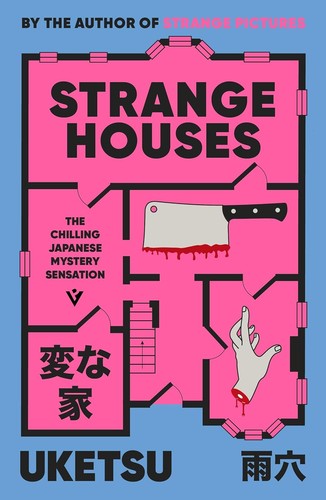
Strange Houses
by Uketsu
A Japanese mystery bestseller from YouTube sensation Uketsu, built around a series of unsettling floorplans where the reader plays the detective. A windowless room on one plan hints at something hideous.
Best for: Mystery readers who like puzzles and a different kind of whodunit.
Strange Houses is #10 on BookWard's Rising chart for November 2026: the hottest new books published in the past two years.
What Strange Houses is about
A writer is handed the floor plan of a house and asked what he makes of it. The layout is odd, and with the help of a man named Kurihara he begins picking out the features that don't add up, including spaces hidden away inside the walls. The more they study it, the more it looks as though the house was designed with a crime in mind.
Their curiosity carries them on to other properties, earlier incidents and a widening circle of people, all pointing toward a darker connection. A windowless room on the plan hints at something terrible.
The book is built around its floor plans, so the reader gets to play detective alongside the narrator. Its mood is eerie and puzzle-like, a good fit for anyone who enjoys a quiet, unsettling mystery.
Why Strange Houses is on the Rising chart
Its Wikipedia page had 4,807 views last month, up 55% on the two months before; 172 readers have shelved it on Open Library since 2025. The Rising score blends six public signals, each scored from 0 to 100 against the other new books and weighted as shown.
| Signal | This book | Weight |
|---|---|---|
| Reader pace | 77 | 28% |
| Buzz | 52 | 24% |
| Growth | 64 | 18% |
| Being read right now | 68 | 12% |
| Reader love | 7 | 10% |
| Newness | 67 | 8% |
Rising Wikipedia attention is up 25% or more on the two months before.
The numbers behind it
- Wikipedia: 4,807 page views last month, against an average of 3,094 in the two months before (up 55%). Read the article.
- Open Library readers: 158 want to read, 3 reading now, 11 have read it.
- Ratings: 3.38 out of 5 from 8 Open Library ratings.
Strange Houses on the Rising chart: history
| Month | Rank | Score |
|---|---|---|
| November 2026 | #10 | 60 |
| October 2026 | #29 | 45 |
Questions about Strange Houses
Is Strange Houses a new book?
Yes. Strange Houses by Uketsu was first published in 2025, and BookWard's Rising chart only includes books published in the past two years.
Why is Strange Houses on the Rising chart?
Its Wikipedia page had 4,807 views last month, up 55% on the two months before; 172 readers have shelved it on Open Library since 2025.
More new books readers are finding
- Dear Debbie Freida McFadden
- The Secret of Secrets Dan Brown
Prefer proven favorites? See the Top 100, or all Rising books.
How we know
This page uses public data: Open Library reader counts and ratings, and Wikipedia page views. The description is paraphrased from real source text (Open Library or Wikipedia). A book is on the Rising chart only if it was published in 2025 or 2026 and its readers are active and its interest is not falling. Rankings reflect reading interest, not quality or sales. Read the full methodology.
Suits older teens and adults who like short, clue-driven mysteries.
206 pages, about 3.5 to 5 hours.
A floor plan puzzle that turns a house into a crime scene. 56% taste match
 BookWard’s take
A floor plan puzzle that turns a house into a crime scene
Strange Houses is a short, fast mystery built around one clever hook: a floor plan that cannot be explained innocently. A writer and his architect friend, Kurihara, study a house's odd layout, concealed spaces included, and the book hands you the same clues they see. The opening grabs at once, and at 206 pages it never sags in the middle. The logic is the draw, since each deduction has to hold up on the page. The ideas lead and the people stay thin, so character depth is modest. The prose is plain and functional, and the book tends to explain things outright rather than letting scenes carry them. That's a real limitation, but the freshness of the premise and the brisk pace more than make up for it.
At 206 pages it is compact and quick to finish, which matches BookWard's love of tight books.
Short chapters and a steady stream of discoveries keep it moving, close to BookWard's preferred speed.
Solving a mystery by reading house plans is a distinctive hook, which BookWard rewards.
The writing is spare and functional, plainer than BookWard's middle-of-the-road taste.
Plot and puzzle clearly lead; this is less character-driven than BookWard tends to prefer.
A sinister crime and a dark family secret make for a bleak outlook, below BookWard's mild lean toward hope.
The floor plan illustrations and investigation-as-document format are mildly unconventional but still easy to follow.
It plays the mystery straight with little humor, serious where BookWard leans lighter.
A hidden crime and a sinister family tradition make it quite dark, a little beyond BookWard's middle ground.
The detached investigating tone keeps feelings muted, below BookWard's moderate emotional level.
See all 50 dialsEvery position, side by side with this book
Where it lines up
- LengthBookWard 1 · book 1
- OpeningBookWard 10 · book 10
- SentimentBookWard 8 · book 8
Where it pulls apart
- ExpositionBookWard 2 · book 8
- Character depthBookWard 8 · book 3
- Story or ideasBookWard 3 · book 8
At 206 pages it is compact and quick to finish, which matches BookWard's love of tight books.
The unexplained floor plan pulls you in from the first pages, exactly the instant hook BookWard wants.
Crime and a sinister family secret are familiar territory, but the floor plan framing keeps it fresher than standard mystery tropes.
The whole book rests on deducing a crime from architectural clues, so its reasoning is central and mostly sound, in line with BookWard's taste.
Short chapters and a steady stream of discoveries keep it moving, close to BookWard's preferred speed.
Solving a mystery by reading house plans is a distinctive hook, which BookWard rewards.
Characters serve the investigation and stay lightly sketched, a step below the depth BookWard prefers.
The tone is cool and analytical rather than tearful, which suits BookWard's restraint.
The darkness comes from the crime's logic rather than gratuitous scenes, though the reveals do aim to unsettle.
The deadpan, puzzle-box narration has a recognizable stamp from a YouTube storyteller, moderately distinctive.
The concept drives everything, more than the people, so it is far more idea-led than BookWard usually likes.
Characters talk through and explain the clues outright, which leans against BookWard's preference for showing.
Short and structured as a chain of reveals, it holds momentum throughout, as BookWard prefers.
The writing is spare and functional, plainer than BookWard's middle-of-the-road taste.
Plot and puzzle clearly lead; this is less character-driven than BookWard tends to prefer.
A sinister crime and a dark family secret make for a bleak outlook, below BookWard's mild lean toward hope.
The floor plan illustrations and investigation-as-document format are mildly unconventional but still easy to follow.
It plays the mystery straight with little humor, serious where BookWard leans lighter.
Quick, clear and approachable, it asks little effort beyond following the clues.
It follows mainly the investigators' perspective, narrower than BookWard's taste for many viewpoints.
Past incidents are pieced together alongside the present investigation, a bit more shifting than strictly linear.
The crime is entirely grounded in real architecture and human behavior, so it sits at the grounded pole.
A small investigating duo plus a gradually widening set of people tied to the properties gives a modest cast.
The story stays close to houses, families and one investigation, so it feels intimate.
It focuses on observable clues, layouts and events more than on private thoughts.
Romance plays no meaningful part in this investigation-driven story.
For many Western readers the Japanese domestic setting is moderately unfamiliar, which BookWard enjoys.
It is set in a recognizably modern, contemporary world.
The premise is durable, though its internet-era storytelling ties it somewhat to its moment.
The account is delivered fairly straightforwardly by an investigating writer, so it reads as reliable.
Right and wrong are fairly clear, though the family secrets add some murkiness, while BookWard likes more ambiguity.
Spaces are described mainly for clue purposes, giving practical detail rather than lush description.
It is the first of a series with several sequels, unlike the standalones BookWard might lean toward.
Each deduction leads to a new revelation, so surprises come steadily, which BookWard enjoys.
It is unsettling but not heavy, more of a puzzle than a challenge to the reader's worldview.
A hidden crime and a sinister family tradition make it quite dark, a little beyond BookWard's middle ground.
The detached investigating tone keeps feelings muted, below BookWard's moderate emotional level.
Humor is largely absent and any lightness is dry.
Sexual content is absent from the story.
The book is concerned with crime and family secrets, not politics.
The prose is plain and clear, easy to follow in translation.
The narration stays neutral and observational, with little editorializing.
It reconstructs past events to explain the present, looking mostly backward.
A cynical view of what families hide leaves little room for idealism.
Review written by BookWard, dial version 1, November 2026.
Who is Strange Houses right for?
Suits older teens and adults who like short, clue-driven mysteries. It deals with a hidden crime and a sinister family secret, with disturbing ideas rather than graphic scenes.
Quick, clear and approachable, it asks little effort beyond following the clues.
A hidden crime and a sinister family tradition make it quite dark, a little beyond BookWard's middle ground.
The detached investigating tone keeps feelings muted, below BookWard's moderate emotional level.
Book CompanionStrange Houses: ideas, characters, themes
A strange floor plan becomes evidence of a hidden crime, and the reader solves it alongside the investigators.
- The floor plan premise. A house with a peculiar layout and concealed spaces suggests it was built to make a crime possible.
- The investigating pair. A writer works with Kurihara to analyze the architecture and its inconsistencies.
- Widening search. Their curiosity pushes them beyond one house to other properties and past incidents.
- Hidden connections. The inquiry uncovers a more sinister link between the places and the people involved.
- Reader as detective. The book presents its clues so that you can try to work out the secret yourself.
Characters
The writer
Narrator and investigator
Asked to examine the floor plan of a house with a peculiar design.
Kurihara
Collaborator
Helps analyze the puzzling features and inconsistencies in the architecture.
Themes
What a building conceals can reveal what its owners wanted to hide.
Domestic life can mask a sinister history.
Truth emerges from patient attention to small details.
The urge to keep digging leads from one puzzle to a larger one.
Discussion questions
- Did you spot any clues in the floor plans before the investigators explained them?
- How does using architecture as evidence change the way you read a mystery?
- Which discovery shifted your suspicions the most?
- Does the book need deeper characters, or does the puzzle carry it?
- How would the story change if it were told without the floor plan illustrations?
Personalize your Book Companion
This is the general edition. In BookWard, the Companion is written for you: your reading profile, your notes, and spoiler-safe to the page you are on.
Buy, listen or borrow Strange Houses
Each link opens a search for this book on that store, in a new tab.
Read on a device
Borrow
Reviews and community
If you liked Strange Houses
A cautionary techno-thriller that runs on ideas and teeth
Tell Me What You DidCarter WilsonA podcast host's confession booth turns on its own host
A Good Girl's Guide to MurderHolly JacksonA teen true-crime fan reopens a murder case for school
The VisitorLee ChildA fast Reacher thriller built around a killer who leaves nothing behind
Find new books before everyone else
Add what you have read, rate it, and BookWard will recommend what to read next.
Free to start. No credit card needed.