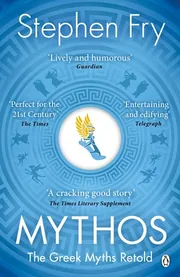
It suits teens and adults who enjoy mythology, humor and storytelling, including newcomers to the Greek myths.
441 pages, about 7 to 10.5 hours.
Greek myths retold with a comedian's wit and a scholar's care. 43% taste match
The story
Mythos is a retelling of the Greek myths by Stephen Fry, first published in 2017. It belongs to the fantasy shelf and draws on classical mythology, with gods, goddesses and legends at its center. The book opens with the origin of the universe and moves through the early stories of the ancient world, including the tale of Pandora's box and the story of Prometheus and his fire.
The adventures of Zeus and the Olympians run through the telling. Fry, known as a writer, actor and comedian, brings a humorous voice to these old stories while keeping their sense of wonder. The text runs to roughly 441 pages and is accompanied by classical artwork inspired by the myths, along with notes from the author that add cultural background. It suits readers who want a single volume covering the Greek gods and their legends, whether they are new to the material or returning to familiar tales.
These days the origin of the universe is explained by proposing a Big Bang, a single event that instantly brought into being all the matter from which everything and everyone are made.
Themes
Mythology, greekMythology, classicalGodsGoddessesLegendsGreek MythologyClassical MythologyMythology
- Want to read 206
- Reading now 8
- Read 41
Most people shelving it are saving it for later.
Of 255 readers who put it on a shelf, 81% want to read it, 3% are reading it now, 16% have finished it and 0% stopped before the end.
By the numbers
- The median edition runs 441 pages. Counting about 275 words a page and an adult reading pace of 250 words a minute, that is about 8.1 hours of reading.
- Open Library tracks 22 editions from 16 publishers, the earliest dated 2017 and the latest 2024, across 3 languages.
- On reader demand it ranks in the top 3% of the recent books in our catalog (6,647 of them).
- Libraries shelve it under Library of Congress class BL-0783.00000000.
 BookWard’s take
Greek myths retold with a comedian's wit and a scholar's care
Stephen Fry takes the Greek myths, from the birth of the universe through Pandora's box and Prometheus's fire to the exploits of Zeus and the Olympians, and tells them in a voice that is unmistakably his own. His humor and asides are the reason to read it. The stories themselves are ancient and well-worn, so whatever freshness there is lives in the telling, not the material. The tone is funny without losing wonder, and the pace holds up across 441 pages because each myth is a self-contained story. The author's notes and classical artwork add context for newcomers. It is a generous, companionable introduction that rewards both first-timers and returning readers.
At 441 pages it is a substantial single volume, longer than BookWard prefers, though the short myths keep it moving.
Short, self-contained stories keep the momentum steady, close to the quick pace BookWard enjoys.
The material is thousands of years old, so originality comes from Fry's treatment rather than the stories themselves.
Fry writes with polish and playful flourish, richer than plain but never heavy.
The myths are driven by events and divine deeds more than by inner growth of characters.
Many myths end in loss or punishment, though wonder and humor lift the mood overall.
It follows a broadly chronological arc from creation onward, which is conventional for a retelling.
Humor is a defining feature, with jokes and asides running through the stories, matching BookWard's taste.
Violence, cruelty and tragedy appear regularly, softened by humor.
Moments of grief, love and rage land with feeling, tempered by Fry's lightness.
See all 50 dialsEvery position, side by side with this book
Where it lines up
- EndingBookWard 8 · book 7
- Authorial voiceBookWard 9 · book 10
- Story or ideasBookWard 3 · book 4
Where it pulls apart
- Familiar tropesBookWard 10 · book 3
- Internal logicBookWard 10 · book 4
- LengthBookWard 1 · book 6
At 441 pages it is a substantial single volume, longer than BookWard prefers, though the short myths keep it moving.
It opens with the origin of the universe and settles quickly into vivid, story-sized episodes that pull a reader along.
These myths are the source of countless tropes, so familiarity is built in; the fresh voice only partly offsets that for BookWard.
Myths follow dream logic, with gods acting on whim and contradiction, which is looser than BookWard's airtight preference.
Short, self-contained stories keep the momentum steady, close to the quick pace BookWard enjoys.
The material is thousands of years old, so originality comes from Fry's treatment rather than the stories themselves.
Gods and heroes are drawn with warmth and quirks, but they remain larger-than-life figures more than psychologically deep people.
Individual myths tend to conclude firmly, though the larger web of stories keeps spilling into the next, which suits BookWard fairly well.
Fry mixes tenderness with irreverence, so feeling is present but often undercut by wit.
Myth is full of cruelty and violence, but it belongs to the stories and is not used as cheap shock.
Author's notes and cultural context add learning, though this remains a retelling more than a scholarly study.
Fry's wry, conversational, unmistakable voice carries the whole book, exactly what BookWard prizes.
Story leads here, with each myth told as a tale, though themes of power and fate sit underneath.
Fry often steps in to explain names, origins and connections, leaning more explanatory than BookWard likes.
Because the book is a chain of separate tales, energy rarely dips for long.
Fry writes with polish and playful flourish, richer than plain but never heavy.
The myths are driven by events and divine deeds more than by inner growth of characters.
Many myths end in loss or punishment, though wonder and humor lift the mood overall.
It follows a broadly chronological arc from creation onward, which is conventional for a retelling.
Humor is a defining feature, with jokes and asides running through the stories, matching BookWard's taste.
Easy and companionable to read, though the huge cast of names asks for a little attention.
Fry moves between many gods, mortals and monsters as the focus of different myths.
It runs roughly from creation forward, with occasional looks back to explain who is related to whom.
Gods, monsters and miracles fill every page, so this is fully fantastical.
A vast roster of gods, titans, mortals and creatures appears across the book.
It spans the creation of the cosmos and the lives of the gods, which is epic in scope.
Action, quarrels and transformations dominate over private reflection.
Stories are narrated more than staged, with speech used in moderation.
Love and desire drive many myths but are not the book's central thread.
Ancient Greece and Mount Olympus are far from everyday life, though the stories are widely known.
The stories belong to antiquity, with only the telling coming from the present day.
These myths have lasted millennia and still shape how stories are told.
Fry narrates openly and plainly as a storyteller, with no deception.
Gods and heroes act with mixed motives, and the stories rarely hand out neat verdicts.
Fry paints the gods, monsters and landscapes with lively, colorful detail.
The retelling reads as storytelling, not argument, and is firmly narrative.
Fry's presence is felt through asides and jokes, so the telling feels personal.
It is the first of Fry's Greek myth books, which continue in later volumes.
Transformations, betrayals and divine tricks supply plenty of surprises, even to those who know the outlines.
It is an inviting, entertaining read that offers more comfort than challenge.
Violence, cruelty and tragedy appear regularly, softened by humor.
Moments of grief, love and rage land with feeling, tempered by Fry's lightness.
Fry's humor is witty and playful, with a knowing wink more than slapstick.
Myth includes battles, murders and monstrous deeds, often described plainly.
Divine affairs and abductions are part of the stories, handled frankly but not luridly.
Power struggles among gods echo politics, though the book stays focused on story.
The language is clear and accessible, though unfamiliar Greek names take some adjusting.
Fry's views, jokes and commentary are woven into the narration throughout.
The book looks back to ancient stories, retold for modern readers.
It admires courage and wonder while staying clear-eyed about divine and human folly.
Review written by BookWard, dial version 1, November 2026.
Who is Mythos right for?
It suits teens and adults who enjoy mythology, humor and storytelling, including newcomers to the Greek myths. It contains violence, cruelty and some sexual content typical of the original myths.
Easy and companionable to read, though the huge cast of names asks for a little attention.
Violence, cruelty and tragedy appear regularly, softened by humor.
Moments of grief, love and rage land with feeling, tempered by Fry's lightness.
Myth includes battles, murders and monstrous deeds, often described plainly.
Book CompanionMythos: ideas, characters, themes
Stephen Fry retells the Greek myths from the creation of the universe onward in a funny, warm voice that keeps the wonder intact.
- Creation of the cosmos. The book begins with the origin of the universe before moving into the early stories of the ancient world.
- Pandora's box. One of the early tales explores the story of Pandora and the box that changed the world.
- Prometheus and fire. The story of Prometheus and his gift of fire stands among the well-known myths retold here.
- Zeus and the Olympians. The adventures of Zeus and the other Olympian gods run through the telling and link many of the tales.
- Notes and artwork. Classical artwork inspired by the myths and the author's learned notes add cultural context to the stories.
Characters
Zeus
King of the Olympian gods
His adventures form a central thread through the book.
Prometheus
Titan associated with fire
His story of fire is one of the early tales told.
Pandora
Figure of the box myth
Her story is among the best-known early episodes.
Themes
How gods and mortals seek, use and lose authority.
The tension between what is destined and what characters decide.
The sense of awe at gods, monsters and a mythic world.
The flaws and appetites that drive both gods and people into trouble.
How old tales are kept alive by being retold with fresh humor and care.
Discussion questions
- Which myth did you know least before reading, and how did Fry's telling change it for you?
- How does humor change the way we feel about the cruelty in these stories?
- Why do the Greek gods behave so much like flawed humans?
- What does the story of Prometheus suggest about the cost of progress?
- Do the author's notes and artwork enrich the stories, and how?
Personalize your Book Companion
This is the general edition. In BookWard, the Companion is written for you: your reading profile, your notes, and spoiler-safe to the page you are on.
Buy, listen or borrow Mythos
Each link opens a search for this book on that store, in a new tab.
Read on a device
Borrow
Reviews and community
If you liked Mythos
Hamilton's lucid, orderly map of Greek, Roman and Norse myth
Norse MythologyNeil GaimanGaiman retells the Norse myths in clean, witty, storyteller's prose
StardustNeil GaimanA modern fairy tale with an old, wry heart
The Last HeroTerry PratchettCohen's last ride, in Pratchett's most lavishly illustrated Discworld
Sources: Open Library.
Track Mythos and find your next favorite
Add it to your shelf, rate what you have read, and BookWard will recommend what fits you.
Free to start. No credit card needed.