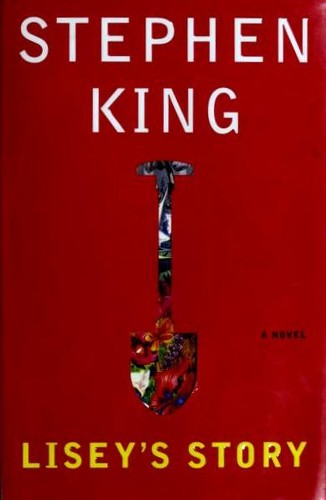
Lisey's Story
by Stephen King
★ Top 25 book of 2006 · #17 on Best Books of 2006
Two years after her novelist husband Scott died, Lisey Landon starts clearing out his office and refuses to sell his unpublished papers. A threatening man who calls himself Zack McCool begins stalking her, while buried memories from her marriage may hold clues to survival.
Best for: Readers who enjoy suspense about a widow, buried memories, and a stalker
Lisey's Story is #17 on BookWard's Best Books of 2006, out of 47 2006 books that cleared our data bar.
What Lisey's Story is about
Lisey Landon is the widow of Scott Landon, a hugely successful novelist, and two years after his death she is still sorting through his writing space. Academics keep asking for his unpublished work, and then a man calling himself Zack McCool threatens to hurt her unless she hands Scott's papers over to a professor. Her fragile sister Amanda helps her search, but the strain proves too much for her.
The novel moves between Lisey's present and her memories of life with Scott, a man from a family marked by mental illness who could reach a place he called Boo'ya Moon. As she pushes on, Lisey finds a strength she did not know she had and starts to recall events from her marriage that she had buried. King has called it his favorite of his own books, and it won the Bram Stoker Award for Best Novel. It suits readers who want a quieter, more personal kind of horror about grief, memory and love.
Lisey's Story on the Best Books of 2006
Lisey's Story came out in 2006. Of the 47 books first published in 2006 that met BookWard's data bar, it ranks #17 on our Best Books of 2006 list.
Why it made the list: 500 readers have shelved it on Open Library; readers rate it 3.8 out of 5 (25 ratings); 26 are reading it right now. The list ranks each year’s books on how many readers have picked them up, how highly readers rate them, and how many are reading them right now.
Nearby on the 2006 list
- Cell Stephen King, #15
- Fablehaven Brandon Mull, #16
- Omnivore's Dilemma. a Natural History of Four Meals Michael Pollan, #18
- Aloha-Ha-Ha! Barbara Park, #19
See all Best Books of 2006 Best books by year
More years: Best Books of 2005 Best Books of 2007.
The numbers behind it
- Readers: 420 want to read it, 26 are reading it now and 51 have read it, according to Open Library.
- Ratings: 3.8 out of 5 from 25 Open Library ratings.
| Signal | This book (0 to 100) | Weight |
|---|---|---|
| Reach | 74 | 55% |
| Reader love | 23 | 25% |
| Being read right now | 74 | 20% |
Questions about Lisey's Story
When was Lisey's Story published?
Lisey's Story by Stephen King was first published in 2006.
Was Lisey's Story one of the best books of 2006?
Lisey's Story is #17 on BookWard's Best Books of 2006, out of 47 2006 books that cleared our data bar. 500 readers have shelved it on Open Library; readers rate it 3.8 out of 5 (25 ratings); 26 are reading it right now.
Why is Lisey's Story on the Best Books of 2006 list?
500 readers have shelved it on Open Library; readers rate it 3.8 out of 5 (25 ratings); 26 are reading it right now.
More of the best books of 2006
- The Sea of Monsters Rick Riordan, #1
- The Book Thief Markus Zusak, #2
- Half of a Yellow Sun Chimamanda Ngozi Adichie, #3
- The Boy in the Striped Pyjamas John Boyne, #4
- The Secret Rhonda Byrne, #5
- Mindset Carol S. Dweck, #6
See the full Best Books of 2006, the Top 100, or new books on Rising.
How we know
This page uses public data: Open Library reader counts and ratings, and Wikipedia page views for recent years. The description is paraphrased from real source text. Rankings reflect reading interest, not quality or sales, and can be affected by data gaps. Lists update monthly.
Best for adult readers comfortable with a long, slow-burning horror novel.
Depends on the edition you pick.
A widow, a dead novelist's papers, and a dangerous past. 49% taste match
 BookWard’s take
A widow, a dead novelist's papers, and a dangerous past
Stephen King calls this his favorite of his own novels, and it shows in how personal the material feels. Lisey Landon is clearing out her late husband's study when a stalker starts demanding his papers, and her memories of the marriage begin to surface. The strongest thing here is the characterization: a long marriage drawn in private language and small rituals, so lived-in that it feels less invented than remembered. It is less sure-footed elsewhere. The book is slow to commit, circling its memories before it settles into the story, and it runs long enough that readers who prize a tight, propulsive read may grow restless. Still, it is strikingly original, rendering a marriage through invented words and a hidden place. The prose is richer than the usual run of King, and the exposition is deliberately oblique, asking you to piece things together alongside Lisey rather than handing them over.
A big, unhurried novel that takes its time with a marriage, which runs against BookWard's preference for tight and short.
Memory and reflection slow the stalker plot, so it moves at a deliberate pace, slower than BookWard's taste.
A couple's private language and an invented realm give the story a genuinely distinctive shape, which BookWard rewards.
King uses a rich, coined-word style that is more ornate than plain, a little above BookWard's usual.
The story is driven by Lisey's inner journey more than by the stalker plot, which fits BookWard's character lean.
Grief and horror run through it, yet it moves toward healing and a measure of hope.
Interleaved present and remembered past make it more adventurous in form than a straight thriller.
This is a serious, grief-heavy book with only occasional dry touches.
Madness, cruelty and loss run through it, making it a dark read.
Grief, love and fear are felt strongly and kept close to the surface.
See all 50 dialsEvery position, side by side with this book
Where it lines up
- OriginalityBookWard 9 · book 8
- Character depthBookWard 8 · book 9
- EndingBookWard 8 · book 7
Where it pulls apart
- LengthBookWard 1 · book 9
- OpeningBookWard 10 · book 5
- Internal logicBookWard 10 · book 6
A big, unhurried novel that takes its time with a marriage, which runs against BookWard's preference for tight and short.
It opens in the quiet of cleaning a study rather than with a jolt, so it builds more slowly than BookWard likes.
Stalker and haunted-writer elements are familiar, but the marriage at the center is handled in fresh, personal ways.
The supernatural place has its own rules, though the book prizes mood and memory over airtight mechanics.
Memory and reflection slow the stalker plot, so it moves at a deliberate pace, slower than BookWard's taste.
A couple's private language and an invented realm give the story a genuinely distinctive shape, which BookWard rewards.
Lisey and Scott are drawn through shared history in close detail, matching BookWard's love of deeply drawn people.
The central threads are resolved with real emotional closure, in line with BookWard's taste for payoff.
Grief and love are felt openly, so it leans warmer and less restrained than BookWard's usual preference.
The darkness stems from trauma and loss within the story, though some moments reach for a jolt.
This is a novel, so the dial does not apply.
King's voice is unmistakable, with private idioms and a rhythm no one else would write.
It is story-led, driven by Lisey's search through memory, with ideas about marriage and creativity underneath.
Much is revealed through memory and oblique hints rather than outright explanation, close to BookWard's liking for shown scenes.
The reflective stretches can drift, though the mounting threat pulls the book forward.
King uses a rich, coined-word style that is more ornate than plain, a little above BookWard's usual.
The story is driven by Lisey's inner journey more than by the stalker plot, which fits BookWard's character lean.
Grief and horror run through it, yet it moves toward healing and a measure of hope.
Interleaved present and remembered past make it more adventurous in form than a straight thriller.
This is a serious, grief-heavy book with only occasional dry touches.
The invented vocabulary and layered memories ask for attention, so it reads as more demanding than BookWard's norm.
We stay almost entirely inside Lisey's perspective, narrower than BookWard's taste for many viewpoints.
Present-day cleanup is constantly broken up by flashbacks, so time shifts more than BookWard's usual.
A hidden otherworldly place sits inside a mostly grounded domestic story.
A tight circle of Lisey, her sisters and a handful of others keeps the cast small.
It is intimate at heart, centered on one marriage and one house despite its length.
Most of the action happens in Lisey's thoughts and memories rather than in outward events.
Conversations, including private marital talk, carry a good share of the book.
A long marriage is the emotional core, making love central to everything that happens.
The settings are mostly everyday New England, with a strange hidden realm as the exception.
Set in a recent present looking back across decades, so it sits closer to now than to the past.
Grief, marriage and the cost of creating are lasting themes, though the book is tied to King's own moment.
Lisey's memory is imperfect and partly suppressed, but she is a mostly trustworthy guide.
Right and wrong are mostly clear, with the threat and the heroine plainly drawn.
Domestic spaces and the otherworldly place are given lush, sensory detail.
Buried memories surface in stages, delivering a few revelations rather than constant turns.
It confronts grief, trauma and abuse, so it leans toward challenging over comforting.
Madness, cruelty and loss run through it, making it a dark read.
Grief, love and fear are felt strongly and kept close to the surface.
Humor is sparse and dry, mostly in the couple's private banter.
There are scenes of shooting, self-harm and a mutilated animal, enough to register without dominating.
Intimacy appears within the marriage but is not a focus.
The story stays personal, with almost no political content.
Invented words and private slang make the language denser than usual.
The narration is close and colored by Lisey's feelings, with a strong voice of its own.
Most of the book looks back through memory, though it ends facing forward.
Despite the horror, it affirms love and endurance as forces that matter.
Review written by BookWard, dial version 1, November 2026.
Who is Lisey's Story right for?
Best for adult readers comfortable with a long, slow-burning horror novel. It includes grief, trauma, self-harm, a mutilated animal and threats of violence.
The invented vocabulary and layered memories ask for attention, so it reads as more demanding than BookWard's norm.
Madness, cruelty and loss run through it, making it a dark read.
Grief, love and fear are felt strongly and kept close to the surface.
There are scenes of shooting, self-harm and a mutilated animal, enough to register without dominating.
Book CompanionLisey's Story: ideas, characters, themes
A widow must face the secrets of her husband's life, and her own suppressed memories, to survive a threat tied to his unpublished papers.
- A study to clear. Two years after her husband's death, Lisey is still sorting through his writing space and putting off the work.
- The pressure to hand over papers. Academics and a menacing caller want Scott's unpublished writing, and Lisey refuses to give it up.
- Memory as a second story. Lisey's recollections of the marriage run alongside the present, and she avoids the most frightening ones.
- A sister in crisis. Her fragile sister Amanda spirals, adding family strain and an odd message in Scott's voice.
- A hunt with a prize. Scott's mention of a hunt with a reward at the end sets Lisey on a trail through his hidden past.
Characters
Lisey Landon
Protagonist
Widow of a famous novelist, working through grief and long-buried memories while under threat.
Scott Landon
Late husband
A hugely successful writer whose life is revealed through Lisey's remembering.
Amanda
Lisey's sister
Mentally fragile, she slips into crisis and becomes a channel for a strange message.
Zack McCool
Antagonist
A menacing caller who demands Scott's papers and begins to stalk Lisey.
Themes
The private language and rituals that bind two people over many years.
How loss lingers and shapes the way a survivor handles a dead partner's things.
What making art takes from the artist and from the people close to them.
How painful experiences are buried and what happens when they resurface.
Fragile minds and the line between inner torment and outer threat.
Discussion questions
- Why does Lisey keep stopping herself mid-memory, and what does that avoidance protect?
- How does the book use invented, private language to show intimacy in a marriage?
- Is the threat from the stalker more important than Lisey's inner journey, or less?
- What does the novel say about the line between a writer and the person who loves them?
- Does the hidden place in Scott's past deepen the story or pull attention from the marriage?
Personalize your Book Companion
This is the general edition. In BookWard, the Companion is written for you: your reading profile, your notes, and spoiler-safe to the page you are on.
Buy, listen or borrow Lisey's Story
Each link opens a search for this book on that store, in a new tab.
Read on a device
Borrow
Reviews and community
If you liked Lisey's Story
A Lagos family curse, a reincarnation belief, and a girl fighting her fate
The Time Traveler's WifeAudrey NiffeneggerA time-travel love story that trades logic for feeling
Bag of BonesStephen KingA grieving novelist, a haunted lake house, and a long slow dread
Dream CountChimamanda Ngozi AdichieFour women, one pandemic, and a long reckoning with love and regret
Find your own best books
Add what you have read, rate it, and BookWard will recommend what to read next.
Free to start. No credit card needed.