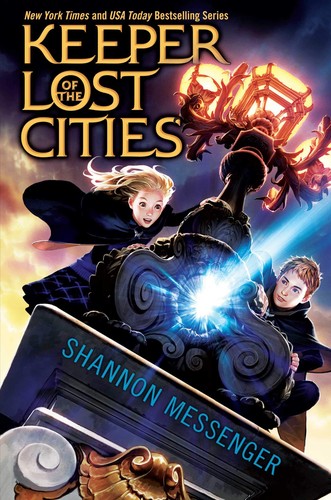
Keeper of the Lost Cities
by Shannon Messenger
★ Top 10 book of 2012 · #8 on Best Books of 2012
Twelve-year-old Sophie hides the fact that she can read minds, until a boy named Fitz reveals she belongs elsewhere. Moving to a strange new world, she must uncover who she really is before time runs out.
Best for: Middle-grade fantasy fans who like hidden identities, secret powers, and mystery
Keeper of the Lost Cities is #8 on BookWard's Best Books of 2012, out of 59 2012 books that cleared our data bar.
What Keeper of the Lost Cities is about
Twelve-year-old Sophie has never quite fit in. She has skipped several grades, she has little in common with the older kids around her, and she keeps a secret she believes no one knows: she is a Telepath and can read minds. Then she meets Fitz, a mysterious, adorable boy who shares her gift and tells her why she has never felt at home among humans. Sophie must leave her family behind and start a new life in a very different place. Her own memories hold dangerous answers that many people want, and the big questions become who she really is and why she was hidden. A whimsical, mysterious adventure about belonging, identity and secrets.
Keeper of the Lost Cities on the Best Books of 2012
Keeper of the Lost Cities came out in 2012. Of the 59 books first published in 2012 that met BookWard's data bar, it ranks #8 on our Best Books of 2012 list.
Why it made the list: 891 readers have shelved it on Open Library; readers rate it 4.7 out of 5 (62 ratings); 49 are reading it right now. The list ranks each year’s books on how many readers have picked them up, how highly readers rate them, and how many are reading them right now.
It earns Reader favorite.
Nearby on the 2012 list
- The Power of Habit Charles Duhigg, #6
- Me Before You Jojo Moyes, #7
- Quiet Susan Cain, #9
- En Man Som Heter Ove Fredrik Backman, #10
See all Best Books of 2012 Best books by year
More years: Best Books of 2011 Best Books of 2013.
The numbers behind it
- Readers: 752 want to read it, 49 are reading it now and 90 have read it, according to Open Library.
- Ratings: 4.7 out of 5 from 62 Open Library ratings.
| Signal | This book (0 to 100) | Weight |
|---|---|---|
| Reach | 78 | 55% |
| Reader love | 100 | 25% |
| Being read right now | 78 | 20% |
Questions about Keeper of the Lost Cities
When was Keeper of the Lost Cities published?
Keeper of the Lost Cities by Shannon Messenger was first published in 2012.
Was Keeper of the Lost Cities one of the best books of 2012?
Keeper of the Lost Cities is #8 on BookWard's Best Books of 2012, out of 59 2012 books that cleared our data bar. 891 readers have shelved it on Open Library; readers rate it 4.7 out of 5 (62 ratings); 49 are reading it right now.
Why is Keeper of the Lost Cities on the Best Books of 2012 list?
891 readers have shelved it on Open Library; readers rate it 4.7 out of 5 (62 ratings); 49 are reading it right now.
More of the best books of 2012
- Wonder R. J. Palacio, #1
- The Fault in Our Stars John Green, #2
- The Selection (the Selection #1) Kiera Cass, #3
- Drama Raina Telgemeier, #4
- Throne of Glass Sarah J. Maas, #5
- The Power of Habit Charles Duhigg, #6
See the full Best Books of 2012, the Top 100, or new books on Rising.
How we know
This page uses public data: Open Library reader counts and ratings, and Wikipedia page views for recent years. The description is paraphrased from real source text. Rankings reflect reading interest, not quality or sales, and can be affected by data gaps. Lists update monthly.
Suits middle-grade and younger teen readers who enjoy fantasy and mystery.
Depends on the edition you pick.
A telepath finds she was hidden among humans, and why. 50% taste match
 BookWard’s take
A telepath finds she was hidden among humans, and why
Sophie is twelve, a Telepath who has never fit anywhere, and the opening gives her a reason almost at once: a boy named Fitz shows up and tells her the truth about herself. That hook is quick, and it's where the book works best. The pace stays brisk, and the central mystery of who she really is keeps the middle from sagging. Where it falters is in how familiar it all feels: the hidden, chosen child and a new world revealed to a lonely kid are well-worn ideas, and the book leans on them more than it reinvents them. It favors story over ideas and shows its world in scene rather than explaining it, which is the better way to do it. It is also the first in a long series, so the ending is only partly settled.
A middle-grade fantasy with room to build a world, so it runs longer than BookWard's taste for tight books.
The mystery of Sophie's identity keeps things moving at a steady clip, close to BookWard's preferred speed.
The mind-reading elf-world premise has its own touches but rests on well-known fantasy patterns.
Plain, readable prose aimed at young readers rather than ornate styling.
Plot and character share the weight, with Sophie's search for belonging driving much of the action.
Despite danger, the book tilts toward wonder and found belonging, a hopeful outlook BookWard enjoys.
A conventional, linear telling from Sophie's side with no structural tricks.
There is real danger and mystery, but it stays within what suits middle-grade readers.
Sophie's loneliness and her longing to belong carry real emotional weight.
See all 50 dialsEvery position, side by side with this book
Where it lines up
- OpeningBookWard 10 · book 9
- PaceBookWard 8 · book 7
- Story or ideasBookWard 3 · book 2
Where it pulls apart
- Familiar tropesBookWard 10 · book 3
- LengthBookWard 1 · book 7
- Internal logicBookWard 10 · book 6
A middle-grade fantasy with room to build a world, so it runs longer than BookWard's taste for tight books.
Fitz arrives and upends Sophie's life early, which suits BookWard's liking for stories that grab at once.
A lonely gifted kid learns she belongs to a hidden world, a familiar setup that BookWard tends to mark down.
The rules of telepathy and the hidden world hold together well enough for a young-reader fantasy, if not airtight.
The mystery of Sophie's identity keeps things moving at a steady clip, close to BookWard's preferred speed.
The mind-reading elf-world premise has its own touches but rests on well-known fantasy patterns.
Sophie's isolation and secrets give her real feeling, though the wider cast leans toward familiar types.
As the series opener it resolves its core questions while leaving big threads open, short of BookWard's full resolution.
It leans into warm, earnest emotion more than BookWard's restrained preference.
The danger around Sophie's buried memories raises stakes through the plot rather than gratuitous darkness.
Not applicable to a fantasy novel.
The narration is clear and friendly but not strongly distinctive compared with BookWard's taste.
This is story first: a girl, a secret, and a new world, with ideas serving the plot.
Sophie learns the world alongside the reader, so some explaining happens, though much arrives through scenes.
The identity mystery gives the middle a steady pull that keeps momentum going.
Plain, readable prose aimed at young readers rather than ornate styling.
Plot and character share the weight, with Sophie's search for belonging driving much of the action.
Despite danger, the book tilts toward wonder and found belonging, a hopeful outlook BookWard enjoys.
A conventional, linear telling from Sophie's side with no structural tricks.
Easy to read and aimed at middle-grade readers, lighter than BookWard's usual effort.
A hidden world of telepaths makes this fully fantasy, far from the grounded end.
A new world brings a good number of named characters, though the focus stays on a few.
The stakes grow beyond Sophie herself, but the story still centers on her personal discovery.
Sophie's inner life and the outward events of her new world get balanced attention.
Telepathy and new friendships mean plenty of conversation, a good fit for BookWard's liking for dialogue.
Sophie steps into a place unlike anything she has known, strongly unfamiliar and a draw for BookWard.
Sophie begins in a recognizable modern setting before moving to the hidden world.
Belonging and identity are lasting themes, though the style belongs to its young-adult moment.
The new world is drawn with plenty of vivid detail, leaning rich.
Not applicable to a fantasy novel.
Not applicable to a fantasy novel.
It opens a long running series, so it sits at the far end of this dial.
Secrets and hidden origins keep revelations coming, which matches BookWard's taste for surprises.
A comforting, adventurous read for young audiences more than a challenging one.
There is real danger and mystery, but it stays within what suits middle-grade readers.
Sophie's loneliness and her longing to belong carry real emotional weight.
Light, friendly humor sits alongside the mystery without turning broad.
Peril exists but remains mild and age-appropriate.
Essentially absent beyond a hint of a young crush.
Some in-world factions and rules exist, but politics is not a main focus.
Plain, accessible language throughout.
The narration stays neutral and lets Sophie's discoveries speak.
Sophie faces forward into a new life, though her buried past drives the mystery.
Friendship, belonging and hope shape the tone, leaning idealistic.
Review written by BookWard, dial version 1, November 2026.
Who is Keeper of the Lost Cities right for?
Suits middle-grade and younger teen readers who enjoy fantasy and mystery. It contains peril and a loss of family ties, but nothing graphic.
Easy to read and aimed at middle-grade readers, lighter than BookWard's usual effort.
There is real danger and mystery, but it stays within what suits middle-grade readers.
Sophie's loneliness and her longing to belong carry real emotional weight.
Peril exists but remains mild and age-appropriate.
Book CompanionKeeper of the Lost Cities: ideas, characters, themes
A gifted twelve-year-old who has never fit in learns she is a telepath from another world and must uncover why she was hidden among humans.
- A misfit's secret. Sophie skips grades, feels apart from her family, and hides that she can read minds.
- Fitz arrives. A boy named Fitz reveals that he is a telepath too and that Sophie is not alone.
- A new home. Sophie leaves her family behind for a place vastly different from anything she has known.
- Buried memories. Answers about her identity lie deep in her memory, protected for good reason.
- High stakes. The truth about who she is carries danger, and time is running out.
Characters
Sophie
Protagonist
A twelve-year-old telepath who has never felt at home and is searching for who she really is.
Fitz
Guide and friend
A mysterious boy and fellow telepath who shows Sophie the truth about her world.
Themes
Sophie's search for a place and people where she truly fits.
Learning who she really is and why she was hidden.
What is buried, who wants it, and why it is dangerous.
Finding connection after years of feeling apart.
Discussion questions
- Why does Sophie feel she doesn't fit in before she meets Fitz?
- How would you react if someone told you that your whole life had hidden a truth?
- Why might Sophie's memories be hidden, and who benefits from that?
- What does Sophie gain and lose by leaving her family?
- Which tropes in the story did you spot, and did they work for you?
Personalize your Book Companion
This is the general edition. In BookWard, the Companion is written for you: your reading profile, your notes, and spoiler-safe to the page you are on.
Buy, listen or borrow Keeper of the Lost Cities
Each link opens a search for this book on that store, in a new tab.
Read on a device
Borrow
Reviews and community
If you liked Keeper of the Lost Cities
Book three of a fantasy series that bets everything on momentum
NeverseenShannon MessengerA big, twisty fourth Lost Cities book that trusts its readers
Escaping PerilTui T. SutherlandA dragon built for killing learns what loyalty can mean
CinderMarissa MeyerCinderella reimagined as a cyborg mechanic in New Beijing
Find your own best books
Add what you have read, rate it, and BookWard will recommend what to read next.
Free to start. No credit card needed.