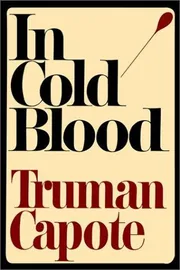
In Cold Blood
by Truman Capote · 1965
Best suited to mature teens and adults.
352 pages, about 5.5 to 8 hours.
A true crime landmark that reads like a novel, cold and exact. 66% taste match
The story
In Cold Blood is a work of true crime by Truman Capote, presented as a non-fiction novel and first published in 1965. It sits in the mystery and thriller category and runs to roughly 352 pages in its typical edition. The book is a case study of a multiple murder, written by an American author about events in his own country.
The story centers on Holcomb, a small farming community on the wheat plains of western Kansas. On November 15, 1959, four members of the Clutter family were killed in their home by intruders. The book follows the crime and the two men connected to it, Perry Edward Smith and Richard Eugene Hickock, both born in the late 1920s and early 1930s and both dying in 1965. Readers interested in real criminal cases, rural American life at the end of the 1950s, and the way a single event can reshape a town will find a clear subject here. The book has appeared in well over a hundred editions.
problems. However, the last seven years have been years of droughtless beneficence.
Characters
Clutter FamilyTruman CapotePerry Edward SmithRichard Eugene Hickock
Setting
HolcombKansasHolcomb Kansas
Period
195915th
Themes
TrueCrimeMurderMysteryCas, Études deMeurtreAnálisis de casosAsesinato
- Want to read 1,182
- Reading now 58
- Read 148
- Stopped 2
Most people shelving it are saving it for later.
Of 1390 readers who put it on a shelf, 85% want to read it, 4% are reading it now, 11% have finished it and 0% stopped before the end.
By the numbers
- The median edition runs 352 pages. Counting about 275 words a page and an adult reading pace of 250 words a minute, that is about 6.5 hours of reading.
- Open Library tracks 121 editions from 67 publishers, the earliest dated 1965 and the latest 2020, across 9 languages.
- On reader demand it ranks in the top 1% of the classic books in our catalog (8,749 of them).
- Libraries shelve it under Dewey 364.15230978144 and Library of Congress class HV-6533.00000000.K3 C3 1968.
 BookWard’s take
A true crime landmark that reads like a novel, cold and exact
Capote builds a nonfiction narrative out of the 1959 killing of the Clutter family in Holcomb, Kansas, and the two men tied to it, Perry Smith and Dick Hickock. What stands out is how rigorous it is: the case is reported in close, documented detail, yet the voice is unmistakably Capote's, controlled and watchful. The opening hooks at once, and the pace holds because the book keeps cutting between the town and the men. The real achievement is character, since the killers are drawn closely enough to unsettle you. It is a dark book, though it earns that darkness rather than leaning on shock. Expect a restrained tone and a firmly resolved ending.
At roughly 352 pages it is a moderate length, longer than BookWard's tight ideal but without padding.
The cutting between the town and the two men keeps it moving, a little slower than BookWard's preference.
Presenting a real murder case as a non-fiction novel was a distinctive form for its time and still stands out.
The prose is polished and measured rather than plain, a touch more crafted than BookWard's middle ground.
The book leans toward its people, though the unfolding case still drives the structure.
The subject is a family's murder and its consequences, so the outlook is bleak, below BookWard's hopeful lean.
It moves between the town and the killers, a more composed structure than a straight chronicle.
The material is grave and the tone serious throughout, well away from BookWard's lighter side.
A family is murdered in their home, so the content is dark by design.
The feeling is held under control, strong but never loud.
See all 50 dialsEvery position, side by side with this book
Where it lines up
- OriginalityBookWard 9 · book 9
- SentimentBookWard 8 · book 8
- Shock for effectBookWard 9 · book 9
Where it pulls apart
- LengthBookWard 1 · book 4
- Familiar tropesBookWard 10 · book 8
- ToneBookWard 7 · book 1
At roughly 352 pages it is a moderate length, longer than BookWard's tight ideal but without padding.
It opens on a quiet Kansas town and pulls you toward the crime, a hook BookWard rates highly.
It largely sidesteps standard crime-story formulas by following the killers and the town rather than a detective.
The account of the crime and its aftermath is laid out in a clear, traceable sequence.
The cutting between the town and the two men keeps it moving, a little slower than BookWard's preference.
Presenting a real murder case as a non-fiction novel was a distinctive form for its time and still stands out.
Perry Smith and Dick Hickock are drawn in close, unsettling detail, which BookWard values.
The case runs to a definite conclusion rather than an ambiguous one, matching BookWard's taste for resolution.
The tone stays cool and observational, avoiding easy sentiment in the way BookWard likes.
The darkness comes from the real events themselves and is treated with care rather than staged for effect.
It is a case study built on a documented crime, firmly in BookWard's rigorous territory, though shaped like fiction.
Capote's controlled, watchful style is unmistakable, exactly the distinctive voice BookWard looks for.
This is story-led: the crime and its people carry the book more than an argument does.
Events and people are shown in scene instead of being explained outright, close to BookWard's preference.
The structure keeps tension running across the book, though a few stretches are more procedural.
The prose is polished and measured rather than plain, a touch more crafted than BookWard's middle ground.
The book leans toward its people, though the unfolding case still drives the structure.
The subject is a family's murder and its consequences, so the outlook is bleak, below BookWard's hopeful lean.
It moves between the town and the killers, a more composed structure than a straight chronicle.
The material is grave and the tone serious throughout, well away from BookWard's lighter side.
The writing is accessible, though the subject asks for steady attention.
It follows the Holcomb community and the two men connected to the crime, giving it several vantage points.
The narrative cuts back and forth between the killers and the town while broadly moving forward through the case.
This is entirely grounded in a real 1959 crime in Kansas.
The Clutters, the townspeople and the two men make a moderate cast, not a sprawling one.
The focus stays on one family and one small community, an intimate frame.
It balances what happens with close attention to the people involved.
Conversation carries a fair share of the book, though description and narration do plenty of the work.
Romance plays no real part in a book about a murder case.
A Kansas farming community of the 1950s is distant for many readers but not exotic.
It is set in the late 1950s, firmly in the past rather than the present day.
Its subject and its form have kept it widely read across well over a hundred editions.
The narration reads as steady and trustworthy rather than slippery.
The book invites uncomfortable questions about its subjects instead of handing down tidy verdicts.
Place, weather and people are rendered in rich detail, richer than BookWard's baseline.
It is narrative nonfiction through and through, telling the case as a story rather than analyzing it.
Capote's presence is felt in the shaping of the material, so the perspective is closer to personal than detached.
It stands entirely on its own.
The crime is known from the start, so the interest lies in detail rather than reversals.
The material is hard to sit with and asks questions it does not answer comfortably.
A family is murdered in their home, so the content is dark by design.
The feeling is held under control, strong but never loud.
There is little humor, and what exists is dry.
The crime is central and its violence is present, though handled with some restraint.
Sexual content is minimal.
Questions of justice and punishment surface, but politics is not the focus.
The language is clear, with some period and regional flavor.
The narration mostly observes and lets events speak, leaning neutral.
The book looks back at a past event and its aftermath.
The worldview is sober and unillusioned, closer to cynical than idealistic.
Review written by BookWard, dial version 1, November 2026.
Who is In Cold Blood right for?
Best suited to mature teens and adults. It deals with the murder of a family and the lives of those who committed it, so the subject matter is heavy.
The writing is accessible, though the subject asks for steady attention.
A family is murdered in their home, so the content is dark by design.
The feeling is held under control, strong but never loud.
The crime is central and its violence is present, though handled with some restraint.
Book CompanionIn Cold Blood: ideas, characters, themes
A single killing in a small Kansas town is examined from both sides, the community that suffers it and the men connected to it.
- The crime. On November 15, 1959, four members of the Clutter family were killed in their home in Holcomb, Kansas.
- The town. Holcomb is a small farming community on the plains, and the book shows how the event shakes its sense of safety.
- The two men. Perry Edward Smith and Richard Eugene Hickock are the figures the case turns toward.
- A non-fiction novel. Capote presents real events with the shape and pull of a novel.
- The aftermath. The book follows the case beyond the crime itself, to what it leaves behind.
Characters
The Clutter family
Victims
Four members of the family were killed in their home in Holcomb, Kansas.
Perry Edward Smith
Man connected to the crime
One of the two men the book follows, born in the late 1920s and dying in 1965.
Richard Eugene Hickock
Man connected to the crime
The second man the book follows, born in the early 1930s and dying in 1965.
Themes
How a crime with no apparent motive unsettles those who try to understand it.
How one event can change a small town's sense of security.
What accountability looks like after a senseless act.
How real events are shaped when told as a novel.
Discussion questions
- Why might Capote have chosen to tell a true case in the form of a novel?
- How does the book make you feel about Perry Smith and Dick Hickock, and is that comfortable?
- What does the focus on Holcomb add beyond the crime itself?
- Does the lack of an apparent motive make the story harder or easier to follow?
- What responsibilities does a writer have when telling the story of real victims?
Personalize your Book Companion
This is the general edition. In BookWard, the Companion is written for you: your reading profile, your notes, and spoiler-safe to the page you are on.
Buy, listen or borrow In Cold Blood
Each link opens a search for this book on that store, in a new tab.
Read on a device
Borrow
Reviews and community
If you liked In Cold Blood
A hunted, drinking priest and the faith he cannot shed
The Spirit Catches You and You Fall DownAnne FadimanA child's illness becomes a study of two worlds colliding
The Last Days of HitlerH. R. Trevor-RoperA ten-day bunker investigation that reads like a thriller
The Bluest EyeToni MorrisonA short, devastating debut about beauty, shame, and who gets seen
Sources: Open Library.
Track In Cold Blood and find your next favorite
Add it to your shelf, rate what you have read, and BookWard will recommend what fits you.
Free to start. No credit card needed.