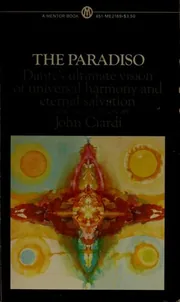
Il Paradiso
by Dante Alighieri · 1595
Suited to mature readers and students of classic literature who can handle dense verse and theological argument.
418 pages, about 6.5 to 10 hours.
Dante's final ascent: a demanding, dazzling climb toward the vision of God. 41% taste match
What is inside
Il Paradiso is the third and final part of Dante Alighieri's Divine Comedy, a long poem in Italian that first appeared in print in 1595. It follows the earlier sections set in Hell and Purgatory and takes the poet upward into the realm of heaven. Guided by Beatrice, Dante moves through the heavenly spheres toward a vision of God. The poem treats paradise, divine will and salvation, and it opens with lines about the glory of the One who moves all things and its light reaching some parts of the universe more than others.
The poet is from Florence, and the work belongs to Italian literature and to the wider tradition of writing about heaven. It has been translated into English many times and has appeared in a large number of editions, some of them illustrated, and others accompanied by dictionaries, bibliographies and related shorter poems. A typical edition runs to about 418 pages. The book suits readers of classic poetry, those interested in how heaven has been imagined in literature, and anyone reading the Divine Comedy through to its last canticle.
The glory of Him who moves everything penetrates through the universe, and shines in one part more and in another less.
Setting
ItalyFlorence
Themes
PoetryHeavenParadiseHeaven in literatureBibliographyDictionariesParadise in literatureRime
- Want to read 102
- Reading now 4
- Read 10
Most people shelving it are saving it for later.
Of 116 readers who put it on a shelf, 88% want to read it, 3% are reading it now, 9% have finished it and 0% stopped before the end.
By the numbers
- The median edition runs 418 pages. Counting about 275 words a page and an adult reading pace of 250 words a minute, that is about 7.7 hours of reading.
- Open Library tracks 291 editions from 168 publishers, the earliest dated 1595 and the latest 2025, across 10 languages.
- On reader demand it ranks in the top 16% of the classic books in our catalog (8,749 of them).
- Libraries shelve it under Dewey 851.1 and Library of Congress class PQ-4302.00000000 F72B.
 BookWard’s take
Dante's final ascent: a demanding, dazzling climb toward the vision of God
Il Paradiso is the closing third of the Divine Comedy, and it asks more of a reader than the Inferno does. Beatrice leads Dante upward through the heavenly spheres toward a vision of God, and the poem is built to be airtight: its structure, rhyme and cosmology all lock together, so that every part answers to the rest. It is also strongly driven by ideas rather than story, and it explains its theology outright instead of dramatizing it in scene, which is part of why it feels so demanding. Dante's voice is unmistakable throughout. As for lasting power, it is about as timeless as books get. Readers who want pace and plot will find it slow.
A single canticle of a long poem, about 418 pages in a typical edition, so substantial but not sprawling; BookWard prefers tighter.
Progress is a deliberate ascent through spheres, with long discourses between each stage, so it moves slowly.
Dense, intricate verse in rhyme, with elaborate imagery of light and music, sits well toward the ornate end.
Little happens in the plot sense; the poem is about the soul's growing understanding and its relationship with Beatrice.
It is about salvation and the rapture of union with God, one of the most hopeful endings in literature.
Fixed rhyme scheme, cantos and a spheres-based architecture make it formally rigorous but unconventional to modern eyes.
Humor is nearly absent from this solemn, exalted canticle.
After Hell and Purgatory, this is the luminous canticle, full of light and joy.
The poem builds toward overwhelming rapture and intense devotion.
See all 50 dialsEvery position, side by side with this book
Where it lines up
- Internal logicBookWard 10 · book 10
- Shock for effectBookWard 9 · book 9
- OriginalityBookWard 9 · book 10
Where it pulls apart
- OpeningBookWard 10 · book 6
- Story or ideasBookWard 3 · book 9
- ExpositionBookWard 2 · book 8
A single canticle of a long poem, about 418 pages in a typical edition, so substantial but not sprawling; BookWard prefers tighter.
It opens with an invocation of the Muses and Apollo, a grand statement of theme rather than a scene that grabs you.
Its heaven is built from medieval theology and cosmology, and Dante shaped that tradition more than he leaned on it.
Every sphere, rank of souls and turn of argument fits a rigorous system, which matches BookWard's love of airtight design.
Progress is a deliberate ascent through spheres, with long discourses between each stage, so it moves slowly.
Beatrice and the souls Dante meets speak for ideas and positions more than they develop as rounded characters.
The poem culminates in a full vision of God, a resolution as complete as any poem offers.
The emotion is intense yet disciplined by form, rapturous without turning sugary.
There is little shock here; its force comes from awe and argument, not from darkness used for effect.
The theological and cosmological reasoning is worked out with real intellectual discipline.
Dante's voice is among the most distinctive in all literature, unmistakable from the first canto.
The poem exists to represent divine order and salvation, so ideas lead and story serves them, unlike BookWard's story-led taste.
Souls and guides explain doctrine outright at length, the opposite of BookWard's preference for showing in scene.
The structure keeps escalating toward the final vision, though some theological stretches test attention.
Dense, intricate verse in rhyme, with elaborate imagery of light and music, sits well toward the ornate end.
Little happens in the plot sense; the poem is about the soul's growing understanding and its relationship with Beatrice.
It is about salvation and the rapture of union with God, one of the most hopeful endings in literature.
Fixed rhyme scheme, cantos and a spheres-based architecture make it formally rigorous but unconventional to modern eyes.
Humor is nearly absent from this solemn, exalted canticle.
Medieval theology, astronomy and layered allusion make it a serious undertaking, more demanding than BookWard usually seeks.
Dante narrates throughout, though many souls speak in turn.
The journey unfolds in one linear ascent from sphere to sphere.
A tour of heaven's spheres and the divine vision is as far from grounded reality as a poem gets.
Dante meets numerous saints, souls and historical figures across the spheres, giving a wide cast.
Its subject is the whole cosmos and the order of divine will, as epic as scale gets.
The action is contemplative: seeing, understanding and being transformed, not external events.
Souls and Beatrice speak often, though mostly in extended discourse rather than conversational exchange.
Beatrice is central as guide and beloved, but the love is spiritual and idealized rather than romantic plotline.
Dante's heavenly spheres are as unfamiliar a setting as exists, shaped by medieval cosmology.
A medieval Italian poem, first printed in 1595 in this edition, belongs firmly to the past.
Centuries of translation and editions show its lasting hold on readers.
Dante as narrator reports his journey plainly and reliably.
The moral order is clearly defined within the poem's theology, with little ambiguity about right and wrong.
The imagery of light, spheres and divine radiance is rich and inventive throughout.
Dante speaks as himself, a Florentine poet with his own stake in the journey.
It is the third and final part of the Divine Comedy and best read after Hell and Purgatory.
The journey is steady and foreseeable, with few plot surprises.
It confronts the reader with demanding theology and compressed argument.
After Hell and Purgatory, this is the luminous canticle, full of light and joy.
The poem builds toward overwhelming rapture and intense devotion.
Heaven holds no violence on the page.
Nothing sexual appears in this exalted canticle.
Dante's political concerns surface at moments, but theology dominates.
Even in translation the language is dense, allusive and archaic, with demanding vocabulary.
Dante judges, praises and instructs with unmistakable conviction.
It looks toward eternity and salvation, a forward-leaning vision of the soul's destiny.
It is among the most idealistic works ever written, imagining perfect union with divine love.
Review written by BookWard, dial version 1, November 2026.
Who is Il Paradiso right for?
Suited to mature readers and students of classic literature who can handle dense verse and theological argument. It contains nothing graphic, though its ideas and allusions demand patience and often a good annotated edition.
Medieval theology, astronomy and layered allusion make it a serious undertaking, more demanding than BookWard usually seeks.
After Hell and Purgatory, this is the luminous canticle, full of light and joy.
The poem builds toward overwhelming rapture and intense devotion.
Heaven holds no violence on the page.
Book CompanionIl Paradiso: ideas, characters, themes
Guided by Beatrice, Dante rises through the heavenly spheres to a vision of God, where individual destiny merges with universal order.
- The final canticle. Il Paradiso completes the Divine Comedy after the journeys through Hell and Purgatory.
- Beatrice as guide. Beatrice leads Dante upward through the spheres of heaven.
- The spheres of heaven. The ascent moves stage by stage through the heavenly spheres toward the highest realm.
- Divine will and salvation. The poem treats the sublime truths of divine will and eternal salvation.
- The vision of God. The journey culminates in a rapturous vision of God.
Characters
Dante
Poet and pilgrim
The narrator who ascends through Paradise toward the vision of God.
Beatrice
Guide
Dante's beloved, who leads him through the heavenly spheres.
Themes
The way individual destiny merges with a universal design.
The eternal fulfilment promised to the redeemed soul.
The force that moves the heavens and draws the soul upward.
Radiance as the poem's central image for understanding God.
The role of Beatrice in leading Dante toward truth.
Discussion questions
- Why might Dante invoke Apollo as well as the Muses at the start of the poem?
- How does Beatrice's role as guide differ from that of earlier guides in the Divine Comedy?
- Does the poem's heavenly ascent feel more like a journey or a lesson?
- How does Dante use light to represent understanding of the divine?
- How does reading Paradiso change your sense of the whole Divine Comedy?
Personalize your Book Companion
This is the general edition. In BookWard, the Companion is written for you: your reading profile, your notes, and spoiler-safe to the page you are on.
Buy, listen or borrow Il Paradiso
Each link opens a search for this book on that store, in a new tab.
Read on a device
Borrow
Reviews and community
If you liked Il Paradiso
Bunyan's dreamed road to the heavenly city, still walking
CosmosCarl SaganSagan's grand, humane tour of the universe and of us
AnathemNeal StephensonA monastery of mathematicians, an alien ship, and a vast invented world
Pale Blue DotCarl SaganSagan's long look at space, and why we must go
Sources: Open Library.
Track Il Paradiso and find your next favorite
Add it to your shelf, rate what you have read, and BookWard will recommend what fits you.
Free to start. No credit card needed.