Suits mature teens and adults who enjoy history and political intrigue.
427 pages, about 7 to 10 hours.
A sly, poisonous tour of imperial Rome, told by its survivor. 59% taste match
The story
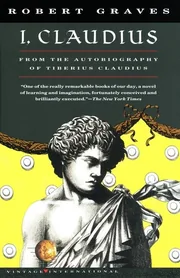
I, Claudius is a historical novel by Robert Graves, first published in 1934. It belongs to the tradition of biographical fiction and is told as the autobiography of Claudius, the Roman emperor who lived from 10 B.C. to 54 A.D. The narrator begins with his earliest childhood and recounts his life year by year, recalling the names his family and acquaintances once used for him, among them "Claudius the Idiot" and "Poor Uncle Claudius."
The story is set in Rome and follows the Julio-Claudian dynasty through the early years of the Roman Empire, from the assassination of Julius Caesar in 44 BC to the assassination of Caligula in AD 41. Augustus and Tiberius figure among the rulers whose reigns Claudius lived through, and the intrigues and poisonings of those courts form the background to his own rise to the throne in 41 A.D. Although the narrative is largely fictionalised, most of its events are drawn from the accounts of the Roman historians Suetonius and Tacitus. Valeria Messalina also appears among its people. The novel runs to roughly 427 pages in a typical edition and has appeared in 56 editions.
Characters
AugustusTiberiusRoman emperor
Setting
RomaRome
Period
Claudio, 41-54Claudius, 41-54
Themes
LiteratureEmperadoresEmperorsHistoriaEmperor of RomeRomeFicciónNovela biográfica
- Want to read 126
- Reading now 7
- Read 29
Most people shelving it are saving it for later.
Of 162 readers who put it on a shelf, 78% want to read it, 4% are reading it now, 18% have finished it and 0% stopped before the end.
By the numbers
- The median edition runs 427 pages. Counting about 275 words a page and an adult reading pace of 250 words a minute, that is about 7.8 hours of reading.
- Open Library tracks 56 editions from 34 publishers, the earliest dated 1934 and the latest 2008, across 5 languages.
- On reader demand it ranks in the top 7% of the classic books in our catalog (8,749 of them).
- Libraries shelve it under Dewey 823.912 and Library of Congress class PZ-0003.00000000.G7876 Iac 1978.
 BookWard’s take
A sly, poisonous tour of imperial Rome, told by its survivor
Graves gives Claudius the chair of a survivor, the family idiot who outlasted everyone, and lets him recount the Julio-Claudian court year by year. The voice is where this book wins: dry, confiding and unmistakable, it is among the best things in the novel and the main reason to read it. The internal logic is also strong, because the intrigues and poisonings follow from one another and from the historical record of Suetonius and Tacitus. It is highly original for its form, a fake autobiography that doubles as a history lesson. Where it tests a reader is the exposition: Claudius the historian explains a good deal outright, and the cast is large and demanding to keep straight. Expect the pace to run steady rather than fast, and the dialogue to stay lighter than the narration.
At 427 pages it is a substantial read, though it moves through decades briskly enough that it never feels sprawling.
Year-by-year recounting keeps events moving, but the chronicle form means some stretches are measured rather than quick.
A fictional autobiography built on the surviving ancient historians was a fresh idea, and it still reads as inventive.
The style is clear and conversational rather than ornate, shaped to sound like a plain-spoken memoir.
Events and reigns drive the book more than inner change, though Claudius's voice carries real personality.
Ambition, murder and decay dominate the court, leaving a distinctly bleak outlook on power.
A single memoir told in order is conventional in shape, with the autobiography conceit as its one twist.
There is dry, sardonic wit throughout, but the subject matter keeps the overall tone serious.
Intrigue, poison and the mad reign of Caligula give it a distinctly dark edge.
Claudius feels deeply but reports it with composure, so the emotion is held in check.
See all 50 dialsEvery position, side by side with this book
Where it lines up
- EndingBookWard 8 · book 8
- Internal logicBookWard 10 · book 9
- OriginalityBookWard 9 · book 8
Where it pulls apart
- LengthBookWard 1 · book 5
- OpeningBookWard 10 · book 6
- ExpositionBookWard 2 · book 8
At 427 pages it is a substantial read, though it moves through decades briskly enough that it never feels sprawling.
Claudius frames himself as the despised weakling and starts at his earliest childhood, an intriguing setup that builds rather than grabs at once.
It sidesteps the usual swords-and-sandals gloss by making a mocked outsider its narrator, which BookWard admires.
Court intrigues and poisonings follow from one another and from the historical record, so the chain of cause holds firmly.
Year-by-year recounting keeps events moving, but the chronicle form means some stretches are measured rather than quick.
A fictional autobiography built on the surviving ancient historians was a fresh idea, and it still reads as inventive.
Claudius is richly drawn through self-regard and self-doubt, though the vast court around him is sketched more quickly.
His story runs through to his rise to the throne in 41 A.D., giving a clear arc and a firm close.
Claudius narrates with wry detachment and little softening, which fits BookWard's preference for restraint.
Poisonings and cruelty belong to the story's history and serve its picture of power, not cheap effect.
It is fiction, but most events are drawn from Suetonius and Tacitus, giving it unusual grounding.
The dry, confiding, self-deprecating narrator is the book's great strength and entirely its own.
It is firmly story-led, a chronicle of reigns and families, though ideas about power run underneath.
Claudius often explains who is who and why, which is natural to a historian-narrator but runs against BookWard's liking for scene.
The chronicle keeps drawing on fresh reigns and crises, so the middle stays lively.
The style is clear and conversational rather than ornate, shaped to sound like a plain-spoken memoir.
Events and reigns drive the book more than inner change, though Claudius's voice carries real personality.
Ambition, murder and decay dominate the court, leaving a distinctly bleak outlook on power.
A single memoir told in order is conventional in shape, with the autobiography conceit as its one twist.
There is dry, sardonic wit throughout, but the subject matter keeps the overall tone serious.
The prose is easy, but the many names and shifting alliances ask for steady attention.
Everything comes through Claudius alone, a single viewpoint by design.
He tells it year by year in order, with only occasional glances back or forward.
This is a grounded historical account with no supernatural machinery.
The Julio-Claudian dynasty brings a very large, crowded roster of rulers, relatives and rivals.
It spans emperors and decades of Roman power, though always seen from one man's close vantage.
Claudius observes and reflects, but the book is mostly about what happens at court around him.
Marriages and affairs appear, among them Messalina, but love is never the engine of the story.
Ancient Rome and its court are unfamiliar to most readers, and the book makes them vivid.
The story sits in the first century, far from the present day, though written in 1934.
Its portrait of power and survival has held readers across many editions since 1934.
Claudius is candid about his own limits and weaknesses, which makes him largely trustworthy.
Few characters are plainly good or bad, and power muddies nearly everyone, Claudius included.
Rome, its palaces and its customs are conjured with rich, specific detail.
As fiction in the form of a memoir, it is narrative in style rather than analytical.
The first-person memoir keeps the perspective intimate and personal throughout.
It stands as its own novel, though it has a continuation that follows Claudius further.
Court plots keep reversing fortunes, so betrayals and sudden deaths arrive regularly.
It confronts uncomfortable truths about power and cruelty rather than offering comfort.
Intrigue, poison and the mad reign of Caligula give it a distinctly dark edge.
Claudius feels deeply but reports it with composure, so the emotion is held in check.
The humor is dry and ironic, delivered in understatement rather than broad gags.
Murders and poisonings recur through the dynasty, though they are narrated more than lingered over.
Court depravity and scandal are referenced openly, but without much explicit focus.
Imperial succession and the struggle for power are the whole subject of the book.
The language is plain and readable, with only names and Roman terms adding density.
Claudius has sharp views on everyone he meets and states them freely.
It looks back, as an old man's reckoning of a dynasty that is already gone.
Claudius is unsentimental about human nature and Rome's rulers, a deeply cynical view.
Review written by BookWard, dial version 1, November 2026.
Who is I, Claudius right for?
Suits mature teens and adults who enjoy history and political intrigue. It includes poisonings, murder and court depravity, and its large cast can be demanding.
The prose is easy, but the many names and shifting alliances ask for steady attention.
Intrigue, poison and the mad reign of Caligula give it a distinctly dark edge.
Claudius feels deeply but reports it with composure, so the emotion is held in check.
Murders and poisonings recur through the dynasty, though they are narrated more than lingered over.
Book CompanionI, Claudius: ideas, characters, themes
A despised weakling outlasts the deadly Julio-Claudian court by being underestimated, and recounts its crimes in his own dry voice.
- Autobiographical frame. The novel is written as Claudius's own memoir, so every event arrives filtered through his voice and judgment.
- Born from the historians. Most events draw on Suetonius and Tacitus, giving the fiction a firm base in surviving ancient accounts.
- Year-by-year telling. Claudius begins with his earliest childhood and works forward through the reigns he lived under.
- The idiot's advantage. Dismissed as 'Claudius the Idiot' and 'Poor Uncle Claudius', he is overlooked, which helps him survive.
- Dynasty as stage. The story runs from Julius Caesar's assassination in 44 BC to Caligula's in AD 41, covering a whole dynasty.
Characters
Claudius
Narrator and eventual emperor
A man mocked for his infirmities who survives the court's intrigues and rises to the throne in 41 A.D.
Augustus
Ruler of the early empire
One of the emperors whose reign Claudius lives through and recounts.
Tiberius
Ruler of the early empire
Another emperor whose court forms part of the dangerous backdrop to Claudius's life.
Caligula
Mad emperor
His reign and assassination in AD 41 close the dynasty's story and open Claudius's path to power.
Valeria Messalina
Figure in Claudius's circle
One of the historical people who appears in the book.
Themes
How people outlast violent courts, and what staying alive costs.
Weakness and low expectation can become a hidden form of protection.
How the ancient record can be reshaped into a personal narrative.
How absolute authority decays the people who hold it.
A dynasty where relatives are also rivals and threats.
Discussion questions
- Why might Graves have chosen the form of an autobiography rather than a conventional historical narrative?
- How does Claudius's reputation as an idiot shape both his survival and his view of the court?
- Which rulers does the book make you understand, and which does it leave remote?
- How reliable do you find Claudius's judgments of the people around him?
- What does the novel suggest about the link between absolute power and cruelty?
Personalize your Book Companion
This is the general edition. In BookWard, the Companion is written for you: your reading profile, your notes, and spoiler-safe to the page you are on.
Buy, listen or borrow I, Claudius
Each link opens a search for this book on that store, in a new tab.
Read on a device
Borrow
Reviews and community
If you liked I, Claudius
A dry-witted Viking epic that wanders the world and never drags
Hell's AngelsHunter S. ThompsonThompson rides with the Angels and files a gonzo classic
A Man of the PeopleChinua AchebeAchebe's short, sharp satire of Nigerian politics and a corrupt charmer
Gabriel's MoonWilliam BoydA travel writer drifts into Cold War spying, with a childhood fire behind him
Sources: Open Library.
Track I, Claudius and find your next favorite
Add it to your shelf, rate what you have read, and BookWard will recommend what fits you.
Free to start. No credit card needed.