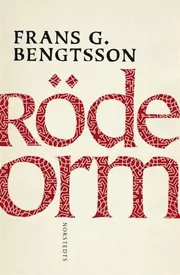
Röde Orm
by Frans Gunnar Bengtsson · 1941
Suits mature teens and adults who enjoy historical adventure and long, rolling stories.
502 pages, about 8 to 11.5 hours.
A dry-witted Viking epic that wanders the world and never drags. 62% taste match
The story
Röde Orm, also known in English as The Long Ships, is a historical adventure novel by the Swedish writer Frans Gunnar Bengtsson. It first appeared in 1941 and belongs to the tradition of sea stories about the Vikings. The action takes place in the late tenth century, around the year 1000, when Norse raiders sailed along the coasts of Europe and into the river systems of the east.
The hero is Orm, a native of Scania who is called Red for his hair and his temper. After joining a Viking ship almost by chance, he travels widely, serving as a galley slave and as a bodyguard in Andalusia under Almansur, and spending a winter feast at the court of Harald Bluetooth in Denmark. His journeys also touch England under Ethelred, Ireland under Brian Boru, the Byzantine Empire, and the lands of Kievan Rus, where the Patzinaks live. Along the way he meets silversmiths, Irish monks, skalds, and his constant companion Toke. Against this wide backdrop the book follows the slow Christianization of Scandinavia and sets the practical outlook of the Norse pagans beside the more exclusive faiths of Islam and Christianity.
Period
Tenth century
Themes
VikingsMiddle Agessea storiesTenth centuryRoman historique suédoisTraductions anglaises
- Want to read 103
- Reading now 5
- Read 22
Most people shelving it are saving it for later.
Of 130 readers who put it on a shelf, 79% want to read it, 4% are reading it now, 17% have finished it and 0% stopped before the end.
By the numbers
- The median edition runs 502 pages. Counting about 275 words a page and an adult reading pace of 250 words a minute, that is about 9.2 hours of reading.
- Open Library tracks 44 editions from 32 publishers, the earliest dated 1943 and the latest 2021, across 4 languages.
- On reader demand it ranks in the top 9% of the classic books in our catalog (8,749 of them).
- Libraries shelve it under Dewey 839.7372 and Library of Congress class PT-9875.00000000.B43 R6 1955.
 BookWard’s take
A dry-witted Viking epic that wanders the world and never drags
Röde Orm is a big, funny adventure that follows a red-haired Scanian from a chance place on a raiding ship to Andalusia, Denmark, England, Ireland, Byzantium and the rivers of Rus. At 502 pages it runs much longer than the short, tight books I tend to love, and I felt that going in. Where it wins is the voice: the narration is wry, distinctive and unlike most historical fiction. The pace is brisk, since the story moves in self-contained episodes, and the saggy middle never arrives because each new court or coast brings fresh trouble. It sidesteps most of the familiar tropes by treating the Norse pagan outlook with pragmatic humour. Expect story first and ideas second, with the background explained in scene rather than lectured.
At 502 pages across two original parts it is long and roaming, the opposite of BookWard's preference for tight and short.
Short, lively episodes keep events moving, though the sheer size of the book slows the total journey compared with BookWard's fast preference.
The blend of Norse saga and eastern tale is distinctive, though it sits within a recognisable adventure tradition.
Clear, plainspoken saga-flavoured prose with a dry comic edge rather than ornament.
Events and journeys drive the book more than Orm's inner change, so it leans toward plot.
Despite raids and hardships the tone is warm and good-humoured, and Orm's fortunes lean upward.
A conventional journey told in order, split into two parts for its original publication.
Humour runs throughout in comic episodes and wry commentary, one of its defining qualities.
Raids and warfare feature, but the comic tone keeps it from feeling dark.
Feeling is present but kept in check by the narrator's dry humour.
See all 50 dialsEvery position, side by side with this book
Where it lines up
- EndingBookWard 8 · book 8
- SentimentBookWard 8 · book 8
- Story or ideasBookWard 3 · book 3
Where it pulls apart
- LengthBookWard 1 · book 9
- OpeningBookWard 10 · book 6
- Familiar tropesBookWard 10 · book 7
At 502 pages across two original parts it is long and roaming, the opposite of BookWard's preference for tight and short.
A young man ends up on a Viking ship almost by chance, which starts the adventure quickly if not with a bang.
It works in familiar Viking sea-story territory but dodges the usual tropes through humour and a pragmatic, unromantic view of its raiders.
Each episode follows plausible cause and effect within its historical setting, which sits well with BookWard's taste for airtight storytelling.
Short, lively episodes keep events moving, though the sheer size of the book slows the total journey compared with BookWard's fast preference.
The blend of Norse saga and eastern tale is distinctive, though it sits within a recognisable adventure tradition.
Orm and companion Toke are drawn with warmth and humour, though they stay closer to vivid types than deep interior portraits.
A two-part adventure that follows its hero through to a settled place, giving the resolution BookWard likes.
The comic, dry telling keeps feeling at arm's length, which suits BookWard's restrained taste.
Raiding and battle are present but handled with wry restraint rather than for effect, matching BookWard's preference for earned darkness.
Real rulers and events such as Almansur, Harald Bluetooth and the Battle of Maldon anchor the tale, though it remains a novel.
This is a story-led book, delivered through incident and travel, which matches BookWard's love of narrative over argument.
History arrives through scenes at courts and on ships rather than in lectures, in line with BookWard's taste.
New lands and rulers keep the episodes fresh, so the long middle holds up well.
Clear, plainspoken saga-flavoured prose with a dry comic edge rather than ornament.
Events and journeys drive the book more than Orm's inner change, so it leans toward plot.
Despite raids and hardships the tone is warm and good-humoured, and Orm's fortunes lean upward.
A conventional journey told in order, split into two parts for its original publication.
Humour runs throughout in comic episodes and wry commentary, one of its defining qualities.
The narration is approachable and entertaining, though the length and cast take some stamina.
The story stays with Orm and his circle rather than shifting among many narrators.
The narrative moves forward in time as Orm travels and ages.
It is a grounded historical adventure built on real rulers and places.
Many kings, monks, skalds, smiths and warriors pass through, giving a large and varied cast.
It sweeps from Scandinavia to Andalusia, the British Isles, Byzantium and Rus, with a broad historical backdrop.
Voyages, battles and court intrigue dominate over private reflection.
Conversation among crews, kings and companions carries much of the comedy.
Love is a thread in the wider adventure rather than the heart of the book.
The Viking Age and its far-flung courts are unfamiliar territory for most readers.
Set around the year 1000, it sits firmly in the distant past.
A classic that has stayed in print and been translated into some twenty languages since 1941.
The narrator is a confident, reliable teller who guides readers through events.
Pagan pragmatism sits against Christian and Muslim certainty without a simple verdict.
Ships, courts and landscapes are drawn with colour and detail but in service of the story.
As a novel it has no nonfiction mode.
The telling stays close to Orm's circle with warm engagement rather than detachment.
Published in two parts that now read as one complete work.
Orm's fortunes turn through chance meetings and shifts of power, giving a fair share of surprises.
A rewarding, entertaining read that comforts more than it challenges.
Raids and warfare feature, but the comic tone keeps it from feeling dark.
Feeling is present but kept in check by the narrator's dry humour.
The humour is dry and understated, built on irony and wry observation.
Battles and raids appear regularly, though they are narrated with composure rather than dwelling.
Sex is a minor and lightly handled presence.
Kings, treaties and religious change shape events, but the focus stays on adventure.
Plain narration with saga-style touches rather than dense language.
The narrator gives a distinct, wry, sometimes mocking view of the world he describes.
The story looks back to a long-gone age.
Realistic and humane rather than cynical or starry-eyed.
Review written by BookWard, dial version 1, November 2026.
Who is Röde Orm right for?
Suits mature teens and adults who enjoy historical adventure and long, rolling stories. It includes raiding, battle and some adult situations, handled with a light comic touch.
The narration is approachable and entertaining, though the length and cast take some stamina.
Raids and warfare feature, but the comic tone keeps it from feeling dark.
Feeling is present but kept in check by the narrator's dry humour.
Battles and raids appear regularly, though they are narrated with composure rather than dwelling.
Book CompanionRöde Orm: ideas, characters, themes
A young Scanian drifts into the Viking life and travels across the known world of the year 1000, meeting kings, monks and rivals while the old gods give way to new faiths.
- A chance beginning. Orm joins a Viking ship almost by accident, and that accident sets the course of his life.
- Journey across Europe. His travels take him from Andalusia to Denmark, the British Isles, Byzantium and the rivers of Rus.
- Real rulers, lively tale. Figures such as Almansur, Harald Bluetooth, Ethelred and Brian Boru give the story historical grounding.
- Pagan pragmatism. The book contrasts the practical Norse outlook with the more exclusive claims of Islam and Christianity.
- Companionship. Orm's friendship with Toke runs through the adventures as a steady human anchor.
Characters
Orm
Hero
A Scanian called Red for his hair and his temper, who drifts into the Viking life by chance.
Toke
Constant companion
Orm's friend, who stays with him throughout his travels.
Almansur
Vizier of the caliph
The Andalusian ruler under whom Orm serves as a bodyguard.
Harald Bluetooth
King of the Danes
The king at whose court Orm spends a winter feast.
Themes
How a life can be reshaped by one accidental turn.
Norse paganism meeting Christianity and Islam, and how each sees the other.
The loyalty between Orm and Toke across long travels.
How the Vikings were changed by the peoples they met.
How wit and nerve carry people through shifting power and danger.
Discussion questions
- Why does the book open with Orm joining the ship almost by chance, and what does that say about his life?
- How does humour change the way we see Viking raiding?
- How does the book set pagan pragmatism against Christian and Muslim certainty?
- What makes the friendship between Orm and Toke work?
- Which of the many places Orm visits is most memorable, and why?
Personalize your Book Companion
This is the general edition. In BookWard, the Companion is written for you: your reading profile, your notes, and spoiler-safe to the page you are on.
Buy, listen or borrow Röde Orm
Each link opens a search for this book on that store, in a new tab.
Read on a device
Borrow
Reviews and community
If you liked Röde Orm
A travel writer drifts into Cold War spying, with a childhood fire behind him
The Right StuffTom WolfeWolfe turns test pilots and astronauts into a living, argumentative culture
Novels (Adventures of Huckleberry Finn / Adventures of Tom Sawyer)Mark TwainTwo Twain classics: a boy's summer, then a river escape
Feet of ClayTerry PratchettPratchett's Watch novel pairs a golem murder with a poisoned Patrician
Sources: Open Library.
Track Röde Orm and find your next favorite
Add it to your shelf, rate what you have read, and BookWard will recommend what fits you.
Free to start. No credit card needed.