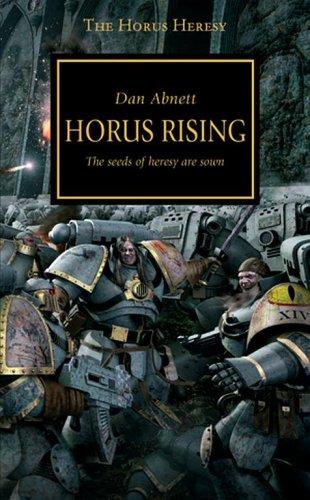
Horus Rising
by Dan Abnett
★ Top 25 book of 2006 · #12 on Best Books of 2006
In the 31st millennium the Imperium of Man is at its peak, and the Emperor hands command of the great crusade to his favorite son, Horus. Can the idealistic new Warmaster fulfill the plan, or will his promotion breed heresy among his brothers?
Best for: Readers starting an epic galactic civil war series from its first book
Horus Rising is #12 on BookWard's Best Books of 2006, out of 47 2006 books that cleared our data bar.
What Horus Rising is about
The Imperium of Man has spent thousands of years spreading across the galaxy, and in the 31st millennium it stands at the height of its power. Its ruler, the Immortal Emperor, governs with a benevolent hand, but he now turns away from the front lines and heads back to Terra. Before he goes, he passes the great crusade to his favourite son, Horus, and names him Warmaster.
The question that drives the story is whether Horus, an idealist, can carry out his father's plan, or whether the honour itself will plant the seeds of heresy among his brothers. This is the first novel in the Horus Heresy series, which leads toward a galactic civil war that threatens to wipe out humanity. The tone is epic and ominous, with ambition, loyalty and betrayal at its core.
Horus Rising on the Best Books of 2006
Horus Rising came out in 2006. Of the 47 books first published in 2006 that met BookWard's data bar, it ranks #12 on our Best Books of 2006 list.
Why it made the list: 459 readers have shelved it on Open Library; readers rate it 4.1 out of 5 (25 ratings); 43 are reading it right now. The list ranks each year’s books on how many readers have picked them up, how highly readers rate them, and how many are reading them right now.
Nearby on the 2006 list
- Naruto 33 Masashi Kishimoto, #10
- World War Z Max Brooks, #11
- The Road Cormac McCarthy, #13
- Sharp Objects Gillian Flynn, #14
See all Best Books of 2006 Best books by year
More years: Best Books of 2005 Best Books of 2007.
The numbers behind it
- Readers: 370 want to read it, 43 are reading it now and 46 have read it, according to Open Library.
- Ratings: 4.1 out of 5 from 25 Open Library ratings.
| Signal | This book (0 to 100) | Weight |
|---|---|---|
| Reach | 72 | 55% |
| Reader love | 64 | 25% |
| Being read right now | 87 | 20% |
Questions about Horus Rising
When was Horus Rising published?
Horus Rising by Dan Abnett was first published in 2006.
Was Horus Rising one of the best books of 2006?
Horus Rising is #12 on BookWard's Best Books of 2006, out of 47 2006 books that cleared our data bar. 459 readers have shelved it on Open Library; readers rate it 4.1 out of 5 (25 ratings); 43 are reading it right now.
Why is Horus Rising on the Best Books of 2006 list?
459 readers have shelved it on Open Library; readers rate it 4.1 out of 5 (25 ratings); 43 are reading it right now.
More of the best books of 2006
- The Sea of Monsters Rick Riordan, #1
- The Book Thief Markus Zusak, #2
- Half of a Yellow Sun Chimamanda Ngozi Adichie, #3
- The Boy in the Striped Pyjamas John Boyne, #4
- The Secret Rhonda Byrne, #5
- Mindset Carol S. Dweck, #6
See the full Best Books of 2006, the Top 100, or new books on Rising.
How we know
This page uses public data: Open Library reader counts and ratings, and Wikipedia page views for recent years. The description is paraphrased from real source text. Rankings reflect reading interest, not quality or sales, and can be affected by data gaps. Lists update monthly.
Best suited to adult and older teen readers who enjoy military science fiction.
Depends on the edition you pick.
The first Horus Heresy novel: golden-age dread before the fall. 45% taste match
 BookWard’s take
The first Horus Heresy novel: golden-age dread before the fall
Horus Rising opens the Horus Heresy at the Imperium's height, with the Emperor handing the Great Crusade to his favourite son. Abnett's real gift is making a sprawling war machine feel lived in, and he does it through soldiers and officers rather than lore dumps. This is wholly part of something bigger, and it reads like a first act. The characters are well drawn for a franchise novel, with real friction inside the Astartes brotherhood. The familiar tropes sit closer to genre convention than I'd like, and the ending is a set-up rather than a resolution. The pace is brisk, the dialogue is plentiful, and the scale is vast. The outlook is idealistic by design, which is exactly why the dread works.
The setting is established franchise territory, so it works from a familiar template rather than breaking new ground.
Clear, functional genre prose with the occasional flourish, plainer than ornate.
Campaign events and the personalities of those leading them share the load fairly evenly.
The Imperium shines at its height, but the whole saga is shadowed by the coming fall.
A conventional forward-moving narrative with little formal experimentation.
It is a serious military epic with only occasional dry soldierly humor.
War and foreboding colour the book, though the worst darkness lies ahead in the saga.
Loyalty and doubt register, but the register is martial rather than anguished.
See all 50 dialsEvery position, side by side with this book
Where it lines up
- PaceBookWard 8 · book 7
- Character depthBookWard 8 · book 7
- Story or ideasBookWard 3 · book 4
Where it pulls apart
- Familiar tropesBookWard 10 · book 4
- LengthBookWard 1 · book 6
- OpeningBookWard 10 · book 6
It opens on the Great Crusade at its peak, which pulls you in, though it eases into the larger story rather than striking instantly.
Space marines, galaxy-spanning empire and brotherhood bonds are well-worn genre ground, though the execution is polished.
The Imperium's command structure and the crusade's mechanics hang together coherently, which suits BookWard's liking for airtight worlds.
The setting is established franchise territory, so it works from a familiar template rather than breaking new ground.
The officers and Astartes have distinct personalities and internal friction, giving more depth than typical franchise fiction.
It closes as the first chapter of a long saga, leaving major threads deliberately open rather than resolved.
Loyalty and brotherhood carry some warmth, but the tone stays mostly martial and measured.
The darkness serves the larger tragedy of the Heresy rather than existing for cheap effect.
Abnett's confident, muscular style is recognisable, though it works within a shared-universe house tone.
This is a story-led novel, driven by campaign events and character relationships rather than argument.
Some worldbuilding is explained outright for newcomers, though much arrives through scene and dialogue.
Clear, functional genre prose with the occasional flourish, plainer than ornate.
Campaign events and the personalities of those leading them share the load fairly evenly.
The Imperium shines at its height, but the whole saga is shadowed by the coming fall.
A conventional forward-moving narrative with little formal experimentation.
It is a serious military epic with only occasional dry soldierly humor.
The universe's vocabulary takes some absorbing, but the writing itself is accessible.
The story moves among several characters and perspectives within the crusade.
Events unfold chronologically through the crusade.
Far-future galactic empire with superhuman warriors and psychic powers puts it firmly in the fantastical.
A broad roster of primarchs, officers and soldiers populates the crusade.
A galaxy-spanning war between rival powers makes this about as epic as fiction gets.
Campaigns and confrontations lead, with a fair amount of interior reflection alongside.
Council scenes, banter and command exchanges make talk a major part of the book.
Romance is essentially absent from this martial story.
The 31st-millennium Imperium is utterly unfamiliar, though the book guides you in.
Set in the distant far future, as removed from the present day as a setting can be.
Its appeal is tied to a specific franchise and its fandom more than to a broad readership.
A straightforward third-person narration with no sense of deception.
The Imperium's ideals are mostly clear, but seeds of doubt and ambiguity are planted from the start.
Battles, ships and alien worlds are painted with generous detail.
Book one of the Horus Heresy, it exists to launch a much longer saga.
Events build toward a known catastrophe, with some revelations along the way.
It's an engaging adventure rather than a deeply unsettling read, at least in this opening volume.
War and foreboding colour the book, though the worst darkness lies ahead in the saga.
Loyalty and doubt register, but the register is martial rather than anguished.
What humor there is comes through dry soldierly exchanges rather than broad comedy.
Combat and war are central, with violence an ongoing part of the story.
Sexual content is essentially absent.
Questions of command, loyalty and the Imperium's governance run through the plot.
The language is accessible, with only invented terminology to learn.
The narration observes events fairly neutrally, letting characters carry the argument.
It looks back from a future setting whose triumphs are already shadowed by the coming fall.
The Imperium's founding dream is sincerely held, which is what gives the tragedy its weight.
Review written by BookWard, dial version 1, November 2026.
Who is Horus Rising right for?
Best suited to adult and older teen readers who enjoy military science fiction. It contains frequent war violence and some grim moments.
The universe's vocabulary takes some absorbing, but the writing itself is accessible.
War and foreboding colour the book, though the worst darkness lies ahead in the saga.
Loyalty and doubt register, but the register is martial rather than anguished.
Combat and war are central, with violence an ongoing part of the story.
Book CompanionHorus Rising: ideas, characters, themes
At the height of humanity's galactic conquest, the Emperor hands the crusade to Horus, and the seeds of a civil war are quietly sown.
- The Great Crusade. Humanity's expansion across the galaxy is at its peak, setting up the golden age that makes the later fall so stark.
- The handover. The Emperor leaves the front lines and entrusts the war effort to his favourite son, Horus.
- The Warmaster. Horus's promotion raises the question of whether an idealist can carry out the Emperor's grand plan.
- Brotherhood and rivalry. The primarchs and their legions form a family whose bonds are tested by the new arrangement.
- The first chapter of a saga. The novel launches the Horus Heresy, the civil war that threatens humanity's extinction.
Characters
Horus
The Warmaster
The Emperor's favourite son, given command of the Great Crusade.
The Emperor
Ruler of the Imperium
The immortal leader who departs the front lines and entrusts the crusade to Horus.
Themes
What brothers and soldiers owe to leaders and to each other.
How power handed over in good faith can invite doubt and division.
A bright human dream shadowed by the conflict to come.
The bonds and rivalries within a family of warriors.
A golden age already carrying the seeds of its collapse.
Discussion questions
- Why does the novel open at the height of the Imperium rather than in crisis?
- What makes Horus a convincing choice for Warmaster, and where might that choice go wrong?
- How does knowing the war's outcome change the way you read the early scenes?
- Which relationships in the crusade feel strongest, and which feel most fragile?
- Does this work as a standalone story or only as a setup?
Personalize your Book Companion
This is the general edition. In BookWard, the Companion is written for you: your reading profile, your notes, and spoiler-safe to the page you are on.
Buy, listen or borrow Horus Rising
Each link opens a search for this book on that store, in a new tab.
Read on a device
Borrow
Reviews and community
If you liked Horus Rising
A gods-and-war sequel that rides on three strong leads
Blood of the Old KingsSung-Il KimAn empire that mines its dead sorcerers, seen through several fighters
EldestChristopher PaoliniA sprawling second Inheritance volume that trades momentum for worldbuilding
The Fury of the GodsJohn GwynneA big-canvas fantasy finale where every road leads to Snakavik
Find your own best books
Add what you have read, rate it, and BookWard will recommend what to read next.
Free to start. No credit card needed.