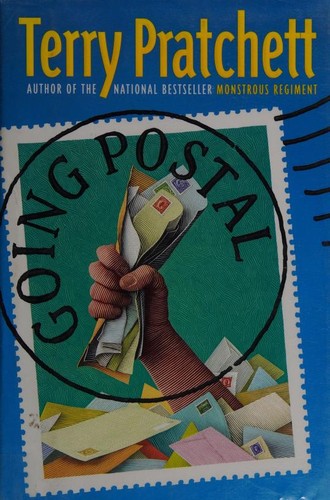
Going Postal
by Terry Pratchett
★ Top 25 book of 2004 · #20 on Best Books of 2004
Condemned swindler Moist von Lipwig escapes the gallows only to be handed the job of reviving Ankh-Morpork's broken Postal Service. Buried mail, a rival communications monopoly and his own scheming nature make this a comic race to deliver hope.
Best for: Readers who enjoy comic fantasy about reluctant rogues taking on impossible jobs
Going Postal is #20 on BookWard's Best Books of 2004, out of 48 2004 books that cleared our data bar.
What Going Postal is about
Moist von Lipwig is a skilled con artist, and he is about to be hanged in the city of Ankh-Morpork. At the last moment, Lord Vetinari fakes his death and offers him a new job: Postmaster of the city's rundown Post Office, which has not worked for decades and is stuffed with undelivered mail. Moist takes the post once he learns the alternative is a fatal drop. His parole officer is a golem, Mr Pump, and his staff amounts to two people, Tolliver Groat and Stanley Howler.
Moist sets about reviving the service with postage stamps and golem carriers, while competing against the Grand Trunk Company and its clacks towers, run by Reacher Gilt. Along the way he meets Adora Belle Dearheart, a chain-smoking golem-rights activist. Satirical and witty, the 33rd Discworld novel looks at redemption, corporate greed, public service and the way new technology changes communication. It was on the shortlist for both the Nebula and Locus Awards for Best (Fantasy) Novel.
Going Postal on the Best Books of 2004
Going Postal came out in 2004. Of the 48 books first published in 2004 that met BookWard's data bar, it ranks #20 on our Best Books of 2004 list.
Why it made the list: 217 readers have shelved it on Open Library; readers rate it 4.6 out of 5 (64 ratings). The list ranks each year’s books on how many readers have picked them up, how highly readers rate them, and how many are reading them right now.
It earns Reader favorite.
Nearby on the 2004 list
- The Walking Dead, Vol. 1 Robert Kirkman, #18
- Collapse Jared Diamond, #19
- Knuffle Bunny Mo Willems, #21
- The Gruffalo's Child Julia Donaldson, #22
See all Best Books of 2004 Best books by year
More years: Best Books of 2003 Best Books of 2005.
The numbers behind it
- Readers: 114 want to read it, 1 are reading it now and 102 have read it, according to Open Library.
- Ratings: 4.6 out of 5 from 64 Open Library ratings.
| Signal | This book (0 to 100) | Weight |
|---|---|---|
| Reach | 50 | 55% |
| Reader love | 100 | 25% |
| Being read right now | 2 | 20% |
Questions about Going Postal
When was Going Postal published?
Going Postal by Terry Pratchett was first published in 2004.
Was Going Postal one of the best books of 2004?
Going Postal is #20 on BookWard's Best Books of 2004, out of 48 2004 books that cleared our data bar. 217 readers have shelved it on Open Library; readers rate it 4.6 out of 5 (64 ratings).
Why is Going Postal on the Best Books of 2004 list?
217 readers have shelved it on Open Library; readers rate it 4.6 out of 5 (64 ratings).
More of the best books of 2004
- Darkly Dreaming Dexter Jeffry P. Lindsay, #1
- Rich Dad, Poor Dad for Teens Robert T. Kiyosaki, #2
- The Ruins of Gorlan John Flanagan, #3
- Blink Malcolm Gladwell, #4
- Alexander Hamilton Ron Chernow, #5
- She Comes First Ian Kerner, #6
See the full Best Books of 2004, the Top 100, or new books on Rising.
How we know
This page uses public data: Open Library reader counts and ratings, and Wikipedia page views for recent years. The description is paraphrased from real source text. Rankings reflect reading interest, not quality or sales, and can be affected by data gaps. Lists update monthly.
Suits teens and adults who enjoy comic fantasy, and it works well as a first Discworld novel.
Depends on the edition you pick.
A con man gets a second shot running the dead Post Office. 65% taste match
 BookWard’s take
A con man gets a second shot running the dead Post Office
Going Postal drops Moist von Lipwig, a con artist saved from the gallows, into the job of reviving Ankh-Morpork's long-dead Post Office. The hook lands at once: the trapdoor, the offer, the door that opens onto a fatal drop. It moves fast, and the middle stays busy as Moist takes on the Grand Trunk clacks company. For a story that borrows the shape of a heist, it feels remarkably original, because the setup and the jokes are unmistakably Pratchett's own. The ending is fully resolved, and the book is hopeful at heart, warmer than it is austere. The prose is plain enough to keep the comedy moving. It is part of the Discworld series but stands comfortably alone.
A full-size novel but well short of sprawling; it moves briskly through one central campaign, which suits BookWard's liking for tightness only partly.
Events keep arriving, from the Post Office rescue to the clacks rivalry, so it reads quickly, close to BookWard's pace.
Reviving a derelict postal service against a telegraph monopoly is an unusual engine for a fantasy, though the broader formula is familiar.
Clear and conversational, with comic precision rather than ornament, slightly plainer than BookWard's middle ground.
Plot-driven in its schemes and rivalry, but Moist's change over the book carries real weight.
The book is openly about delivering hope, and it ends there, more hopeful than BookWard's usual lean.
A conventional forward-moving story, though it breaks Pratchett's usual pattern by being divided into chapters.
Comic invention and deadpan wit carry the whole book, funnier than BookWard's standard.
There is a hanging and some sinister business, but the tone stays mostly gentle.
Feeling surfaces in the hope plotline, but the book prefers wit to intensity.
See all 50 dialsEvery position, side by side with this book
Where it lines up
- PaceBookWard 8 · book 8
- Shock for effectBookWard 9 · book 9
- OpeningBookWard 10 · book 9
Where it pulls apart
- LengthBookWard 1 · book 5
- Familiar tropesBookWard 10 · book 7
- Internal logicBookWard 10 · book 8
A full-size novel but well short of sprawling; it moves briskly through one central campaign, which suits BookWard's liking for tightness only partly.
It opens on a hanging, a trapdoor and an impossible job offer, which gets to the point immediately, exactly as BookWard likes.
Con-man-redeemed is a known shape, but the Post Office premise and the Discworld setting keep it fresher than most.
Vetinari's offers and Moist's schemes follow clear rules within the city, so the plot holds together tightly.
Events keep arriving, from the Post Office rescue to the clacks rivalry, so it reads quickly, close to BookWard's pace.
Reviving a derelict postal service against a telegraph monopoly is an unusual engine for a fantasy, though the broader formula is familiar.
Moist is a well-realised rogue with a real arc, though supporting players lean toward comic types.
The central conflicts are settled and the story closes with a clear sense of arrival, in line with BookWard.
It is warm and willing to be touching, so it sits a little more sentimental than BookWard's restrained taste.
Its darker moments serve the plot rather than being used for effect, which BookWard values.
Pratchett's voice is unmistakable, full of wry asides and chapter-opening synopses of philosophical themes.
Ideas about trust, hope and communication run through it, but a clear story with a con man at its centre leads.
The world is mostly conveyed through scenes and jokes, though the narrator is happy to explain things directly when it helps.
Clear and conversational, with comic precision rather than ornament, slightly plainer than BookWard's middle ground.
Plot-driven in its schemes and rivalry, but Moist's change over the book carries real weight.
The book is openly about delivering hope, and it ends there, more hopeful than BookWard's usual lean.
A conventional forward-moving story, though it breaks Pratchett's usual pattern by being divided into chapters.
Comic invention and deadpan wit carry the whole book, funnier than BookWard's standard.
Easy to follow and quick to get into, with little effort required.
Moist leads, with cutaways to Vetinari and the Grand Trunk board, so it uses a handful of perspectives.
The story moves forward in a straight line without flashbacks.
Golems, a magical city and talking mail make this firmly fantastical comedy.
A sizeable ensemble of postal workers, officials and executives fills Ankh-Morpork.
A single city and its institutions, with real stakes but nothing epic in scope.
Moist's cleverness drives a lot of external action, with some inner reckoning alongside.
Banter and verbal duels drive many scenes, so dialogue-heavy, a touch beyond BookWard's lean.
A romantic thread exists but it stays secondary to the Post Office plot.
Discworld is invented and idiosyncratic, though the comedy makes it quick to settle into.
A fantasy city with a Victorian flavour, firmly removed from the present day.
Its themes of institutions, trust and swindlers age well, and the comedy holds up.
The narration is a trustworthy guide even when it is being playful.
Right and wrong are fairly clear, with the villains plainly in the wrong, despite Vetinari's grey methods.
Rich in comic detail, from the dung-buried Post Office to the clacks towers.
It is the 33rd Discworld novel, though it is a self-contained story.
The mystery of the dead Postmasters and the Grand Trunk scheming keep surprises coming.
Light and reassuring in feel, with little to push the reader against.
There is a hanging and some sinister business, but the tone stays mostly gentle.
Feeling surfaces in the hope plotline, but the book prefers wit to intensity.
A mix of dry wit and broader comic set-pieces, landing in the middle.
Present as plot and danger but kept light in the telling.
Almost absent; this is a nearly clean read.
Monopolies, government and corporate power matter to the story, though comically framed.
The language is plain and easy to follow throughout.
The narrator freely editorialises, with a clear comic point of view.
Moist is building something new, and the book looks to what the Post Office can become.
It finishes believing that decent work and hope are worth something.
Review written by BookWard, dial version 1, November 2026.
Who is Going Postal right for?
Suits teens and adults who enjoy comic fantasy, and it works well as a first Discworld novel. There is a hanging, some threats and a few deaths, handled lightly.
Easy to follow and quick to get into, with little effort required.
There is a hanging and some sinister business, but the tone stays mostly gentle.
Feeling surfaces in the hope plotline, but the book prefers wit to intensity.
Present as plot and danger but kept light in the telling.
Book CompanionGoing Postal: ideas, characters, themes
A condemned swindler is given the job of reviving a dead Post Office, and discovers something worth believing in along the way.
- The offer. Vetinari fakes Moist's hanging, then presents him with the choice of becoming Postmaster or walking out of a door that leads to a drop.
- The dead Post Office. The building is full of decades of undelivered mail, hidden beneath pigeon dung, with only two employees left.
- The Grand Trunk. A company runs the clacks, a visual telegraph system, and its service has declined since it took control.
- The Postmasters' fate. Moist's predecessors have died in the building within weeks of each other, in unusual circumstances.
- The structure. Unlike most Discworld novels, it is divided into chapters, each opening with a synopsis of philosophical themes.
Characters
Moist von Lipwig
Protagonist
A skilled con artist saved from the gallows and made Postmaster.
Havelock Vetinari
Patrician of Ankh-Morpork
The cunning and manipulative ruler who gives Moist his choice.
Mr Pump
Parole officer
A golem who brings Moist to the Post Office.
Reacher Gilt
Chairman of the Grand Trunk Company
Head of the clacks company, rumoured to want Vetinari's job.
Tolliver Groat
Junior Postman
An aged postal worker and one of the Post Office's last two employees.
Themes
What happens when someone who has failed is given real responsibility.
The idea that a service as ordinary as mail can offer people something to believe in.
How a company that controls a system can let it decline.
The role of the con in persuading others, and when it becomes something more honest.
How organisations decay and what it takes to revive them.
Discussion questions
- Why does Vetinari offer Moist this choice instead of simply punishing him?
- What makes a derelict Post Office a good setting for a story about hope?
- How does Moist's skill as a swindler help and hinder him as Postmaster?
- What does the Grand Trunk's decline suggest about companies that control communication?
- Does the humour make the book's serious ideas easier or harder to take seriously?
Personalize your Book Companion
This is the general edition. In BookWard, the Companion is written for you: your reading profile, your notes, and spoiler-safe to the page you are on.
Buy, listen or borrow Going Postal
Each link opens a search for this book on that store, in a new tab.
Read on a device
Borrow
Reviews and community
If you liked Going Postal
A dragon, a doomed Watch, and Pratchett's sharpest early satire
Men at ArmsTerry PratchettPratchett's cop story: a city, a gonne, a rightful king
Feet of ClayTerry PratchettPratchett's Watch novel pairs a golem murder with a poisoned Patrician
Wyrd SistersTerry PratchettPratchett's Macbeth-flavored Discworld comedy, sharp and quick, with three unforgettable witches
Find your own best books
Add what you have read, rate it, and BookWard will recommend what to read next.
Free to start. No credit card needed.