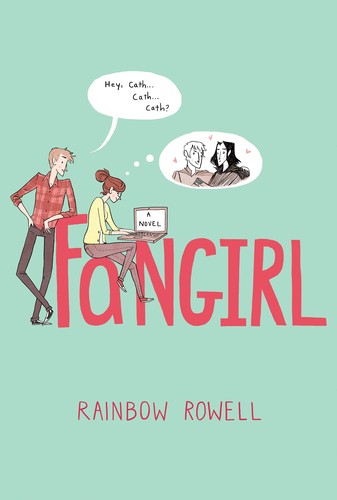
Fangirl
by Rainbow Rowell
★ Top 25 book of 2013 · #21 on Best Books of 2013
Cath is devoted to the Simon Snow series and its fan fiction, but starting college without her twin sister Wren pushes her far from her comfort zone. She must decide whether she can build her own life and write her own stories.
Best for: Teens and adults who love fandom, fan fiction, and coming-of-age college stories
Fangirl is #21 on BookWard's Best Books of 2013, out of 46 2013 books that cleared our data bar.
What Fangirl is about
Cath and Wren are twin sisters starting their freshman year at the University of Nebraska–Lincoln, and the move pulls them in different directions. Wren is outgoing, makes friends easily, and heads off to parties. Cath, who deals with social anxiety, would rather stay in her room writing fan fiction about the Simon Snow series, the books the twins leaned on as kids after their mother left. Now Wren says she has outgrown all that and keeps her distance.
Cath is not entirely alone. Her roommate Reagan and Reagan's friend Levi look out for her, a classmate named Nick becomes a writing partner, and a professor who dislikes fan fiction challenges her work. She also worries about her loving but fragile father. Rainbow Rowell writes with warmth and humor about shyness, creativity, family, and learning to stand on your own.
Fangirl on the Best Books of 2013
Fangirl came out in 2013. Of the 46 books first published in 2013 that met BookWard's data bar, it ranks #21 on our Best Books of 2013 list.
Why it made the list: 282 readers have shelved it on Open Library; readers rate it 4.2 out of 5 (18 ratings); 22 are reading it right now. The list ranks each year’s books on how many readers have picked them up, how highly readers rate them, and how many are reading them right now.
Nearby on the 2013 list
- The Day the Crayons Quit Drew Daywalt, #19
- The First 20 Hours Josh Kaufman, #20
- Tales from a Not-so-happy Heartbreaker Rachel Renée Russell, #22
- The 5Th Wave (the 5Th Wave #1) Richard Yancey, #23
See all Best Books of 2013 Best books by year
More years: Best Books of 2012 Best Books of 2014.
The numbers behind it
- Readers: 236 want to read it, 22 are reading it now and 24 have read it, according to Open Library.
- Ratings: 4.2 out of 5 from 18 Open Library ratings.
| Signal | This book (0 to 100) | Weight |
|---|---|---|
| Reach | 46 | 55% |
| Reader love | 59 | 25% |
| Being read right now | 70 | 20% |
Questions about Fangirl
When was Fangirl published?
Fangirl by Rainbow Rowell was first published in 2013.
Was Fangirl one of the best books of 2013?
Fangirl is #21 on BookWard's Best Books of 2013, out of 46 2013 books that cleared our data bar. 282 readers have shelved it on Open Library; readers rate it 4.2 out of 5 (18 ratings); 22 are reading it right now.
Why is Fangirl on the Best Books of 2013 list?
282 readers have shelved it on Open Library; readers rate it 4.2 out of 5 (18 ratings); 22 are reading it right now.
More of the best books of 2013
- House of Hades Rick Riordan, #1
- Hard Luck Jeff Kinney, #2
- Crown of Midnight Sarah J. Maas, #3
- The Screaming Staircase Jonathan Stroud, #4
- Unravel Me Tahereh Mafi, #5
- The Goldfinch Donna Tartt, #6
See the full Best Books of 2013, the Top 100, or new books on Rising.
How we know
This page uses public data: Open Library reader counts and ratings, and Wikipedia page views for recent years. The description is paraphrased from real source text. Rankings reflect reading interest, not quality or sales, and can be affected by data gaps. Lists update monthly.
Well suited to older teens and adults who enjoy gentle, character-focused stories.
Depends on the edition you pick.
A warm, funny campus novel about fandom, family and finding your own voice. 53% taste match
 BookWard’s take
A warm, funny campus novel about fandom, family and finding your own voice
Fangirl follows Cath, a first-year student who would rather write Simon Snow fan fiction than face a dorm full of strangers. It runs long for what it does, a sprawling campus novel where a tighter one would serve, and its familiar tropes (the grumpy roommate, the charming boy) are well-worn. Where it earns its place is in its characters: Cath's anxiety, her twin sister and her fragile father are drawn with real care. The voice is distinctive and easy, the dialogue is lively, and the ending resolves cleanly. The sentiment runs warmer than I usually like, but the humor keeps it grounded, and the central question of whether Cath can write her own story is worth the page count.
It runs a full academic year at novel length, longer than its story needs, which sits against BookWard's love of tight books.
It moves at the gentle rhythm of semester life, slower than BookWard's taste for momentum.
The fan fiction angle is fresh, but the college coming-of-age frame is well-trodden.
The prose is plain and conversational, built for ease rather than ornament.
Cath's inner growth drives everything, far more than any plot machinery.
Despite real hardship, the book moves toward growth and connection.
It follows a conventional chronological arc, with fan fiction excerpts as light variation.
Humor runs throughout alongside the heavier themes, giving it a light touch.
It handles a father's mental illness and a mother's absence, but stays gentle overall.
Feelings run close to the surface, from loneliness to tenderness.
See all 50 dialsEvery position, side by side with this book
Where it lines up
- Character depthBookWard 8 · book 8
- EndingBookWard 8 · book 8
- Shock for effectBookWard 9 · book 8
Where it pulls apart
- LengthBookWard 1 · book 7
- Familiar tropesBookWard 10 · book 4
- OpeningBookWard 10 · book 6
It runs a full academic year at novel length, longer than its story needs, which sits against BookWard's love of tight books.
It opens on Cath's first-day anxiety, a relatable hook that builds interest steadily rather than grabbing at once.
The grumpy roommate and charming boy are familiar campus beats, so it leans on tropes more than BookWard likes.
Events follow cleanly from character and circumstance, which suits BookWard's appetite for consistency.
It moves at the gentle rhythm of semester life, slower than BookWard's taste for momentum.
The fan fiction angle is fresh, but the college coming-of-age frame is well-trodden.
Cath, Wren and their father are drawn with real care, which BookWard values highly.
The year closes with its main threads settled, matching BookWard's preference for resolution.
It leans warm and openly emotional, softer than the restraint BookWard prefers.
Its harder moments, like a parent's crisis, arise from the story rather than for effect, which BookWard respects.
This is a novel, so the rigor dial does not apply.
Cath's wry, self-deprecating perspective gives the book a distinctive, confident voice.
It is story-led, driven by Cath's relationships and choices, not by an argument.
Backstory comes through scenes and Cath's writing, so little is explained outright.
The middle drifts in places across the long school year, though the stakes keep returning.
The prose is plain and conversational, built for ease rather than ornament.
Cath's inner growth drives everything, far more than any plot machinery.
Despite real hardship, the book moves toward growth and connection.
It follows a conventional chronological arc, with fan fiction excerpts as light variation.
Humor runs throughout alongside the heavier themes, giving it a light touch.
It reads easily and asks little of the reader beyond attention.
The story stays close to Cath throughout, giving it a single, focused viewpoint.
It moves forward through the school year in a linear sequence.
The setting is a realistic university, with the fantasy confined to Cath's fiction.
The cast stays small and tight, centered on family, roommate and a few friends.
The stakes are personal, set within a family and a campus, not on a grand stage.
Most of the drama happens inside Cath's head, in anxiety and self-doubt.
Conversation carries a lot of the book, especially the banter between Cath and Levi.
A romance with Levi is a major thread, though Cath's own growth stays at the center.
A college campus is a familiar, everyday setting for most readers.
It is set in a recognizably contemporary world of fandom and dorm life.
It captures a specific era of internet fandom, though its feelings of first-year loneliness endure.
Right and wrong are fairly clear, with few morally murky choices at stake.
Setting is sketched lightly, with attention on feelings more than scenery.
This is fiction, so the nonfiction style dial does not apply.
This is a novel, so the perspective dial does not apply.
It is a standalone story, though it contains an invented series within it.
The plot unfolds in expected ways, with few real surprises.
It is a comforting, affirming read even when it touches difficult subjects.
It handles a father's mental illness and a mother's absence, but stays gentle overall.
Feelings run close to the surface, from loneliness to tenderness.
The comedy is wry and observational rather than slapstick.
There is almost no physical violence on the page.
Romance stays tame, with little sexual content on the page.
Politics barely register in a story focused on personal life.
The language is straightforward and plain throughout.
Cath's perspective colors the telling, but the narration stays fairly even-handed.
It follows Cath toward her own future and independence as the year ends.
It believes in the power of connection and creativity to help people grow.
Review written by BookWard, dial version 1, November 2026.
Who is Fangirl right for?
Well suited to older teens and adults who enjoy gentle, character-focused stories. It touches on a parent's mental illness, an absent mother and a character's alcohol poisoning.
It reads easily and asks little of the reader beyond attention.
It handles a father's mental illness and a mother's absence, but stays gentle overall.
Feelings run close to the surface, from loneliness to tenderness.
There is almost no physical violence on the page.
Book CompanionFangirl: ideas, characters, themes
A shy student who finds comfort in fan fiction must learn to step out of her shell and write her own story.
- Starting college. Cath begins her freshman year at the University of Nebraska-Lincoln, where her social anxiety makes everything feel harder.
- A sister drifting away. Her twin Wren is more outgoing, has outgrown fan fiction and distances herself from Cath.
- Writing as refuge. Cath spends much of her free time writing Simon Snow fan fiction, which gives her comfort and purpose.
- New connections. Her roommate Reagan, Reagan's friend Levi and her classmate Nick begin to draw her out.
- Family pressure. Cath worries constantly about her father, who is loving but fragile, and the strain tests her resolve.
Characters
Cath
Protagonist
A socially anxious freshman who writes Simon Snow fan fiction and struggles to adjust to college.
Wren
Cath's twin sister
More outgoing than Cath, she has moved away from fandom and wants some distance.
Reagan
Cath's roommate
A surly roommate who, with her friend, tries to help Cath.
Levi
Reagan's friend
Charming and always around, he grows close to Cath.
Nick
Writing classmate
A classmate Cath meets regularly for writing sessions.
Themes
How loving someone else's story can lead to making your own.
Learning to stand on your own after leaving home.
How siblings and parents shape and strain each other.
Finding a place for yourself when social life feels overwhelming.
How a parent's illness affects the whole family.
Discussion questions
- Why is Cath so reluctant to leave Simon Snow behind?
- How does her relationship with Wren change across the year?
- Is fan fiction real writing? Where does the book land on that?
- How does Cath's family history shape the person she becomes?
- What does it mean for Cath to write something that is truly her own?
Personalize your Book Companion
This is the general edition. In BookWard, the Companion is written for you: your reading profile, your notes, and spoiler-safe to the page you are on.
Buy, listen or borrow Fangirl
Each link opens a search for this book on that store, in a new tab.
Read on a device
Borrow
Reviews and community
If you liked Fangirl
A crowded household, an absent father, and a warm family comedy
LovelessAlice OsemanA first-year at Durham learns what she does not feel
Holding Up the UniverseJennifer NivenTwo teens, one secret each, and a love story with real feeling
You Are HereDavid NichollsA warm, funny walk toward love in middle age
Find your own best books
Add what you have read, rate it, and BookWard will recommend what to read next.
Free to start. No credit card needed.