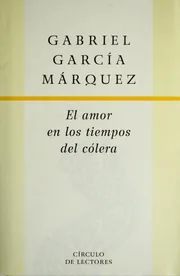
El amor en los tiempos del cólera
by Gabriel García Márquez · 1985
Best suited to adult readers and mature teens comfortable with a long, reflective novel.
451 pages, about 7 to 10.5 hours.
A fifty-year wait for love, told with wit and tenderness. 54% taste match
The story
Gabriel García Márquez's novel, first published in 1985, is a work of historical fiction and a love story set in Colombia, with Cartagena among its places. It follows Florentino Ariza and Fermina Daza, who fall in love when they are young. The story reaches into the twentieth century and spans a long stretch of their lives, with courtship and family life at its heart. Alongside the two leads, the cast includes Juvenal Urbino, Tránsito Ariza, Lorenzo Daza, Escolástica, Hildebranda Sánchez, Leona Cassiani and América Vicuña.
Fermina chooses to marry a prosperous doctor, and Florentino, though hurt, builds a career in business while keeping his feelings for her. Over the years he has 622 brief romances, yet his heart stays with Fermina. When her husband dies, Florentino attends the funeral and renews his declaration of love after fifty-one years, nine months and four days. The book belongs to Colombian and Spanish-language fiction, has been translated into English, and runs to about 451 pages in its median edition.
Era inevitable: el olor de las almendras amargas le recordaba siempre el destino de los amores contrariados.
Characters
Florentino ArizaFermina DazaJuvenal UrbinoTránsito ArizaLorenzo DazaEscolástica
Setting
ColombiaColombieCartagena (Colombia)
Period
20th century
Themes
Vida familiarFamily lifeHistorias de amorLove storiesFicció históricaNovelsNovelaCourtship
- Want to read 823
- Reading now 53
- Read 96
Most people shelving it are saving it for later.
Of 972 readers who put it on a shelf, 85% want to read it, 5% are reading it now, 10% have finished it and 0% stopped before the end.
By the numbers
- The median edition runs 451 pages. Counting about 275 words a page and an adult reading pace of 250 words a minute, that is about 8.3 hours of reading.
- Open Library tracks 130 editions from 76 publishers, the earliest dated 1985 and the latest 2022, across 13 languages.
- On reader demand it ranks in the top 1% of the modern books in our catalog (15,152 of them).
- Libraries shelve it under Dewey 863.64 and Library of Congress class PQ-8180.17000000.A73 A8 1985.
 BookWard’s take
A fifty-year wait for love, told with wit and tenderness
García Márquez gives a lifetime of longing the room it needs, and the result is a novel that earns its length. Even so, at 451 pages it sprawls, and readers who prefer their fiction tight and short may feel that. Where it lands squarely is the voice, which is unmistakably his own, and the originality, since a love that waits half a century is not a familiar shape. The prose runs richer and more ornate than many readers will be used to, and the opening is a slow, patient build rather than an instant hook. But the character work is the draw: Florentino and Fermina are drawn across decades, and the humor keeps the sentiment from going soft. Expect warmth with a wry edge, in a Colombian setting that feels rich and unfamiliar.
At 451 pages it is a long, unhurried novel that spans decades of two lives, well past the tight and short we favor.
It moves at a leisurely, patient pace across years, slower than the brisk momentum BookWard prefers.
A love that waits fifty years, told with this much wit and warmth, is a distinctive take on the love story.
The prose is lush and flowing, richer and more ornate than the plain style BookWard leans toward.
The book is propelled by what Florentino and Fermina want and feel, far more than by plot mechanics.
Love endures through loss and time, so the outlook is warm and hopeful despite the heartache.
The structure is mostly a life story, with some freedom in how it moves through the years.
Wry humor runs through it, but the tone stays mainly earnest and romantic rather than comic.
Heartbreak and loss are present, but the tone is more tender and wry than dark.
Longing, melancholy and joy run strong across a lifetime of feeling.
See all 50 dialsEvery position, side by side with this book
Where it lines up
- EndingBookWard 8 · book 8
- OriginalityBookWard 9 · book 8
- Character depthBookWard 8 · book 9
Where it pulls apart
- LengthBookWard 1 · book 7
- OpeningBookWard 10 · book 5
- PaceBookWard 8 · book 3
At 451 pages it is a long, unhurried novel that spans decades of two lives, well past the tight and short we favor.
It opens by settling into its world rather than grabbing at once, which is slower than the instant pull BookWard likes.
A romance, but one built around a half-century wait and 622 brief affairs, so it steps around the usual tropes.
Its emotional cause and effect hold together across a long span, even where the telling drifts through time.
It moves at a leisurely, patient pace across years, slower than the brisk momentum BookWard prefers.
A love that waits fifty years, told with this much wit and warmth, is a distinctive take on the love story.
Florentino and Fermina are followed across decades of family life and ambition, which gives them real weight and depth.
The long wait pays off in a renewed declaration, so the central question gets a clear answer.
Feeling runs high, but humorous sagacity keeps it from turning syrupy, though it is warmer than our restrained taste.
The darker or stranger turns come from the characters' lives and choices, not from effect.
This is fiction, so the rigor dial does not apply.
García Márquez's style is unmistakable, humorous, polished and fully his own, a clear match for BookWard.
Story leads, driven by one long courtship, with the ideas about love carried inside the plot.
Much is told in sweeping narration that summarizes years, more explained than shown in scene.
Over so many pages it can drift, though the central longing keeps pulling the story forward.
The prose is lush and flowing, richer and more ornate than the plain style BookWard leans toward.
The book is propelled by what Florentino and Fermina want and feel, far more than by plot mechanics.
Love endures through loss and time, so the outlook is warm and hopeful despite the heartache.
The structure is mostly a life story, with some freedom in how it moves through the years.
Wry humor runs through it, but the tone stays mainly earnest and romantic rather than comic.
The writing is flowing and accessible, though the length and layered time ask for patience.
The story centers on the lovers, with a husband and others bringing in some other perspectives.
It spans decades and moves back and forth across a long stretch of their lives.
It is grounded in a recognizable Colombian world, with little in the way of the fantastical.
Alongside the leads are family, lovers and acquaintances, a mid-sized cast that serves the central story.
The canvas covers decades, but the heart is a personal love story, so it feels intimate rather than epic.
The focus is on longing, feeling and memory far more than on outward action.
Narration and reflection carry much of the book, so conversation plays a moderate role.
Romance is the whole point, the heart of the book from first page to last.
A Colombian setting with Cartagena among its places is unfamiliar territory for many readers, and it is richly drawn.
It is set in the past, reaching into the twentieth century, and is far from the present day.
A love story about devotion and time feels durable and has kept its appeal.
The narration is steady and trustworthy, guiding us through events without deception.
Right and wrong is not tidy here; Florentino's devotion and his many affairs sit side by side.
Places, feelings and the passing of years are described with rich, sensuous detail.
This is fiction, so the nonfiction style dial does not apply.
This is fiction, so the nonfiction perspective dial does not apply.
It reads as a self-contained novel, a standalone story with a complete arc.
The book is driven by a long wait and a slow unfolding, with few abrupt surprises.
It is warm and engaging, though its length and its view of obsession give it some bite.
Heartbreak and loss are present, but the tone is more tender and wry than dark.
Longing, melancholy and joy run strong across a lifetime of feeling.
The humor is wry and sly, closer to dry wit than to broad comedy.
Violence is minimal; this is a story of love and time, not conflict.
Florentino's many romances bring a fair amount of sexual content, though it is not the book's focus.
Politics sits in the background of the setting rather than driving the story.
The language is fluent and literary but not dense or hard to follow.
The narrator has a distinct, humorous point of view on love and its follies.
The book looks backward, tracing a lifetime and the long memory of an old love.
It holds that love can outlast time and disappointment, an idealistic stance.
Review written by BookWard, dial version 1, November 2026.
Who is El amor en los tiempos del cólera right for?
Best suited to adult readers and mature teens comfortable with a long, reflective novel. It includes numerous romantic and sexual encounters and themes of obsession, aging and death.
The writing is flowing and accessible, though the length and layered time ask for patience.
Heartbreak and loss are present, but the tone is more tender and wry than dark.
Longing, melancholy and joy run strong across a lifetime of feeling.
Violence is minimal; this is a story of love and time, not conflict.
Book CompanionEl amor en los tiempos del cólera: ideas, characters, themes
A love that begins in youth is carried through half a century of other lives, losses and loves until it can finally be spoken again.
- Two young lovers. Florentino Ariza and Fermina Daza fall passionately in love when they are young, and that bond anchors the whole novel.
- A different choice. Fermina eventually decides to marry a rich doctor from a very good family, leaving Florentino stunned.
- A career and many romances. Florentino builds a flourishing business career and has 622 small romances, yet his heart still belongs to Fermina.
- The long wait. His devotion lasts for decades, a love left unreturned for fifty years that nonetheless keeps flowing in many forms.
- A declaration renewed. When Fermina's husband dies, Florentino attends the funeral with purpose and professes his love once again.
Characters
Florentino Ariza
The persistent romantic
A man whose business career thrives while his heart stays fixed on one woman for decades.
Fermina Daza
The woman he loves
She is Florentino's first love, who chooses to marry a prosperous doctor.
Juvenal Urbino
The doctor
The rich, well-bred physician Fermina marries, whose death reopens the story.
Tránsito Ariza
Family
A member of Florentino's family who appears among the book's wider cast.
Lorenzo Daza
Family
A member of Fermina's family who figures in the web of relationships around the lovers.
Themes
Affection that survives decades of separation, choice and change.
How long stretches of life reshape desire, hope and the people who feel them.
The tension between one fixed love and the many passing romances around it.
How social standing and household pressures shape who marries whom.
The way an old love is carried, retold and kept alive across a lifetime.
Discussion questions
- Is Florentino's devotion admirable, unhealthy, or both?
- How does the book's humor change the way you read a story of heartbreak?
- Why might García Márquez choose such a long span of years for one love story?
- What does Fermina's choice of a prosperous doctor say about the world she lives in?
- Does the idea of love lasting fifty years feel hopeful or sad to you?
Personalize your Book Companion
This is the general edition. In BookWard, the Companion is written for you: your reading profile, your notes, and spoiler-safe to the page you are on.
Buy, listen or borrow El amor en los tiempos del cólera
Each link opens a search for this book on that store, in a new tab.
Read on a device
Borrow
Reviews and community
If you liked El amor en los tiempos del cólera
Hardy's pastoral love triangle, slow in the telling but sure-footed
BuckeyePatrick RyanA small Ohio town, two families, and one buried secret
Snow Falling on CedarsDavid GutersonA courtroom drama where snow and memory press on an island
MiddlesexJeffrey EugenidesA Greek-American family saga with a mutated gene at its center
Sources: Open Library.
Track El amor en los tiempos del cólera and find your next favorite
Add it to your shelf, rate what you have read, and BookWard will recommend what fits you.
Free to start. No credit card needed.