Suits older teens and adults comfortable with dense, slang-heavy science fiction.
295 pages, about 4.5 to 7 hours.
Gibson's braided cyberspace sequel, fast, strange and rarely familiar. 63% taste match
The story
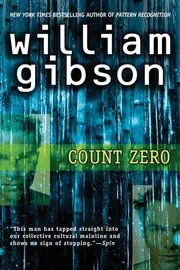
Count Zero is a cyberpunk science fiction novel by William Gibson, first published in 1986. It is the second book in his Sprawl trilogy and follows Neuromancer. The story is set in a near future where a global network of supercomputers has produced the matrix, a virtual, three-dimensional space known as cyberspace. Competition inside it is fierce, and it is dominated by multinational corporations and a small number of very rich individuals.
The novel braids three plot lines that move toward one another. One follows Turner, a corporate mercenary who wakes in a rebuilt body and is sent by Hosaka Corporation to extract a defecting research chief from Maas-Neotek, along with a biochip he has developed. Others have their own designs on that chip, and not all of them are human. Another thread follows a young data hustler from the rustbelt who gets caught up when the defection sets off conflict in cyberspace, leaving him with a price on his head and voodoo showing up on the Net. The book runs to roughly 295 pages in a typical edition and has appeared in 31 editions. It is American fiction with elements of mystery and detective writing.
They set a slamhound on Turner's trail in New Delhi, slotted it to his pheromones and the color of his hair.
Themes
Long Now Manual for CivilizationAmerican literatureSprawl TrilogyVirtual realityCyberspaceMatrix (Imaginary place)
- Want to read 91
- Reading now 5
- Read 89
Readers are split between finishing it and saving it for later.
Of 185 readers who put it on a shelf, 49% want to read it, 3% are reading it now, 48% have finished it and 0% stopped before the end.
By the numbers
- The median edition runs 295 pages. Counting about 275 words a page and an adult reading pace of 250 words a minute, that is about 5.4 hours of reading.
- Open Library tracks 31 editions from 25 publishers, the earliest dated 1986 and the latest 2017, across 8 languages.
- On reader demand it ranks in the top 5% of the modern books in our catalog (15,152 of them).
- Libraries shelve it under Dewey 813.54 and Library of Congress class PS-3557.00000000.I2264 C66 1986.
 BookWard’s take
Gibson's braided cyberspace sequel, fast, strange and rarely familiar
Count Zero braids three threads, Turner's extraction job for Hosaka among them, into a compact, quick-moving cyberpunk story. It grabs hard from the opening: a mercenary wakes in a rebuilt body and the job is already waiting. It was fresh in 1986, with the matrix, the corporate gamesmanship and the voodoo showing up on the Net, and it still reads as distinctive today. The voice is the book's signature, dense with invented slang and clipped, glittering detail. The prose runs more ornate than I tend to like, but I admire how it trusts you to work things out rather than explaining them. The reading effort is real, and the ending leaves some threads suggested rather than tied. It is the second Sprawl book and works well enough on its own.
At 295 pages it is short for its ambitions and keeps moving, which suits BookWard's love of tight books.
Three plot lines cut between each other briskly, keeping momentum up, close to BookWard's preference.
A virtual matrix, corporate warfare and voodoo on the Net add up to something few books imitate well.
The prose is dense and stylized, more ornate than BookWard's middling taste, though always purposeful.
Missions, defections and chases drive events, with character work playing a supporting role.
The tone is wary and corporate-bleak, with only glints of hope for its people.
Three braided threads converging is more ambitious than a straight line, without being truly experimental.
It is mostly cool and tense, with only dry flickers of humor.
See all 50 dialsEvery position, side by side with this book
Where it lines up
- PaceBookWard 8 · book 8
- OriginalityBookWard 9 · book 9
- SentimentBookWard 8 · book 8
Where it pulls apart
- Internal logicBookWard 10 · book 6
- OpeningBookWard 10 · book 8
- Familiar tropesBookWard 10 · book 8
At 295 pages it is short for its ambitions and keeps moving, which suits BookWard's love of tight books.
A mercenary wakes in a rebuilt body with a dangerous mission already queued, so the story is moving from the first pages.
Its cyberspace and voodoo-in-the-network ideas were fresh in 1986 and still feel unlike stock science fiction.
The world hangs together on its own terms, though some of it is left half-explained on purpose.
Three plot lines cut between each other briskly, keeping momentum up, close to BookWard's preference.
A virtual matrix, corporate warfare and voodoo on the Net add up to something few books imitate well.
Turner and the hustler are drawn with real texture, but the genre's stylishness sometimes outweighs interior depth.
The threads converge, though the final stretch leaves some questions open compared with BookWard's taste for resolution.
It stays cool and street-smart rather than sentimental, which BookWard likes.
Its violence and menace serve the plot and setting rather than existing for effect.
Gibson's clipped, invented, jewel-bright idiom is unmistakable and easily matches BookWard's love of a distinctive voice.
Ideas about cyberspace and corporations are strong, but they ride on a thriller plot rather than replacing it.
The book drops you into its world and lets you piece it together instead of explaining it.
The three strands keep trading off, so momentum rarely stalls before they converge.
The prose is dense and stylized, more ornate than BookWard's middling taste, though always purposeful.
Missions, defections and chases drive events, with character work playing a supporting role.
The tone is wary and corporate-bleak, with only glints of hope for its people.
Three braided threads converging is more ambitious than a straight line, without being truly experimental.
It is mostly cool and tense, with only dry flickers of humor.
The slang and unexplained world ask for attention, a bit more effort than BookWard's easy-going ideal.
Three plot lines each carry their own viewpoint, a good fit for BookWard's liking for many perspectives.
Events unfold in a forward line, with the strands meeting rather than jumping through time.
Cyberspace entities and voodoo on the Net push it well past grounded, though it stays near-future.
Three strands bring in a fair number of players, but it never becomes a sprawling ensemble.
Corporate and cyberspace stakes feel wide, though the story keeps close to a few people.
Chases and extractions lean outward, balanced by some interior moments.
Conversation carries a fair share of the book without dominating it.
Romance is a small thread at most; the story is about missions and survival.
Its near-future corporate cyberpunk setting is vivid and far from everyday experience.
Written in 1986 about a near future, so it reads as past-facing now despite its forward gaze.
Its vision of networks and corporate power has aged better than most predictions of its day.
The narration is straightforward and trustworthy, with no tricks played on the reader.
Corporations, mercenaries and hustlers all operate in grey areas with no clean heroes.
Dense, glittering sensory detail builds the world, richer than BookWard's usual preference.
Review written by BookWard, dial version 1, November 2026.
Who is Count Zero right for?
Suits older teens and adults comfortable with dense, slang-heavy science fiction. It contains violence and a menacing, morally grey world.
The slang and unexplained world ask for attention, a bit more effort than BookWard's easy-going ideal.
Book CompanionCount Zero: ideas, characters, themes
In a near future ruled by corporations and a vast virtual network, ordinary people get pulled into a war fought in cyberspace that may involve forces not human.
- A braided structure. Three plot lines run in parallel and move toward one another until they meet.
- A mercenary's mission. Turner is sent by Hosaka Corporation to bring out a defecting research chief and his biochip.
- A hustler in over his head. A young rustbelt data hustler is swept up when the defection triggers conflict in cyberspace.
- The matrix as a place. Cyberspace is treated as a three-dimensional inner space that people move through.
- Not everyone is human. Some parties interested in the chip are not human, raising the stakes beyond corporate rivalry.
Characters
Turner
Corporate mercenary
He wakes in a reconstructed body and is sent on a dangerous extraction job.
Bobby Newmark
Data hustler
A rustbelt hustler unprepared for the war in cyberspace and left with a price on his head.
Themes
Multinational corporations and the very rich dominate even the digital frontier.
The line between people, machines and something else is tested.
Ordinary people try simply to get out alive in a hostile system.
Voodoo appearing on the Net suggests older beliefs surviving inside new technology.
Discussion questions
- Why might Gibson braid three plot lines rather than follow one character?
- How does the book make cyberspace feel like a place rather than a tool?
- What does voodoo showing up on the Net suggest about technology and belief?
- Does the book work without having read Neuromancer first?
- How well do its predictions about corporate power hold up today?
Personalize your Book Companion
This is the general edition. In BookWard, the Companion is written for you: your reading profile, your notes, and spoiler-safe to the page you are on.
Buy, listen or borrow Count Zero
Each link opens a search for this book on that store, in a new tab.
Read on a device
Borrow
Reviews and community
If you liked Count Zero
Gibson's dense, electric heist that invented how we picture cyberspace
A Memory Called EmpireArkady MartineA murder mystery wrapped in an empire that devours its neighbors
The player of gamesIain BanksA bored game master walks into an empire built on one game
A Fire Upon the DeepVernor VingeVinge's space opera where the laws of thought bend with location
Sources: Open Library.
Track Count Zero and find your next favorite
Add it to your shelf, rate what you have read, and BookWard will recommend what fits you.
Free to start. No credit card needed.