Best suited to older teens and adults comfortable with dense, stylized prose and invented slang.
317 pages, about 5 to 7.5 hours.
Gibson's dense, electric heist that invented how we picture cyberspace. 63% taste match
The story
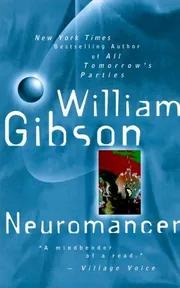
Neuromancer is a science fiction novel by William Gibson, first published in 1984 and belonging to the cyberpunk strand of the genre. It was Gibson's debut novel and opens the Sprawl trilogy, which continues with Count Zero in 1986 and Mona Lisa Overdrive in 1988. The book won the Hugo Award, and it runs to roughly 317 pages in its typical edition.
The story is set in the near future and centers on Case, a computer hacker whose nervous system has been damaged by injury. He is drawn into a crew assembled for a high-stakes heist, working alongside Molly Millions and a man named Armitage. The plot involves an artificial intelligence, corporate conspiracy, and the networked world of cyberspace and virtual reality. Its locations range across Japan, including Chiba City, as well as Istanbul, the Boston Atlanta Metropolitan Axis, and the orbital habitat Freeside. Readers interested in hackers, digital worlds, and intrigue among powerful business interests will find those threads at the heart of the book.
The sky above the port was the color of television, tuned to a dead channel.
Characters
CaseMolly MillionsArmitage
Setting
JapanEarth OrbitChibaIstanbulBAMA
Themes
Information superhighwayComputer hackersConspiraciesCiencia-ficciónBusiness intelligenceNervous systemWounds and injuriesLong Now Manual for Civilization
- Want to read 827
- Reading now 56
- Read 173
Most people shelving it are saving it for later.
Of 1056 readers who put it on a shelf, 78% want to read it, 5% are reading it now, 16% have finished it and 0% stopped before the end.
By the numbers
- The median edition runs 317 pages. Counting about 275 words a page and an adult reading pace of 250 words a minute, that is about 5.8 hours of reading.
- Open Library tracks 65 editions from 43 publishers, the earliest dated 1984 and the latest 2023, across 11 languages.
- On reader demand it ranks in the top 1% of the modern books in our catalog (15,152 of them).
- Libraries shelve it under Dewey 813.54 and Library of Congress class PS-3557.00000000.I2264 N48 2000.
 BookWard’s take
Gibson's dense, electric heist that invented how we picture cyberspace
Neuromancer drops you into Case's damaged, desperate life and keeps moving. It grabs fast and rarely lets go, which is a real pleasure. Originality is the true draw: this is the novel that gave cyberspace its look, and nothing else in the genre quite matches that. Most of what now reads as a familiar trope started here, so the imitations that followed feel tired while this one does not. The pace is brisk across 317 pages, and the middle stays sustained rather than sagging. The prose runs richer and more ornate than I usually like, and the reading effort is real, since Gibson explains little and trusts you to catch up. Story and ideas are balanced, though scenes carry more than lectures do. The ending resolves its plot while leaving a few questions humming.
At 317 pages it is compact for its ambition, which suits BookWard's love of tight books.
The run moves quickly from job to job, close to BookWard's preferred speed.
Its vision of cyberspace and street-level tech was new in 1984, exactly what BookWard rewards.
The language is dense, glittering and stylized, richer than BookWard's usual middle ground.
Plot and heist mechanics lead, with character serving the machinery, which sits more plot-driven than BookWard's lean.
The tone stays bleak and weary, darker than BookWard's mild optimism.
The telling is mostly straightforward with some surreal digressions into cyberspace.
Wry touches appear but this is a serious, cool-toned book.
Its world is seedy and grim, somewhat darker than BookWard's midpoint.
Feeling is kept at arm's length, cooler than BookWard's moderate intensity.
See all 50 dialsEvery position, side by side with this book
Where it lines up
- PaceBookWard 8 · book 8
- ExpositionBookWard 2 · book 2
- Sagging middleBookWard 8 · book 8
Where it pulls apart
- Internal logicBookWard 10 · book 7
- OpeningBookWard 10 · book 8
- Story or ideasBookWard 3 · book 6
At 317 pages it is compact for its ambition, which suits BookWard's love of tight books.
It starts inside Case's ruined life and the pull is immediate, matching BookWard's taste for openings that grab at once.
It established the cyberpunk look, so it reads as source rather than imitation, which BookWard prizes.
The heist and its rules mostly hold together, though some strands stay deliberately murky, a touch looser than BookWard likes.
The run moves quickly from job to job, close to BookWard's preferred speed.
Its vision of cyberspace and street-level tech was new in 1984, exactly what BookWard rewards.
Case and Molly are vividly sketched, though style often outweighs interior depth, a little under BookWard's bar.
The central job reaches a clear conclusion, with some mystery left over; slightly short of BookWard's full resolution.
Gibson keeps feeling cool and guarded, which BookWard values.
The grim edges feel part of the world rather than a stunt, which BookWard respects.
Gibson's clipped, noir-flecked style is unmistakable, the kind of distinct voice BookWard rates highly.
Big ideas about machines and minds drive the plot, yet they arrive through scenes, nearer the middle than BookWard's story-led lean.
Gibson drops you in and lets you infer the world, which is exactly how BookWard likes it.
The momentum holds from the first job to the last, in line with BookWard's taste.
The language is dense, glittering and stylized, richer than BookWard's usual middle ground.
Plot and heist mechanics lead, with character serving the machinery, which sits more plot-driven than BookWard's lean.
The tone stays bleak and weary, darker than BookWard's mild optimism.
The telling is mostly straightforward with some surreal digressions into cyberspace.
Wry touches appear but this is a serious, cool-toned book.
Invented slang and unexplained tech make it work for the reader, more demanding than BookWard usually seeks.
The story follows Case closely, keeping to essentially one viewpoint.
Events unfold in order, easy to follow.
Cyberspace and artificial intelligence push it well beyond the everyday, more speculative than BookWard's middle.
A small crew and a few antagonists carry it, about where BookWard sits.
The stakes reach orbit and global systems, bigger than BookWard's balanced middle.
Action and sensory immersion share space with Case's inner state, leaning a bit more outward than BookWard.
Conversation drives key scenes without dominating, a bit lighter than BookWard's lean.
Romance sits at the edges rather than the center.
The settings, from Japanese cities to orbital habitats, feel gloriously unfamiliar, which BookWard enjoys.
Written in 1984 and set in a future, it reads as a vision of tomorrow rather than a present-day story.
Its imagery still shapes how we talk about technology, giving it lasting power BookWard admires.
The narration is a straightforward close third person you can trust.
Its characters are shaded and compromised, more ambiguous than BookWard's clear leaning.
Neon, grime and data are drawn in rich, vivid detail, more lavish than BookWard's middle.
It opens the Sprawl trilogy, so it sits firmly in a series, though it reads as complete.
Revelations about the crew and the target keep landing, matching BookWard's taste.
It pushes the reader and the era's assumptions, in line with BookWard's appetite for challenge.
Its world is seedy and grim, somewhat darker than BookWard's midpoint.
Feeling is kept at arm's length, cooler than BookWard's moderate intensity.
Humor is dry and sparse when it appears, drier than BookWard's midpoint.
Violence is present and sharp but not constant, a little above BookWard's midpoint.
Sexual content is minimal and brief, below BookWard's midpoint.
Corporate power sits in the background, not at the front, about at BookWard's midpoint.
Street slang and invented tech vocabulary make it dense, above BookWard's midpoint.
Gibson stays cool and observational rather than preaching, below BookWard's midpoint.
It looks hard ahead to a networked future, more forward-facing than BookWard's slight lean.
The world is cynical and corporate, far from BookWard's slightly idealistic lean.
Review written by BookWard, dial version 1, November 2026.
Who is Neuromancer right for?
Best suited to older teens and adults comfortable with dense, stylized prose and invented slang. It contains drug use, violence and a grim, morally murky world.
Invented slang and unexplained tech make it work for the reader, more demanding than BookWard usually seeks.
Its world is seedy and grim, somewhat darker than BookWard's midpoint.
Feeling is kept at arm's length, cooler than BookWard's moderate intensity.
Violence is present and sharp but not constant, a little above BookWard's midpoint.
Book CompanionNeuromancer: ideas, characters, themes
A broken hacker gets one last job in a world where networks, corporations and artificial minds blur together.
- A damaged hero. Case was once the best data-thief around until his nervous system was crippled, and the book opens on his fall.
- A crew for a heist. A mysterious employer assembles a team around a single high-risk run, with Molly and Armitage among them.
- The target. The goal is an immensely powerful artificial intelligence tied to the Tessier-Ashpool business clan.
- Cyberspace as place. Gibson renders the network as a landscape you move through, a vision that shaped later ideas of virtual worlds.
- Start of a trilogy. This debut opens the Sprawl trilogy, continued by Count Zero and Mona Lisa Overdrive.
Characters
Case
Protagonist
A once-elite computer hacker whose damaged nervous system has cut him off from the work he loves.
Molly Millions
Crew member
A mirror-eyed street-samurai who watches Case's back during the run.
Armitage
Employer or crew leader
The figure who assembles the crew for the dangerous job.
Themes
How deeply machines and networks reshape what a person is.
Business dynasties wielding influence beyond ordinary law.
A ruined man chasing one last shot at what he lost.
What a created mind might want and what that costs humans.
Where the physical world ends and the digital one begins.
Discussion questions
- How does Gibson make cyberspace feel like a real place rather than a gadget?
- Why might the book refuse to explain its slang and technology up front?
- What does Case's physical injury say about his relationship to the network?
- How does the heist structure shape the pacing and tension?
- Which parts of Gibson's 1984 vision still feel recognizable today?
Personalize your Book Companion
This is the general edition. In BookWard, the Companion is written for you: your reading profile, your notes, and spoiler-safe to the page you are on.
Buy, listen or borrow Neuromancer
Each link opens a search for this book on that store, in a new tab.
Read on a device
Borrow
Reviews and community
If you liked Neuromancer
Gibson's braided cyberspace sequel, fast, strange and rarely familiar
A Memory Called EmpireArkady MartineA murder mystery wrapped in an empire that devours its neighbors
The player of gamesIain BanksA bored game master walks into an empire built on one game
The Tainted CupRobert Jackson BennettA Holmes-and-Watson murder mystery inside a leviathan-haunted fantasy empire
Sources: Open Library.
Track Neuromancer and find your next favorite
Add it to your shelf, rate what you have read, and BookWard will recommend what fits you.
Free to start. No credit card needed.