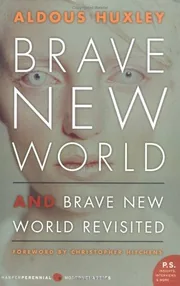
Brave New World and Brave New World Revisited
by Aldous Huxley · 1942
Suits mature teens and adults who enjoy thought-provoking science fiction.
340 pages, about 5.5 to 8 hours.
A cold, clever dystopia about being conditioned into contentment. 62% taste match
The story
This volume gathers Aldous Huxley's *Brave New World* and *Brave New World Revisited*, first published in 1942. It is a work of science fiction in the dystopian tradition, written as psychological fiction by a British author. The story takes place in London in the year AD 2540, in a society where reproduction is handled through genetic engineering and people are sorted into fixed classes before they are born.
The narrative begins with a tour of the Central London Hatchery and Conditioning Centre, where this process is carried out. Bernard Marx is one of the figures in this world, and he feels a vague wish to break away from it. Citizens are conditioned as they grow so that they accept the place assigned to them. The book draws on themes of freedom, family, culture, collectivism, totalitarianism, propaganda, brainwashing and passivity, and it approaches them through satire. The volume runs to roughly 340 pages in its median edition, and it has appeared in 28 editions.
Era un fuerte edificio de treinta y cuatro pisos.
Characters
Bernard Marx
Setting
London
Period
AD 2540
Themes
FamilyFreedomCollectivismGenetic engineeringTotalitarianismBrainwashingCultureDystopias
- Want to read 111
- Reading now 11
- Read 56
Readers are split between finishing it and saving it for later.
Of 178 readers who put it on a shelf, 62% want to read it, 6% are reading it now, 31% have finished it and 0% stopped before the end.
By the numbers
- The median edition runs 340 pages. Counting about 275 words a page and an adult reading pace of 250 words a minute, that is about 6.2 hours of reading.
- Open Library tracks 28 editions from 23 publishers, the earliest dated 1942 and the latest 2022, across 3 languages.
- On reader demand it ranks in the top 6% of the classic books in our catalog (8,749 of them).
- Libraries shelve it under Dewey 823.912 and Library of Congress class PZ-0003.00000000.H981 Bp25.
 BookWard’s take
A cold, clever dystopia about being conditioned into contentment
Huxley's satire opens in a hatchery, and it hooks at once by showing a society built before anyone is born. As for familiar tropes, this is a case of the book inventing the ones others later copied. The internal logic is airtight: conditioning explains nearly everything the citizens do. It is driven by ideas more than by story, and it often explains its world outright instead of dramatizing it, which works against a preference for scenes. Character depth is thinner than the concept, since many figures serve the argument. Bernard Marx's vague longing gives the opening a human thread. The tone is serious with a dry edge, and the reading effort stays moderate. Short, sharp and still unsettling, it rewards anyone who wants a dystopia with real intellectual bite.
At roughly 340 pages for this volume, and far shorter for the novel itself, it stays compact, which BookWard likes.
The novel moves briskly through its scenes, though the ideas sometimes slow the momentum slightly.
Genetic sorting and engineered happiness were strikingly fresh for their time and still feel distinctive.
The prose is polished and ironic without being ornate, sitting a little above plain.
Society and its machinery matter more than any single person's arc, so it leans plot and idea driven.
The vision of a conditioned, passive population is bleak, with little warmth about where it leads.
The structure follows a mostly conventional narrative progression, with no heavy formal experiment.
Satire brings dry wit, but the overall tone stays serious.
The premise is disturbing in its implications, though it avoids relentless grimness on the page.
The emotional register is cool and detached rather than overwhelming.
See all 50 dialsEvery position, side by side with this book
Where it lines up
- OriginalityBookWard 9 · book 9
- Authorial voiceBookWard 9 · book 9
- OpeningBookWard 10 · book 9
Where it pulls apart
- Story or ideasBookWard 3 · book 9
- ExpositionBookWard 2 · book 8
- LengthBookWard 1 · book 3
At roughly 340 pages for this volume, and far shorter for the novel itself, it stays compact, which BookWard likes.
The hatchery tour drops you straight into the engineered world, so the premise grabs you before any plot begins.
It helped define the dystopia, so its ideas read as foundational rather than borrowed, which BookWard rewards.
Conditioning and fixed classes explain how the society holds together, and the rules stay consistent.
The novel moves briskly through its scenes, though the ideas sometimes slow the momentum slightly.
Genetic sorting and engineered happiness were strikingly fresh for their time and still feel distinctive.
Bernard Marx has a recognizable longing, but many figures exist mainly to embody the society's design.
The book drives toward a clear conclusion rather than leaving its argument open, which suits BookWard.
Huxley keeps feeling at arm's length, using satire and cool observation instead of emotional appeals.
The disturbing elements serve the satire's argument rather than existing for effect, which BookWard respects.
This is fiction, so the nonfiction rigor dial does not apply.
Huxley's ironic, intellectual narration is unmistakable and gives the book its character.
The concept drives the book more than plot, leaning firmly toward ideas, which sits against BookWard's story preference.
The world is often explained outright, which runs against BookWard's liking for things shown in scene.
The short length and steady escalation keep the momentum sustained without a noticeable lull.
The prose is polished and ironic without being ornate, sitting a little above plain.
Society and its machinery matter more than any single person's arc, so it leans plot and idea driven.
The vision of a conditioned, passive population is bleak, with little warmth about where it leads.
The structure follows a mostly conventional narrative progression, with no heavy formal experiment.
Satire brings dry wit, but the overall tone stays serious.
The ideas take thought, but the writing is direct and the book is readable.
The narrative moves among several characters rather than staying with one perspective.
The story unfolds in a single future setting and moves forward in a straightforward way.
Genetic engineering is speculative, yet it is presented as plausible science rather than magic.
A modest group of characters carries the book rather than a sprawling roster.
It examines a whole civilization, so its canvas reaches beyond the intimate.
It balances social observation and individual longing, leaning slightly toward inner unease.
Conversation carries a fair share of the book's ideas and social commentary.
Relationships appear within the society, but romance is not the book's center.
AD 2540 London and its hatchery system are deeply unfamiliar, a strength of the book.
It looks far into the future, so it feels removed from the present day.
Its concerns about control, comfort and freedom stay relevant well beyond its own moment.
The narration is a steady, reliable guide through the world rather than a deceptive voice.
The book deliberately unsettles easy answers about happiness and freedom, leaving judgments contested.
The hatchery and world are drawn with vivid, specific detail, though ideas dominate over scenery.
It reads as a self-contained novel, though this volume adds a companion nonfiction piece.
The book is driven more by revelation of its world than by plot twists.
It challenges comfortable assumptions about happiness and freedom rather than soothing the reader.
The premise is disturbing in its implications, though it avoids relentless grimness on the page.
The emotional register is cool and detached rather than overwhelming.
Humor runs dry and ironic rather than broad.
Violence is not the focus; the menace lies in conditioning and control.
Sexuality is part of the society's conditioning and appears as a theme rather than a spectacle.
Collectivism, totalitarianism and propaganda sit at the core of the book.
The language is accessible, with only some invented terms of the world to absorb.
The narration carries a distinct satirical point of view rather than staying neutral.
As a warning about where society might head, it faces the future.
Its stance is skeptical of engineered utopias, reading as a cynical diagnosis.
Review written by BookWard, dial version 1, November 2026.
Who is Brave New World and Brave New World Revisited right for?
Suits mature teens and adults who enjoy thought-provoking science fiction. It deals with engineered reproduction, social control and sexuality as ideas, so some readers may want to know that going in.
The ideas take thought, but the writing is direct and the book is readable.
The premise is disturbing in its implications, though it avoids relentless grimness on the page.
The emotional register is cool and detached rather than overwhelming.
Violence is not the focus; the menace lies in conditioning and control.
Book CompanionBrave New World and Brave New World Revisited: ideas, characters, themes
A society that conditions people to be content can strip away freedom without any visible cruelty.
- The hatchery opening. The book begins with a tour of the Central London Hatchery and Conditioning Centre, introducing the engineered world.
- Designed classes. People are bred into a rigid class system before birth.
- Conditioned happiness. As they mature, citizens are trained to be content with the roles society assigns them.
- Bernard's longing. Bernard Marx feels an ill-defined wish to break free from this order.
- A satirical lens. The book approaches freedom, propaganda and passivity through satire rather than plain argument.
Characters
Bernard Marx
A figure within the society
He harbors an ill-defined longing to break free from the world around him.
Themes
What it costs to give up choice for comfort.
A society that values the group over the individual.
Conditioning that shapes what people want.
Control that works through consent rather than force.
A population trained to accept its assigned role.
Discussion questions
- Is a society that makes everyone content still unfree?
- How does satire change the way the book makes its argument?
- What does Bernard Marx's longing suggest about human nature?
- Which parts of this world feel closest to the present day?
- Why might a book about conditioning still feel unsettling after so long?
Personalize your Book Companion
This is the general edition. In BookWard, the Companion is written for you: your reading profile, your notes, and spoiler-safe to the page you are on.
Buy, listen or borrow Brave New World and Brave New World Revisited
Each link opens a search for this book on that store, in a new tab.
Read on a device
Borrow
Reviews and community
If you liked Brave New World and Brave New World Revisited
A bored game master walks into an empire built on one game
The Day of the TriffidsJohn WyndhamA quiet-voiced catastrophe where the walking plants are the lesser danger
The Word for World is ForestUrsula K. Le GuinA short, furious novel about a forest world under occupation
The Windup GirlPaolo BacigalupiA brutal, brilliant future Bangkok where calories are the currency
Sources: Open Library.
Track Brave New World and Brave New World Revisited and find your next favorite
Add it to your shelf, rate what you have read, and BookWard will recommend what fits you.
Free to start. No credit card needed.