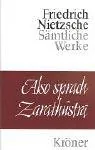
Also sprach Zarathustra
by Friedrich Nietzsche · 1883
Best suited to mature teens and adults ready for dense, challenging ideas.
354 pages, about 5.5 to 8.5 hours.
Nietzsche's prophet-poem: ideas in parable, argued with fire. 43% taste match
What it covers
Also sprach Zarathustra, first published in 1883, is a work of German philosophy by Friedrich Nietzsche, written in a literary form that blends philosophical argument with narrative. It is usually shelved with classic literature as well as philosophy, and it has appeared in many editions and languages, with a typical printing running to around 354 pages.
The book follows Zarathustra, who at the age of thirty leaves his home and the lake beside it and goes up into the mountains. From there it develops Nietzsche's idea of the Superman, the Ubermensch, a figure of passion and creativity who lives beyond conventional standards of good and evil. The work presents Zarathustra as a kind of alter ego for the author and ties into his view that humankind's aim should be found in its highest individuals. It is an essential text for readers following German thought of the nineteenth century, and for anyone tracing the philosophical concept of the Superman.
When Zarathustra was thirty years old he left his home and the lake of his home and went into the mountains.
Themes
Classic LiteratureFilosofieFilosofíaGerman PhilosophyGerman languagePhilosophySuperhombre (Concepto filosófico)Superman
- Want to read 511
- Reading now 30
- Read 33
Most people shelving it are saving it for later.
Of 574 readers who put it on a shelf, 89% want to read it, 5% are reading it now, 6% have finished it and 0% stopped before the end.
By the numbers
- The median edition runs 354 pages. Counting about 275 words a page and an adult reading pace of 250 words a minute, that is about 6.5 hours of reading.
- Open Library tracks 552 editions from 154 publishers, the earliest dated 1883 and the latest 2022, across 15 languages.
- On reader demand it ranks in the top 3% of the classic books in our catalog (8,749 of them).
- Libraries shelve it under Dewey 193.220 and Library of Congress class B--3313.00000000.A43 E5 1917.
 BookWard’s take
Nietzsche's prophet-poem: ideas in parable, argued with fire
This is philosophy dressed as scripture, and it asks for a different kind of attention than an argument does. The voice is as distinctive as any in the canon, and that is a large part of its appeal. It leans hard toward ideas over story, with Zarathustra descending from his mountain mainly as a vehicle for a doctrine, so readers who come for narrative will feel the pull the other way. The prose is ornate and rhythmic, well beyond the plain register of most philosophy, and the reading is demanding because the parables are dense and deliberately provocative. The originality is close to unmatched, and the book's staying power is long since proven. The pace is slow and the ending is left open, so it rewards patience over momentum.
At 354 pages it is moderate in size but feels longer because every section is dense and demands slow reading.
Passages are meant to be chewed over, so the reading pace is slow even when the language surges.
A philosophical treatise written as a prophetic, poetic narrative was startling in 1883 and still is.
Rich, rhythmic, biblical in cadence, this is far more ornate than BookWard's usual preference.
Whatever movement exists comes from ideas unfolding, with little plot in the usual sense.
It is exhilarated about human potential through the Superman yet harsh about the present, so outlook is mixed.
Speeches, parables and songs arranged in parts make it unconventional compared with standard philosophy.
There are moments of irony and mockery, but the book is overwhelmingly earnest and grave.
Its themes are bracing and austere, but it is more philosophical than disturbing.
The language runs hot with exaltation and defiance, giving it a strong emotional charge.
See all 50 dialsEvery position, side by side with this book
Where it lines up
- Familiar tropesBookWard 10 · book 10
- OriginalityBookWard 9 · book 10
- SentimentBookWard 8 · book 7
Where it pulls apart
- Internal logicBookWard 10 · book 4
- OpeningBookWard 10 · book 5
- Story or ideasBookWard 3 · book 9
At 354 pages it is moderate in size but feels longer because every section is dense and demands slow reading.
It opens with a man leaving home for the mountains, an image with pull, though the doctrine takes patience to arrive.
Few books sound less like anything else, and the form itself resists every familiar template.
It works by aphorism, image and provocation rather than step-by-step proof, so its internal logic is looser than BookWard prefers.
Passages are meant to be chewed over, so the reading pace is slow even when the language surges.
A philosophical treatise written as a prophetic, poetic narrative was startling in 1883 and still is.
Zarathustra is a mouthpiece and alter ego more than a fully psychological figure, so depth is limited by design.
The book closes on transformation and unresolved ideas rather than tying its arguments off.
The tone is fierce and rhetorical rather than soft, though it has moments of lyric tenderness.
Its provocations about morality and tradition are central to the argument, not offered for cheap effect.
It makes its case through parable and rhetoric rather than systematic evidence, so rigor is modest by BookWard's standard.
Nietzsche's voice is instantly recognizable, defiant and musical, which BookWard rates very highly.
Narrative is a frame for doctrine, so this sits firmly on the idea-led side, opposite BookWard's story-first lean.
Ideas are delivered through speeches and images, a mix of dramatized and declared rather than purely explained.
Some sections land harder than others, but the sermon-like structure keeps returning with fresh force.
Rich, rhythmic, biblical in cadence, this is far more ornate than BookWard's usual preference.
Whatever movement exists comes from ideas unfolding, with little plot in the usual sense.
It is exhilarated about human potential through the Superman yet harsh about the present, so outlook is mixed.
Speeches, parables and songs arranged in parts make it unconventional compared with standard philosophy.
There are moments of irony and mockery, but the book is overwhelmingly earnest and grave.
Dense symbolism and compressed argument make this a demanding read that rewards rereading.
We stay with Zarathustra's perspective throughout, so the book is essentially single-voiced.
Events follow his journey and teaching forward, with little disruption of chronology.
Talking animals and symbolic encounters give it a mythic, dreamlike texture beyond strict realism.
Besides Zarathustra there are a few animals and passing figures, so the cast stays small.
The subject is nothing less than the future of humankind, giving the ideas epic reach.
The action is almost entirely reflection and proclamation rather than outward event.
Much of it is monologue and address, with limited back-and-forth exchange.
Romance plays no meaningful part in the book.
A symbolic landscape of mountains and marketplaces feels unfamiliar and allegorical.
It is a nineteenth-century work, though its questions still feel immediate.
More than a century on, it remains a landmark that readers keep returning to.
The authorial figure behind Zarathustra is slippery, speaking through an alter ego with deliberate irony.
It deliberately unsettles good and evil rather than offering a clear moral compass.
Mountains, lakes and symbolic scenery are drawn with vivid, poetic imagery.
It reads closer to scripture or poem than to analytical prose, so it leans toward narrative.
A passionate, subjective voice drives the whole book rather than detached analysis.
It stands complete as a single work.
The book moves by revelation of ideas rather than plot surprises.
It confronts comfortable assumptions about morality, religion and meaning head-on.
Its themes are bracing and austere, but it is more philosophical than disturbing.
The language runs hot with exaltation and defiance, giving it a strong emotional charge.
What humor exists is sardonic and cutting rather than broad.
Violence is mostly metaphorical rather than depicted on the page.
Sexual content is largely absent.
It engages with values and society in the abstract rather than with partisan politics.
Archaic, dense and symbolic language raises the difficulty, even in a strong translation.
Zarathustra preaches rather than observes, so opinion saturates every page.
The whole project aims at what humankind might become, a forward-pointing vision.
The Superman ideal is a bold aspiration, though wrapped in scorn for the present.
Review written by BookWard, dial version 1, November 2026.
Who is Also sprach Zarathustra right for?
Best suited to mature teens and adults ready for dense, challenging ideas. It attacks religion and conventional morality, which some readers may find provocative.
Dense symbolism and compressed argument make this a demanding read that rewards rereading.
Its themes are bracing and austere, but it is more philosophical than disturbing.
The language runs hot with exaltation and defiance, giving it a strong emotional charge.
Violence is mostly metaphorical rather than depicted on the page.
Book CompanionAlso sprach Zarathustra: ideas, characters, themes
Zarathustra comes down from his mountain to teach that humanity is something to be overcome, and that people should create their own values beyond conventional good and evil.
- The descent from the mountain. At thirty, Zarathustra leaves his home and the lake beside it for the mountains, setting the pattern of withdrawal and return that frames his teaching.
- The Superman. The Ubermensch is presented as a figure of supreme passion and creativity, an aim for humankind rather than a settled fact.
- Beyond good and evil. Zarathustra lives on a level of experience above ordinary moral standards, and the book invites readers to question inherited values.
- Philosophy as literature. The work blends argument with narrative and poetry, so its ideas arrive as speeches, images and parables.
- Highest individuals. The book expresses Nietzsche's belief that humankind's object should lie in its highest individuals.
Characters
Zarathustra
Prophet and protagonist
A thirty-year-old who leaves home for the mountains and serves as Nietzsche's alter ego and the voice of his philosophy.
Themes
The idea that people should surpass what they currently are rather than settle.
Questioning the moral standards inherited from tradition.
A figure of creativity and passion held up as humanity's aim.
Ideas expressed through poetic, narrative form instead of plain argument.
Discussion questions
- Why might Nietzsche choose parable and poetry over conventional argument to present his ideas?
- What does it mean to live beyond good and evil, and is that appealing or unsettling?
- Is the Superman a goal for individuals, for humanity, or a provocation?
- How does Zarathustra function as an alter ego, and what does that do to the book's authority?
- Which passages feel most alive to you, and which feel most resistant?
Personalize your Book Companion
This is the general edition. In BookWard, the Companion is written for you: your reading profile, your notes, and spoiler-safe to the page you are on.
Buy, listen or borrow Also sprach Zarathustra
Each link opens a search for this book on that store, in a new tab.
Read on a device
Borrow
Reviews and community
If you liked Also sprach Zarathustra
A suicidal outsider's inner life, told with startling directness
Leaves of GrassWalt WhitmanWhitman's lifelong book of verse, grown from twelve poems to over 400
A Room of One's OwnVirginia WoolfWoolf's short, sharp case for money, space and women's writing
Le città invisibiliItalo CalvinoMarco Polo describes cities to Kublai Khan, each one a riddle
Sources: Open Library.
Track Also sprach Zarathustra and find your next favorite
Add it to your shelf, rate what you have read, and BookWard will recommend what fits you.
Free to start. No credit card needed.