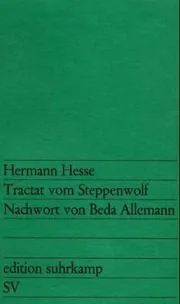
Der Steppenwolf
by Hermann Hesse · 1920
Best for mature teens and adults, since the book deals with suicidal thoughts and deep despair.
224 pages, about 3.5 to 5 hours.
A suicidal outsider's inner life, told with startling directness. 56% taste match
What it covers
Der Steppenwolf is a psychological novel by Hermann Hesse, the German-Swiss author, whose tenth novel it is. It was first published in 1920 and is written in German, with editions also appearing in translation, including Russian. Set in Germany in the early twentieth century, during the 1920s, it places an individual's inner life against the backdrop of Western civilization as it stood in that period. Most editions run to roughly 224 pages.
The central figure is Harry Haller, a man consumed by loneliness and suffering who feels he has no place in a world given over to empty amusement. Having resolved to end his own life, he has a chance encounter that alters his outlook, and he starts to learn how to take pleasure in living. Hesse himself described the book as concerned with transcendence and healing, and it has often been misread as something else. The novel suits readers drawn to German literature, fiction about the search for meaning, and character studies centered on a troubled mind.
The day had gone by just as days go by.
Setting
Germany
Period
Early 20th century1920's1920-1928
Themes
LifeWestern CivilizationFicciónGerman language booksGerman literatureCivilización occidentalVidaGerman language materials
- Want to read 386
- Reading now 25
- Read 100
Most people shelving it are saving it for later.
Of 511 readers who put it on a shelf, 76% want to read it, 5% are reading it now, 20% have finished it and 0% stopped before the end.
By the numbers
- The median edition runs 224 pages. Counting about 275 words a page and an adult reading pace of 250 words a minute, that is about 4.1 hours of reading.
- Open Library tracks 240 editions from 100 publishers, the earliest dated 1927 and the latest 2023, across 13 languages.
- On reader demand it ranks in the top 2% of the classic books in our catalog (8,749 of them).
- Libraries shelve it under Dewey 833.912 and Library of Congress class PT-2617.00000000.E85 S7 2010.
Read it
A digital copy can be borrowed for free.
1 ebook provider carry it and a scanned copy is on the Internet Archive.
 BookWard’s take
A suicidal outsider's inner life, told with startling directness
Der Steppenwolf is a short novel that lives almost entirely inside Harry Haller, a man who feels he has no place in a world of empty amusement. Its great strength is character: Hesse draws a divided mind with real care, and the book is far more about that interior than about events. It is original, too, since its picture of a self split into warring halves still feels unlike most fiction of any decade. The structure is more experimental than I usually enjoy, and the quiet surprise is how much hope it holds. Hesse called it a book about transcendence and healing, not despair. It is introspective rather than fast, and the slow pace is the main place where it parts from my own taste.
At 224 pages it is compact, which suits BookWard's preference for tight books.
Reflective and inward, it moves slower than BookWard's fast-paced preference.
A man split between human and wolf was bold in 1920 and still feels fresh.
The prose is heightened and lyrical but not showy or dense.
It is character-driven through and through, following one mind's struggle.
Despite its dark start, Hesse frames it as a book of healing, with real hope.
It departs from a plain linear form, which stretches BookWard's more conventional lean.
The tone is serious, with only occasional lightness.
It begins at the edge of suicide but moves toward renewal.
The inner turmoil is felt strongly throughout.
See all 50 dialsEvery position, side by side with this book
Where it lines up
- OriginalityBookWard 9 · book 9
- Authorial voiceBookWard 9 · book 9
- LengthBookWard 1 · book 2
Where it pulls apart
- Internal logicBookWard 10 · book 4
- OpeningBookWard 10 · book 6
- Story or ideasBookWard 3 · book 8
At 224 pages it is compact, which suits BookWard's preference for tight books.
It opens on a man out of step with his world, engaging but not a plot-driven grab.
Its portrait of a divided self avoids stock tropes, which BookWard values.
Its inner world follows an emotional and symbolic logic more than a strict, airtight one.
Reflective and inward, it moves slower than BookWard's fast-paced preference.
A man split between human and wolf was bold in 1920 and still feels fresh.
Harry Haller is drawn from the inside with real depth, which BookWard rewards.
It closes with a sense of movement toward healing, though not every thread is tied off.
It feels the pain of its hero openly without turning syrupy.
Its darkness serves the protagonist's crisis rather than existing for effect.
Hesse's voice is unmistakable, intense and searching, a clear plus.
The book is driven by the ideas of selfhood and transcendence more than by events.
Hesse often states the inner conflict outright, more than BookWard's show-in-scene taste.
The reflective stretches hold together because the inner stakes stay live.
The prose is heightened and lyrical but not showy or dense.
It is character-driven through and through, following one mind's struggle.
Despite its dark start, Hesse frames it as a book of healing, with real hope.
It departs from a plain linear form, which stretches BookWard's more conventional lean.
The tone is serious, with only occasional lightness.
Its psychological and symbolic layers ask for patient, attentive reading.
It stays tied to one troubled mind rather than many viewpoints.
The movement is largely forward, with some blurring of inner time.
Dreamlike and symbolic passages push it past strict realism.
A small circle surrounds Harry, keeping the focus tight.
The scale is intimate, centered on one person's inner life.
Almost everything happens in Harry's thoughts, well inside BookWard's inward end.
Reflection outweighs conversation, so dialogue stays moderate.
Relationships matter to his change but are not the center.
A familiar early twentieth-century German setting grounds the story.
It is rooted in the 1920s, firmly in the past.
Its portrait of alienation still resonates a century on.
The telling is filtered through a distressed, self-divided mind, so trust is partial.
It leaves questions of right and wrong open rather than giving verdicts.
Setting is sketched in service of mood, with moderate richness.
It stands alone as a single novel.
Its turns are more psychological than plot surprises.
It confronts despair and the self, a demanding emotional read.
It begins at the edge of suicide but moves toward renewal.
The inner turmoil is felt strongly throughout.
Humor is dry and rare when it appears.
Little violence appears on the page.
Sensuality plays a part in Harry's reawakening without dominating.
Society is criticized, but politics stays in the background.
The language is plain enough, though the ideas are dense.
The narration openly argues and philosophizes.
It looks both at the world as it was and at a path forward for the self.
It tilts toward idealism in its belief in transcendence and healing.
Review written by BookWard, dial version 1, November 2026.
Who is Der Steppenwolf right for?
Best for mature teens and adults, since the book deals with suicidal thoughts and deep despair. Readers sensitive to those themes should approach with care.
Its psychological and symbolic layers ask for patient, attentive reading.
It begins at the edge of suicide but moves toward renewal.
The inner turmoil is felt strongly throughout.
Little violence appears on the page.
Book CompanionDer Steppenwolf: ideas, characters, themes
A lonely man at odds with an empty world is pushed by a chance encounter to rethink his despair and learn how to enjoy living.
- The outsider. Harry Haller feels he has no place in a world given to meaningless frivolity.
- A turning point. Having resolved to end his life, a chance encounter changes his outlook.
- Learning to live. He begins to learn ways to take pleasure in existence.
- Often misread. Hesse said the book is about transcendence and healing, not simply despair.
- A 1920s backdrop. It is set in early twentieth-century Germany against Western civilization.
Characters
Harry Haller
Protagonist
A man consumed by loneliness and suffering who feels out of place in the world.
Themes
The ache of feeling cut off from other people and from a shallow society.
Moving beyond despair toward a larger, healed sense of self.
Recovery from suffering through new ways of living.
Feeling out of place in modern Western civilization.
Discussion questions
- Why does Harry feel he has no place in his world?
- How does the chance encounter change his thinking?
- Is the book more despairing or more hopeful, and why?
- Why might readers misunderstand Hesse's intent?
- What does the 1920s setting add to Harry's isolation?
Personalize your Book Companion
This is the general edition. In BookWard, the Companion is written for you: your reading profile, your notes, and spoiler-safe to the page you are on.
Buy, listen or borrow Der Steppenwolf
Each link opens a search for this book on that store, in a new tab.
Read on a device
Borrow
Reviews and community
If you liked Der Steppenwolf
A quiet boy, a mysterious classmate, and a search for self
Uno, nessuno e centomilaLuigi PirandelloOne man unravels his own identity, one nose-tilt at a time
A Hora da EstrelaClarice LispectorA ninety-six-page novel that turns on its own narrator
The Color of WaterJames McBrideA son's memoir, and his mother's own voice breaking through it
Sources: Open Library.
Track Der Steppenwolf and find your next favorite
Add it to your shelf, rate what you have read, and BookWard will recommend what fits you.
Free to start. No credit card needed.