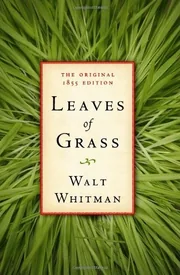
Leaves of Grass
by Walt Whitman · 1855
Suited to older teens and adults who can handle long, dense lines and abstract ideas.
384 pages, about 6 to 9 hours.
Whitman's lifelong book of verse, grown from twelve poems to over 400. 39% taste match
What is inside
Leaves of Grass is a collection of poetry by the American poet Walt Whitman, first issued in 1855. It belongs to the tradition of American verse and is often grouped with epic poetry, and its pages touch on mysticism as well as the history of the United States in the nineteenth century, including the Civil War years of 1861 to 1865. The poems open with the line "HEAVE the anchor short!" and move through a wide range of subjects.
Whitman published the first edition himself, a slim volume of twelve poems. He did not treat it as finished. For the rest of his working life, until his death in 1892, he kept writing, revising and enlarging the collection. Six or nine distinct editions appeared, depending on how a new edition is defined, and the versions in circulation during his lifetime differed greatly from one another. The last of them gathered more than 400 poems. A typical printing runs to about 384 pages, and the book has appeared in 755 editions in all. Readers interested in American poets, nineteenth-century literature, or the way a single work can grow over four decades will find a long and well-documented history here.
HEAVE the anchor short!
Setting
United States
Period
19th centuryCivil War, 1861-1865
Themes
ManuscriptsUnited States Civil War, 1861-1865Gay poetsPresidentsPoetryAmerican PoetsEnglish poetryAmerican poetry
- Want to read 432
- Reading now 39
- Read 23
- Stopped 1
Most people shelving it are saving it for later.
Of 495 readers who put it on a shelf, 87% want to read it, 8% are reading it now, 5% have finished it and 0% stopped before the end.
By the numbers
- The median edition runs 384 pages. Counting about 275 words a page and an adult reading pace of 250 words a minute, that is about 7.0 hours of reading.
- Open Library tracks 755 editions from 376 publishers, the earliest dated 1855 and the latest 2024, across 15 languages.
- On reader demand it ranks in the top 3% of the classic books in our catalog (8,749 of them).
- Libraries shelve it under Dewey 811.4 and Library of Congress class PS-3201.00000000 1942a.
 BookWard’s take
Whitman's lifelong book of verse, grown from twelve poems to over 400
Leaves of Grass is less a single book than a life's work in motion. Whitman self-published twelve poems in 1855, then spent nearly four decades revising and enlarging it until the last edition held over 400. The voice is the first thing to say about it: few writers sound so unmistakably like themselves, and that alone makes it worth reading. It is also long and sprawling, which runs against a taste for the tight and short, and its structure is looser and more experimental than most readers will expect. The pace is unhurried, closer to wandering than racing. Yet the opening is a real jolt, starting mid-motion with an anchor being heaved short. If you want a book that rewards dipping in, not marching through, this earns its place.
A collection that grew from twelve poems to over 400 across editions is long and sprawling, well away from BookWard's taste for tight books.
Long catalogues and meditative lines slow the going, and this reads at a wandering pace rather than the quick one BookWard likes.
The self-published 1855 first edition of twelve poems was a bold departure, and that freshness is a big part of its reputation.
The long, rolling lines and rich cadences are expansive and ornate, richer than BookWard's usual plainer taste.
With no plot to speak of, the book is carried by the personality and presence of its speaker.
The book celebrates democracy, the body and the common person, and its outlook is broadly hopeful.
A collection reworked across six or nine editions, with poems added and reshaped, is unusually fluid in structure.
The tone is earnest and celebratory rather than comic, so humor plays little part.
Mostly celebratory, with shadows cast by the Civil War years and mortality.
Feeling runs high throughout, from exultation to grief, in a voice that holds little back.
See all 50 dialsEvery position, side by side with this book
Where it lines up
- Familiar tropesBookWard 10 · book 9
- OriginalityBookWard 9 · book 10
- Authorial voiceBookWard 9 · book 10
Where it pulls apart
- LengthBookWard 1 · book 8
- Internal logicBookWard 10 · book 4
- Rigor (nonfiction)BookWard 9 · book 2
A collection that grew from twelve poems to over 400 across editions is long and sprawling, well away from BookWard's taste for tight books.
It opens with the line "HEAVE the anchor short!", a mid-motion start that pulls you in, though much of the book rewards patience.
Whitman's free-flowing American verse broke from the tidy poetic conventions of its day, which BookWard admires.
Poems drift by association and sweep rather than argument, so the book is loose where BookWard prefers airtight.
Long catalogues and meditative lines slow the going, and this reads at a wandering pace rather than the quick one BookWard likes.
The self-published 1855 first edition of twelve poems was a bold departure, and that freshness is a big part of its reputation.
Poems built around a speaking self and a broad cast of figures offer vivid presences more than deeply drawn individuals.
A work revised for decades has no single closing note, so it sits open-ended rather than neatly resolved.
Whitman is openly warm and exuberant, so the book leans more toward feeling than the restraint BookWard favors.
Its candor about body and self was striking for its time, but it reads as conviction rather than shock for effect.
Verse is not built on evidence or argument, so rigor does not apply as a measure here.
Few poets are as instantly recognizable as Whitman, and that unmistakable voice is exactly what BookWard prizes.
These poems are driven by vision and ideas about self and nation rather than by plot, far from BookWard's story-led lean.
Whitman often states his views outright instead of dramatizing them, which runs against BookWard's preference for scene.
Across a book this size some stretches thin out, though the energy of the voice carries many of them.
The long, rolling lines and rich cadences are expansive and ornate, richer than BookWard's usual plainer taste.
With no plot to speak of, the book is carried by the personality and presence of its speaker.
The book celebrates democracy, the body and the common person, and its outlook is broadly hopeful.
A collection reworked across six or nine editions, with poems added and reshaped, is unusually fluid in structure.
The tone is earnest and celebratory rather than comic, so humor plays little part.
The scale and sweep ask for some patience, though dipping in poem by poem keeps it approachable.
A single poetic self dominates, yet it takes in many lives and voices from across the nation.
Poems range across moments, from everyday life to the Civil War years, without following a single line of time.
Grounded in the physical world and American life, with a mystical streak but no invented realms.
The poems gather crowds of ordinary people and types, giving a wide sense of a populated world.
Whitman aims to sing a whole nation and its people, which is epic in ambition.
Both the speaker's inner reflection and the outer world of work and country share the stage.
These are poems of declaration rather than conversation, so dialogue is scarce.
Affection and desire surface in places, but romance is not the central thread.
Nineteenth-century America is a distant setting now, though the human subjects feel close.
Written in the nineteenth century and shaped by the Civil War years, it belongs firmly to the past.
Its long life across 755 editions shows how much staying power the work has had.
The speaker addresses the reader directly and openly, so there is little reason to doubt him.
Whitman writes with strong conviction about democracy and human dignity, so its stance is fairly clear.
Long catalogues of people, places and sensations give the book rich, abundant description.
The first-person voice is intimate and unguarded, as personal as perspective gets.
It is a single work, though Whitman kept revising the same title for decades.
There is no plot to turn, so surprises come from imagery and phrasing rather than events.
The unusual form and large ideas offer some challenge, though the spirit is welcoming.
Mostly celebratory, with shadows cast by the Civil War years and mortality.
Feeling runs high throughout, from exultation to grief, in a voice that holds little back.
The Civil War years bring in suffering, but the book is not dwelling on violence.
The body and desire are treated frankly, though in verse rather than explicit scene.
Democracy and the American project are central themes, though expressed through poetry rather than polemic.
Long lines and nineteenth-century diction can feel dense, though the vocabulary is mostly plain.
Whitman speaks with conviction and a strong point of view in nearly every poem.
Though rooted in its era, the book gazes ahead toward the future of democracy and its readers.
A passionate faith in the individual and the nation runs through the whole collection.
Review written by BookWard, dial version 1, November 2026.
Who is Leaves of Grass right for?
Suited to older teens and adults who can handle long, dense lines and abstract ideas. The poems speak frankly about the body and desire, and the Civil War years bring in suffering and loss.
The scale and sweep ask for some patience, though dipping in poem by poem keeps it approachable.
Mostly celebratory, with shadows cast by the Civil War years and mortality.
Feeling runs high throughout, from exultation to grief, in a voice that holds little back.
The Civil War years bring in suffering, but the book is not dwelling on violence.
Book CompanionLeaves of Grass: ideas, characters, themes
Leaves of Grass is one poet's decades-long attempt to sing himself and a whole nation into being, revising the same book until his death.
- A book that kept growing. Whitman published twelve poems in 1855 and kept enlarging the collection until it held over 400 by the final edition.
- Self-published start. He issued the first edition himself, a slim volume, rather than waiting for a publisher.
- Many editions, one title. Depending on how you count, six or nine distinct editions appeared, and the versions in circulation differed greatly.
- Touched by the Civil War. The book's subjects include the history of the United States in the nineteenth century, including the war years of 1861 to 1865.
- Epic and mystical strains. It is often grouped with American epic poetry and touches on mysticism alongside its national themes.
Themes
A single speaking voice that takes in everyone around it.
Faith in ordinary people and the shared American project.
Physical life treated with openness and celebration.
A work never finished, reshaped across a lifetime.
A spiritual sense that runs alongside the physical and civic.
Discussion questions
- How does knowing Whitman kept revising the book change the way you read any one poem?
- What does it mean for a poet to speak as both an individual and a whole nation?
- Why might the opening line, "HEAVE the anchor short!", be a good way to start?
- How do the Civil War years shape the mood of a book so full of celebration?
- Which feels more important here, the ideas or the voice delivering them?
Personalize your Book Companion
This is the general edition. In BookWard, the Companion is written for you: your reading profile, your notes, and spoiler-safe to the page you are on.
Buy, listen or borrow Leaves of Grass
Each link opens a search for this book on that store, in a new tab.
Read on a device
Borrow
Reviews and community
If you liked Leaves of Grass
Nietzsche's prophet-poem: ideas in parable, argued with fire
The Diamond AgeNeal StephensonA nanotech Victorian future, a girl, and a book that teaches her
CosmosCarl SaganSagan's grand, humane tour of the universe and of us
Is a River Alive?Robert MacfarlaneA lyrical argument that rivers deserve to be treated as living beings
Sources: Open Library.
Track Leaves of Grass and find your next favorite
Add it to your shelf, rate what you have read, and BookWard will recommend what fits you.
Free to start. No credit card needed.