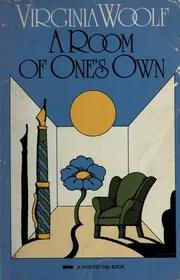
A Room of One's Own
by Virginia Woolf · 1929
Suits mature teens and adults, especially readers interested in literature, history and feminism.
143 pages, about 2.5 to 3.5 hours.
Woolf's short, sharp case for money, space and women's writing. 57% taste match
The story
Virginia Woolf's A Room of One's Own is an extended essay that first appeared in 1929. It grew out of two lectures she gave in October 1928 at Newnham College and Girton College, the women's colleges of Cambridge University, and it runs to six chapters. Though it draws on a fictional narrator and a narrative frame, it is classed as non-fiction.
The essay takes up the subject of women and fiction, looking at women both as authors and as figures within novels. It considers the economic conditions that shape a writer's life and argues for a physical and a figurative place for women who write, within a literary tradition long governed by men. Often read as a work of feminist theory, it touches on history, authorship and literature in Britain. The book opens by addressing the question of what a room of one's own has to do with the topic. A typical edition runs about 143 pages.
But, you may say, we asked you to speak about women and fiction—what has that got to do with a room of one’s own?
Setting
Grande-BretagneGreat BritainEngland
Themes
AuthorshipEconomic conditionsFeminismFeminist theoryFemmesFemmes dans la littératureFemmes écrivainsHistoire
- Want to read 684
- Reading now 39
- Read 57
Most people shelving it are saving it for later.
Of 780 readers who put it on a shelf, 88% want to read it, 5% are reading it now, 7% have finished it and 0% stopped before the end.
By the numbers
- The median edition runs 143 pages. Counting about 275 words a page and an adult reading pace of 250 words a minute, that is about 2.6 hours of reading.
- Open Library tracks 303 editions from 114 publishers, the earliest dated 1929 and the latest 2025, across 14 languages.
- On reader demand it ranks in the top 1% of the classic books in our catalog (8,749 of them).
- Libraries shelve it under Dewey 823.912 and Library of Congress class PN-0471.00000000 W65 1959.
 BookWard’s take
Woolf's short, sharp case for money, space and women's writing
At 143 pages, A Room of One's Own is short, and it earns that economy. Woolf wraps her argument in a fictional narrator, and the voice is unmistakable: a distinct, wandering, ironic mind rather than a lecturer at a podium. It is driven by ideas more than by story, and the case is built as much through imagined scenes and wit as through evidence, so it persuades more by charm than by proof. The prose is fluid and lightly ornate, and the humor is dry. The opening is gentle, asking simply what a room has to do with women and fiction. It lasts well, and its politics are never hidden: they sit at the center of the whole thing.
At 143 pages it is compact, which fits BookWard's love of tight books.
The essay moves briskly through six chapters but lingers in reflective digressions.
A fictional narrator inside a nonfiction essay was a fresh form for its time and still feels so.
The sentences are flowing and lightly ornate, more lyrical than plain.
There is little plot; the narrator's thinking carries the book.
It sees real obstacles but argues for a space where women's writing can thrive.
Six chapters framed by a fictional narrator make it a hybrid, more inventive than a standard essay.
Irony and dry asides run through a serious argument.
The subject is serious but the tone is not grim.
It carries quiet indignation under a controlled surface.
See all 50 dialsEvery position, side by side with this book
Where it lines up
- SentimentBookWard 8 · book 8
- Shock for effectBookWard 9 · book 9
- Sagging middleBookWard 8 · book 8
Where it pulls apart
- OpeningBookWard 10 · book 6
- Story or ideasBookWard 3 · book 9
- Character depthBookWard 8 · book 3
At 143 pages it is compact, which fits BookWard's love of tight books.
It opens by asking what a room has to do with women and fiction, intriguing but unhurried.
Woolf frames the argument through a fictional narrator, avoiding the usual lecture or manifesto template.
The argument builds step by step from economic conditions to creative freedom, and it holds together.
The essay moves briskly through six chapters but lingers in reflective digressions.
A fictional narrator inside a nonfiction essay was a fresh form for its time and still feels so.
The narrator is a vivid presence, but this is an essay, not a gallery of deeply drawn people.
It builds toward a clear closing argument for women writers rather than leaving the question open.
Woolf argues with wit and edge, not with tearful appeals.
It persuades through reasoning and irony, never through shock for effect.
The case draws on history and economic conditions but travels through imagined scenes more than citation.
Woolf's narrator is unmistakable: wry, searching and entirely her own, which BookWard prizes.
The book is built around an argument about women and fiction, not around plot.
Ideas are stated and argued outright, though a narrative frame softens the telling.
At this length the argument stays focused and does not sag.
The sentences are flowing and lightly ornate, more lyrical than plain.
There is little plot; the narrator's thinking carries the book.
It sees real obstacles but argues for a space where women's writing can thrive.
Six chapters framed by a fictional narrator make it a hybrid, more inventive than a standard essay.
Irony and dry asides run through a serious argument.
The prose is clear but dense with allusion and shifting ideas, so it rewards close reading.
One narrator guides the whole essay.
It moves through history but follows a mostly linear line of argument.
It is grounded in real history, institutions and economic conditions.
The cast is essentially the narrator and the writers she considers.
It ranges across literary history but stays an intimate meditation.
Reflection and argument dominate over external action.
It is told through the narrator's thinking, with little exchanged speech.
Romance is not a concern of the book.
The Cambridge and English settings are specific but easy to follow.
Written in 1929, it speaks from a past era.
Its argument about money and space for writers still speaks to readers today.
The narrator is fictional but guides the argument openly and consistently.
Woolf argues a clear position about women, money and writing.
Scenes of imagined settings are drawn with vivid, atmospheric detail.
It blends storytelling and argument, leaning slightly toward the analytical.
The narrator's voice and viewpoint are close and personal.
It stands alone.
The argument develops but there are no plot twists.
It challenges assumptions about gender, literature and economics.
The subject is serious but the tone is not grim.
It carries quiet indignation under a controlled surface.
The wit is dry and ironic, not broad.
There is no violence on the page.
Sexual content is not a feature.
A feminist argument about women's place in literature is the whole point.
The language is plain enough, though the sentences are long and rich.
The narrator argues a strong, openly held position.
It looks ahead to a future where women write freely.
It holds out hope that women can claim their place in literature.
Review written by BookWard, dial version 1, November 2026.
Who is A Room of One's Own right for?
Suits mature teens and adults, especially readers interested in literature, history and feminism. It is demanding in its allusions but contains no graphic content.
The prose is clear but dense with allusion and shifting ideas, so it rewards close reading.
The subject is serious but the tone is not grim.
It carries quiet indignation under a controlled surface.
There is no violence on the page.
Book CompanionA Room of One's Own: ideas, characters, themes
A woman needs money and a space of her own to write, and history explains why so few have.
- A lecture reshaped. The essay grew from two 1928 lectures at Newnham and Girton colleges, Cambridge, and runs to six chapters.
- Fiction inside fact. Woolf uses a fictional narrator and narrative frame, yet the work is classed as non-fiction.
- Women as writers and subjects. It looks at women both as authors of fiction and as characters within it.
- Economics matter. The book considers how economic conditions shape a writer's life and work.
- Literal and figurative space. It argues for both a physical room and a place within a male-dominated literary tradition.
Themes
The money and security a writer needs to work.
A physical and figurative place within literature.
A tradition shaped and dominated by men.
How women appear as characters and as authors.
What conditions allow a writer to create.
Discussion questions
- Why does Woolf use a fictional narrator in a work classed as non-fiction?
- How do money and space shape who gets to write?
- What does the room stand for, literally and figuratively?
- How well does the argument hold up today?
- What does the essay suggest about how women appear in fiction?
Personalize your Book Companion
This is the general edition. In BookWard, the Companion is written for you: your reading profile, your notes, and spoiler-safe to the page you are on.
Buy, listen or borrow A Room of One's Own
Each link opens a search for this book on that store, in a new tab.
Read on a device
Borrow
Reviews and community
If you liked A Room of One's Own
A short, sharp case against turning everything into a show
The Death and Life of Great American CitiesJane JacobsA sharp, readable attack on how cities got planned
The botany of desireMichael PollanA plant's-eye view of us, one apple at a time
Black in BluesImani PerryA meditation on Blackness, told through one color
Sources: Open Library.
Track A Room of One's Own and find your next favorite
Add it to your shelf, rate what you have read, and BookWard will recommend what fits you.
Free to start. No credit card needed.