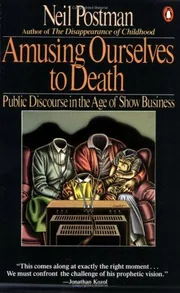
Amusing Ourselves to Death
by Neil Postman, Neil Postman · 1985
Suits adult and older teen readers interested in media, politics and culture.
195 pages, about 3 to 4.5 hours.
A short, sharp case against turning everything into a show. 54% taste match
What it covers
Amusing Ourselves to Death, first published in 1985, is a work of nonfiction by Neil Postman, an American sociologist and scholar of mass media. Its subtitle is Public Discourse in the Age of Show Business. The book sits within history and politics, drawing on sociology and the study of television broadcasting and its social aspects.
Postman examines how television has shaped American culture and the way the country talks about public matters. He considers what happens to politics, journalism, education and religion when entertainment sets the terms, and he also points toward ways of taking back control of the media so that they serve worthwhile ends. The book opens with a reflection on the cities that have each stood at the center of the American spirit at different moments in the nation's past. His son Andrew issued a twentieth anniversary edition in 2005. At around 195 pages, it has appeared in 18 editions.
At different times in our history, different cities have been the focal point of a radiating American spirit.
Characters
Neil Postman
Setting
United States
Themes
Mass mediaInfluenceTelevision broadcastingSocial aspectsPerforming ArtsSociologyCulturele invloedenTelevisie
- Want to read 276
- Reading now 10
- Read 37
Most people shelving it are saving it for later.
Of 323 readers who put it on a shelf, 85% want to read it, 3% are reading it now, 11% have finished it and 0% stopped before the end.
By the numbers
- The median edition runs 195 pages. Counting about 275 words a page and an adult reading pace of 250 words a minute, that is about 3.6 hours of reading.
- Open Library tracks 18 editions from 16 publishers, the earliest dated 1985 and the latest 2015, across 4 languages.
- On reader demand it ranks in the top 3% of the modern books in our catalog (15,152 of them).
- Libraries shelve it under Dewey 302.234 and Library of Congress class P--0094.00000000.P63 1985.
 BookWard’s take
A short, sharp case against turning everything into a show
Postman's argument is that the medium shapes what can be said, and that television turns public talk into entertainment. At 195 pages, the length suits the material well, and the case is built tightly enough that it never sags. Where it divides readers is rigor: the reasoning is consistent and the examples are well chosen, yet this is a polemic written in a strong, distinctive voice, not a data-heavy study. It is driven by ideas more than by story, and its narration never pretends to be neutral. Written in 1985, it still reads as pointed and timeless. I would trade a little rigor for the clarity and bite on offer here.
At 195 pages it makes its whole case without padding, which BookWard rewards.
The chapters move steadily, though it is an argument to follow, not a plot that propels you.
Framing television as a force that reshapes how a culture reasons was a distinctive angle in 1985.
The writing is clear and plain, with occasional flourishes but little ornament.
There is no plot or cast, so this dial does not apply.
The diagnosis is gloomy, though it does point toward taking back control of the media.
It follows a conventional essayistic path from historical background to present-day critique.
The tone is serious, with only dry asides.
The subject is serious but the content is not graphic.
The tone is analytical, with little emotional intensity.
See all 50 dialsEvery position, side by side with this book
Where it lines up
- Authorial voiceBookWard 9 · book 9
- Sagging middleBookWard 8 · book 8
- LengthBookWard 1 · book 2
Where it pulls apart
- Story or ideasBookWard 3 · book 10
- ExpositionBookWard 2 · book 9
- OpeningBookWard 10 · book 6
At 195 pages it makes its whole case without padding, which BookWard rewards.
It opens with a measured reflection on American cities, which builds interest more than it grabs the reader at once.
Its central claim about media and discourse is argued fresh, not through stock arguments.
The argument moves step by step from how a medium shapes thought to what that does to public life.
The chapters move steadily, though it is an argument to follow, not a plot that propels you.
Framing television as a force that reshapes how a culture reasons was a distinctive angle in 1985.
This is an essay on culture, so there are no characters to draw.
The tone is cool and analytical, with little nostalgia or emotional appeal.
Its force comes from argument and observation, not from provocative effect for its own sake.
The reasoning is careful and well sourced in places, but it remains a polemic more than an empirical study.
Postman's confident, pointed style is unmistakable and carries the book.
The book is built entirely on an argument about media and public discourse.
Ideas are stated and explained outright, as an essay of this kind requires.
A compact argument held together from first chapter to last, with little drift.
The writing is clear and plain, with occasional flourishes but little ornament.
There is no plot or cast, so this dial does not apply.
The diagnosis is gloomy, though it does point toward taking back control of the media.
It follows a conventional essayistic path from historical background to present-day critique.
The tone is serious, with only dry asides.
Accessible in length and style, though the argument asks for sustained attention.
It is argued from one authorial perspective.
It moves from earlier eras of print culture toward the television age in a broadly linear way.
It deals entirely with the real world of media and politics.
There is no cast beyond the author's own argument.
It takes in a whole national culture and its public life, a broad canvas for a short book.
It concerns institutions and public behavior more than inner life.
As an essay, it has essentially no dialogue.
Romance plays no part.
It examines the familiar world of American television and politics.
Published in 1985, it is a few decades old but speaks directly to the present.
Its questions about entertainment and public discourse stay relevant long after publication.
The author argues in his own voice, openly and without trickery.
Postman takes a clear stance on what entertainment does to serious public talk.
Description serves the argument and is used sparingly.
It reads as sustained analysis and argument, with illustrations along the way.
It is a scholar's assessment of a culture, with the author's own stance clearly felt.
A standalone work.
An argument unfolds more than it surprises.
It asks readers to question their own media habits, which is uncomfortable.
The subject is serious but the content is not graphic.
The tone is analytical, with little emotional intensity.
Any humor is dry and incidental.
There is no violence on the page.
No sexual content.
Politics and public discourse are central to the argument.
The language is plain and readable for general readers.
Postman argues a strong, openly held position throughout.
Its warnings concern where media culture may lead, but its analysis rests on history.
It wants the media to serve higher ends but is not naive about the trend.
Review written by BookWard, dial version 1, November 2026.
Who is Amusing Ourselves to Death right for?
Suits adult and older teen readers interested in media, politics and culture. Nothing in it is graphic or sensitive.
Accessible in length and style, though the argument asks for sustained attention.
The subject is serious but the content is not graphic.
The tone is analytical, with little emotional intensity.
There is no violence on the page.
Book CompanionAmusing Ourselves to Death: ideas, characters, themes
When public life is shaped by the demands of entertainment, serious discourse in politics, news, education and religion suffers.
- The medium shapes the message. How information is delivered influences what kinds of ideas can be expressed and taken seriously.
- Television and public talk. Postman examines how television has changed the way America discusses public matters.
- Entertainment as the standard. Politics, journalism, education and religion each bend toward the demands of entertainment.
- Cities and the American spirit. The book opens by noting that different cities have, at different times, been the focal point of the American spirit.
- Regaining control. The book offers a way to take back control of the media so that they serve worthwhile ends.
Themes
How the form of communication shapes what people can think and say.
The pull of amusement over serious engagement.
The quality of civic conversation in politics and news.
How older institutions adapt, and suffer, under the rules of show business.
Discussion questions
- Do you agree that the medium shapes what can be said? Where do you see it in daily life?
- How has the media landscape changed since 1985, and does the argument still hold?
- Which of politics, journalism, education or religion seems most affected by entertainment?
- Is the author too pessimistic about television, or is the warning justified?
- What practical steps could a reader take to regain control of their own media habits?
Personalize your Book Companion
This is the general edition. In BookWard, the Companion is written for you: your reading profile, your notes, and spoiler-safe to the page you are on.
Buy, listen or borrow Amusing Ourselves to Death
Each link opens a search for this book on that store, in a new tab.
Read on a device
Borrow
Reviews and community
If you liked Amusing Ourselves to Death
A short, sharp study of why people surrender to causes
Le mythe de SisypheAlbert CamusCamus asks if life is worth living, then answers
The Death and Life of Great American CitiesJane JacobsA sharp, readable attack on how cities got planned
InfluenceRobert B. CialdiniSix levers of persuasion, laid out with evidence and field work
Sources: Open Library.
Track Amusing Ourselves to Death and find your next favorite
Add it to your shelf, rate what you have read, and BookWard will recommend what fits you.
Free to start. No credit card needed.