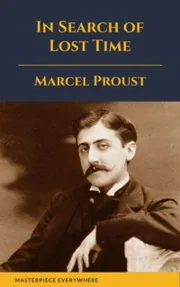
À la recherche du temps perdu
by Marcel Proust · 1919
This suits mature, patient readers comfortable with dense, reflective prose.
550 pages, about 8.5 to 13 hours.
Memory as a whole world, built one long sentence at a time. 42% taste match
The story
À la recherche du temps perdu is a French novel by Marcel Proust, who lived from 1871 to 1922. It was written between 1906 and 1922 and issued in seven volumes from 1913 to 1927, with the last three appearing after the author's death. The first volume, Swann's Way, came out in 1913, and it contains the section known as Swann in Love. The work is set in France and moves through the social life and customs of the 19th and 20th centuries, including village life and the manners of the society around it.
Rather than following a fixed run of events, the novel turns to reflection on literature, memory and time. Its narrator, who is also its central figure, passes through many experiences, and in the final volume he finds a meaning for life in art and literature. Editions in English translation exist alongside the French original, and a typical edition runs to about 550 pages. Some are fitted with indexes. It is often counted among the classics of French literature.
Yellow screen. Sound of a garden gate bell.
Setting
France
Period
19th century20th century
Themes
Social life and customsVillagesFrench literatureFranceObsessive-compulsive disorderSocial conditionsLiteratureReaders
- Want to read 277
- Reading now 18
- Read 26
Most people shelving it are saving it for later.
Of 321 readers who put it on a shelf, 86% want to read it, 6% are reading it now, 8% have finished it and 0% stopped before the end.
By the numbers
- The median edition runs 550 pages. Counting about 275 words a page and an adult reading pace of 250 words a minute, that is about 10 hours of reading.
- Open Library tracks 81 editions from 31 publishers, the earliest dated 1919 and the latest 2024, across 6 languages.
- On reader demand it ranks in the top 4% of the classic books in our catalog (8,749 of them).
- Libraries shelve it under Dewey 843.912 and Library of Congress class PQ-2631.00000000.R63 A7 1987b.
 BookWard’s take
Memory as a whole world, built one long sentence at a time
Proust's seven-volume sequence is the opposite of a tight, fast book, and it makes no apology for that. It is enormously long, and it moves at the speed of reflection rather than event. There is no hook at the start; the work builds slowly from its first volume, Swann's Way. What it offers instead is originality and a voice at full strength: a narrator who is also the central figure, turning memory, literature and time into the real subject. It is driven by ideas more than by story, and the prose is ornate where I tend to prefer plainer writing. The payoff is a sustained arc that does resolve, with the final volume finding life's meaning in art. A demanding classic that rewards patience, not a quick read.
Seven volumes make this among the longest novels ever written, far from BookWard's love of tight, short books.
It moves at the speed of thought and memory, much slower than the brisk pace BookWard prefers.
A novel built around memory, literature and time, not a sequence of events, is distinctive in a way BookWard rewards.
Long, layered, ornate sentences define the experience, more elaborate than the plainer prose BookWard leans toward.
Character and consciousness drive the work, with plot taking a back seat, in line with BookWard's lean toward character.
The narrator's discovery of meaning in art gives the whole work a quietly hopeful turn despite its melancholy.
A single narrator's reflections linked across seven volumes is ambitious, though still anchored in one voice and life.
It is a serious, reflective work, with wit in its social observation but no comic tone at its heart.
Its tone is reflective and melancholy more than dark, with social observation and psychological probing.
Feeling runs deep but is explored through analysis, so its intensity is steady more than explosive.
See all 50 dialsEvery position, side by side with this book
Where it lines up
- EndingBookWard 8 · book 8
- Shock for effectBookWard 9 · book 9
- Familiar tropesBookWard 10 · book 9
Where it pulls apart
- LengthBookWard 1 · book 10
- OpeningBookWard 10 · book 2
- PaceBookWard 8 · book 2
Seven volumes make this among the longest novels ever written, far from BookWard's love of tight, short books.
It opens slowly, building through reflection, which is the opposite of BookWard's taste for a book that grabs at once.
Its psychological and reflective approach avoids stock tropes entirely, which BookWard values highly.
The scattered reflections are bound into one coherent design that pays off in the final volume, a pattern BookWard admires.
It moves at the speed of thought and memory, much slower than the brisk pace BookWard prefers.
A novel built around memory, literature and time, not a sequence of events, is distinctive in a way BookWard rewards.
The narrator and the society around him are drawn through relentless inner observation, matching BookWard's taste for deep characters.
The final volume resolves the whole work by locating life's meaning in art and literature, which suits BookWard's liking for resolution.
Memory and longing run through it, but the analysis keeps feeling examined and not simply indulged.
It earns its seriousness through reflection, not through shock for effect, which BookWard respects.
This is a novel, not a work of fact, so rigor does not apply; the reflection is psychological, not evidential.
Proust's narrating mind is unmistakable and wholly his own, the kind of voice BookWard prizes.
The work is concerned less with a fixed run of events than with ideas about memory and time, leaning idea-led.
The narrator reflects and explains at length instead of simply dramatizing, far from BookWard's preference for showing in scene.
Over seven volumes some stretches drift, though the larger design holds together toward its final revelation.
Long, layered, ornate sentences define the experience, more elaborate than the plainer prose BookWard leans toward.
Character and consciousness drive the work, with plot taking a back seat, in line with BookWard's lean toward character.
The narrator's discovery of meaning in art gives the whole work a quietly hopeful turn despite its melancholy.
A single narrator's reflections linked across seven volumes is ambitious, though still anchored in one voice and life.
It is a serious, reflective work, with wit in its social observation but no comic tone at its heart.
Its length, its density and its slow reflective method make it among the most demanding reads, beyond BookWard's easier comfort zone.
Everything is filtered through one narrator who is also the central figure, a single viewpoint throughout.
Memory drives the narration, so time loops, drifts and recovers the past, moving far from a straight line.
It is firmly grounded in social life, villages and the manners of a real France.
Across seven volumes and a whole society, the cast of people moving through the narrator's life is very large.
It stays close to one consciousness yet spans a whole society and decades, giving it wide breadth.
Almost everything happens inside the narrator's thoughts and memories, with little outward action.
Reflection and narration carry the book, with conversation present in its social scenes but not dominant.
Love is a recurring concern, notably in the section known as Swann in Love, though the book is not a romance.
The French society it depicts is a past world, though it is rendered with enough familiarity to feel recognizable.
It is set in the 19th and early 20th centuries, a long way from the present day.
Often counted among the great works of literature, it has lasted well beyond its moment of publication.
The narrator is also the hero, and his account is a sincere, reflective one, mostly reliable though shaped by memory.
It explores human behavior and feeling with nuance, avoiding simple verdicts on right and wrong.
Rich, sustained attention to places, people and sensations runs through the whole work.
This is fiction, so the nonfiction style dial does not apply.
A narrator speaking from inside his own experience gives it a deeply personal perspective.
It is a single novel published across seven volumes, so it reads as one long sequence, not a standalone.
It is built on reflection and recognition, not on plot surprises.
It asks a great deal of the reader in patience and attention, offering challenge more than comfort.
Its tone is reflective and melancholy more than dark, with social observation and psychological probing.
Feeling runs deep but is explored through analysis, so its intensity is steady more than explosive.
Where wit appears it is dry and observational, aimed at manners and social life.
This is a book of consciousness and society, with almost no violence on the page.
Love and desire are part of the narrator's experience, but the focus stays psychological, not explicit.
Social life and customs are a backdrop more than a political argument.
Long, dense sentences and a formal literary French make the language demanding even in translation.
A narrator who reflects, judges and philosophizes constantly makes the narration highly opinionated.
The whole work turns toward the past, searching for lost time through memory.
It ends by finding meaning in art and literature, a quietly idealistic conclusion.
Review written by BookWard, dial version 1, November 2026.
Who is À la recherche du temps perdu right for?
This suits mature, patient readers comfortable with dense, reflective prose. Its themes of love and desire are handled psychologically, with little graphic content.
Its length, its density and its slow reflective method make it among the most demanding reads, beyond BookWard's easier comfort zone.
Its tone is reflective and melancholy more than dark, with social observation and psychological probing.
Feeling runs deep but is explored through analysis, so its intensity is steady more than explosive.
This is a book of consciousness and society, with almost no violence on the page.
Book CompanionÀ la recherche du temps perdu: ideas, characters, themes
Through a narrator's wandering memories and experiences, the novel arrives at the idea that life finds its meaning in art and literature.
- Memory over events. The work turns away from a fixed run of events toward reflection on memory and time.
- A narrator who is also the hero. The central figure narrates his own life, so the book is shaped by one consciousness.
- Seven volumes. It was issued from 1913 to 1927, with the last three volumes appearing after Proust's death.
- Swann's Way and Swann in Love. The first volume, published in 1913, contains the section known as Swann in Love.
- Meaning found in art. Across positive and negative experiences, the narrator discovers in the final volume that art and literature give life its sense.
Characters
The narrator
Narrator and central figure
He tells his own story and, through his many experiences, comes to find meaning in art and literature.
Swann
Figure in the first volume
He is at the center of the section known as Swann in Love, within Swann's Way.
Themes
How the past is held, recovered and reshaped by the mind.
How lost years are searched for and given meaning.
The place where the narrator finally finds life's meaning.
The manners and habits of the society the narrator moves through.
The desires and attachments explored in sections like Swann in Love.
Discussion questions
- Why might a novel choose reflection on memory over a fixed sequence of events?
- How does it change a story when the narrator is also its central figure?
- What does it mean to find life's meaning in art and literature?
- How does the length of the work shape the way you read it?
- Which moment of memory in your own life feels most like a lost time worth searching for?
Personalize your Book Companion
This is the general edition. In BookWard, the Companion is written for you: your reading profile, your notes, and spoiler-safe to the page you are on.
Buy, listen or borrow À la recherche du temps perdu
Each link opens a search for this book on that store, in a new tab.
Read on a device
Borrow
Reviews and community
If you liked À la recherche du temps perdu
Cromwell's rise, told close and cool, in present tense
El amor en los tiempos del cóleraGabriel García MárquezA fifty-year wait for love, told with wit and tenderness
The Seven Storey MountainThomas MertonA restless young man's road from the world to a Trappist monastery
The AmbassadorsHenry JamesA slow, brilliant study of one man's second sight in Paris
Sources: Open Library.
Track À la recherche du temps perdu and find your next favorite
Add it to your shelf, rate what you have read, and BookWard will recommend what fits you.
Free to start. No credit card needed.