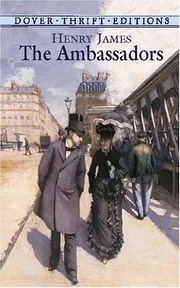
The Ambassadors
by Henry James · 1903
Best for mature readers comfortable with dense, slow, reflective fiction; it is a classic often met in advanced school or university study.
440 pages, about 7 to 10.5 hours.
A slow, brilliant study of one man's second sight in Paris. 50% taste match
The story
The Ambassadors is a novel by Henry James, first published in 1903. It belongs to the tradition of American fiction set among Americans abroad, and it is told in the third person from the point of view of its central figure, Lambert Strether, a man of later middle age. The book works as a psychological study as much as a romance, and its tone has been described as a dark comedy.
Strether travels to Paris on behalf of Mrs. Newsome, a widow from Woollett, Massachusetts, who is engaged to him. Her son Chad has settled in the French capital, and she wants him back to take charge of the family business. Strether's task is to bring him home. In Paris he meets Madame de Vionnet, an older woman of rank who has a close hold on Chad's attention, and Sarah Pocock is also sent to press the case for his return. As the days pass, Strether finds himself drawn to the city and its way of life, and his errand grows harder to complete. The story follows the shifting relationships between the young man, the women around him, and the older man sent to fetch him.
STRETHER'S FIRST question, when he reached the hotel, was about his friend; yet on his learning that Waymarsh was apparently not to arrive till evening he was not wholly disconcerted.
Setting
FranceParis (France)ParisVietnam
Period
20th century
Themes
Man-woman relationshipsRomanceAmericansYoung menClassic LiteratureAmbassadors (James, Henry)James, henry, 1843-1916LITERARY CRITICISM
- Want to read 83
- Reading now 4
- Read 5
Most people shelving it are saving it for later.
Of 92 readers who put it on a shelf, 90% want to read it, 4% are reading it now, 5% have finished it and 0% stopped before the end.
By the numbers
- The median edition runs 440 pages. Counting about 275 words a page and an adult reading pace of 250 words a minute, that is about 8.1 hours of reading.
- Open Library tracks 231 editions from 107 publishers, the earliest dated 1903 and the latest 2023, across 4 languages.
- On reader demand it ranks in the top 19% of the classic books in our catalog (8,749 of them).
- Libraries shelve it under Dewey 813.4 and Library of Congress class PS-2116.00000000.A5 Amb12.
 BookWard’s take
A slow, brilliant study of one man's second sight in Paris
The Ambassadors is a book that may not suit every reader's habits, and that gap is the interesting part. It builds slowly, with Strether's errand unfolding by quiet degrees rather than hooking you at once. The pace is that of a mind turning things over, which is a good deal slower than most readers will want. The prose is ornate where plainer lines might be easier to take, and the reading effort is high. Where it connects is in character: Strether is drawn with real patience, and his shifting view of Paris and the people in it is the whole drama. James's voice is unmistakable from the first page. Expect a book you have to settle into, and one that rewards the slowing down.
At 440 pages it is substantial but not sprawling, longer than BookWard's tight ideal yet contained to one man's errand.
Events are few and the action lives in conversation and reflection, far slower than the brisk pace BookWard favors.
Its single-viewpoint psychological focus on a middle-aged man's awakening feels distinctive, even if the premise has precedents.
The sentences are long, qualified and densely layered, well past the plain style BookWard leans toward.
Character drives everything here; the plot is only the occasion for Strether's changing perceptions.
It balances enchantment against disillusion, offering neither plain cheer nor despair.
The structure is conventional, a single continuous narrative with no formal tricks.
Described as a dark comedy, it carries dry wit but stays mostly sober in manner.
Its darkness is emotional and ironic rather than graphic.
Feeling runs deep but beneath a controlled, formal surface.
See all 50 dialsEvery position, side by side with this book
Where it lines up
- SentimentBookWard 8 · book 8
- Shock for effectBookWard 9 · book 9
- OriginalityBookWard 9 · book 8
Where it pulls apart
- OpeningBookWard 10 · book 2
- LengthBookWard 1 · book 6
- PaceBookWard 8 · book 2
At 440 pages it is substantial but not sprawling, longer than BookWard's tight ideal yet contained to one man's errand.
It opens gently and builds its pull through accumulating perception, the opposite of BookWard's love for a hook at once.
Its Americans-in-Paris setup is a known tradition, but James handles it with little reliance on stock moves, which BookWard respects.
Each character's choices follow from their circumstances and temperament, so the social machinery holds together tightly.
Events are few and the action lives in conversation and reflection, far slower than the brisk pace BookWard favors.
Its single-viewpoint psychological focus on a middle-aged man's awakening feels distinctive, even if the premise has precedents.
Strether is drawn with exceptional patience and nuance, exactly the deep characterization BookWard values most.
The central question reaches a clear conclusion, though shaded with irony, so it resolves without tying everything neatly.
Feeling is held in check by irony and indirection, which suits BookWard's preference for restraint.
There is no gratuitous darkness; whatever pain arrives is earned through character and consequence.
James's voice is instantly recognizable and unlike anyone else's, a clear strength by BookWard's measure.
It leans to story through character, though the real engine is Strether's shifting understanding, so ideas and plot share the load.
Meaning is mostly dramatized in scenes and talk, though the narration does comment on Strether's thinking at length.
The slow tempo is steady, but the repeated rounds of conversation can feel circular to a reader wanting momentum.
The sentences are long, qualified and densely layered, well past the plain style BookWard leans toward.
Character drives everything here; the plot is only the occasion for Strether's changing perceptions.
It balances enchantment against disillusion, offering neither plain cheer nor despair.
The structure is conventional, a single continuous narrative with no formal tricks.
Described as a dark comedy, it carries dry wit but stays mostly sober in manner.
The dense syntax and subtlety make this a demanding read that asks for patience BookWard may find a stretch.
Told in third person from Strether's point of view alone, so the lens never shifts.
Events proceed in order as Strether's stay in Paris unfolds.
Entirely grounded in a realistic, social world.
A handful of central figures carry the book, keeping the circle compact.
The stakes are personal and domestic, a family business and a few relationships.
Nearly everything happens inside Strether's mind, with outward events serving his reflections.
Conversation carries much of the drama, though it is often oblique and heavily interpreted.
Attachments between Chad and Madame de Vionnet matter, but the book is about Strether's perception of them.
Paris and Woollett are rendered as social worlds that may feel foreign to a modern reader.
A turn-of-the-century setting that is firmly past, with manners to match.
Its questions about living fully and regret endure well beyond its period.
The narration stays close to Strether and is fairly dependable, though his own understanding is partial and changing.
Right and wrong are deliberately tangled, and Strether's loyalties pull in opposing directions.
Paris and its interiors are evoked with care, but description serves Strether's impressions more than scenery.
A standalone novel.
Revelations arrive quietly and are more about understanding than shock.
It unsettles easy judgments about duty and pleasure, asking more than it comforts.
Its darkness is emotional and ironic rather than graphic.
Feeling runs deep but beneath a controlled, formal surface.
Humor is dry and ironic, never broad.
Essentially none on the page.
Intimacy is implied and handled with great discretion.
Social and cultural contrasts matter, but politics proper stays in the background.
The convoluted, highly qualified sentences make the language dense going.
The narration is mostly neutral, closely tracking Strether without pushing a verdict.
It dwells on regret and missed living, looking back more than forward.
Strether's romantic hopes meet worldly reality, landing between idealism and cynicism.
Review written by BookWard, dial version 1, November 2026.
Who is The Ambassadors right for?
Best for mature readers comfortable with dense, slow, reflective fiction; it is a classic often met in advanced school or university study. Nothing graphic, though its adult relationships are treated with discretion.
The dense syntax and subtlety make this a demanding read that asks for patience BookWard may find a stretch.
Its darkness is emotional and ironic rather than graphic.
Feeling runs deep but beneath a controlled, formal surface.
Essentially none on the page.
Book CompanionThe Ambassadors: ideas, characters, themes
A middle-aged man sent to retrieve a young one finds his own idea of how to live being quietly overturned.
- The errand. Strether is sent from Massachusetts to Paris to bring Chad Newsome home to the family business.
- What is at stake for him. Mrs. Newsome has promised to marry Strether if he succeeds, which ties his own future to the mission.
- Paris as temptation. The city's charm works on Strether, making his task harder to carry out.
- Madame de Vionnet. An older woman of rank keeps a close hold on Chad's attention and complicates the mission.
- A second envoy. Sarah Pocock is sent too, and her fixed determination contrasts with Strether's wavering.
Characters
Lambert Strether
Protagonist
A man of later middle age sent to Paris, through whose eyes the whole story is told.
Chad Newsome
The young man to be retrieved
Mrs. Newsome's son, settled in Paris and wanted back for the family business.
Madame de Vionnet
Chad's close companion
An older woman of rank with a strong influence on Chad.
Mrs. Newsome
The sender
A widow in Woollett, Massachusetts, engaged to Strether and eager to see her son return.
Sarah Pocock
Second envoy
Sent to press for Chad's return, and well aware of Paris's attractions.
Themes
Strether's obligation to complete his mission pulls against his growing love of Paris.
What Strether sees, and how his view of the people changes, drives the book.
European refinement is set against American practicality and propriety.
Strether confronts what he feels he has missed in his own life.
Characters' surfaces and the truth beneath them rarely match.
Discussion questions
- How does Strether's view of Chad change, and what causes it?
- Is Paris in this novel a real place or a state of mind for Strether?
- What does Sarah Pocock represent that Strether cannot?
- Why might James keep us inside Strether's point of view throughout?
- Does the book judge its characters, or leave that to the reader?
Personalize your Book Companion
This is the general edition. In BookWard, the Companion is written for you: your reading profile, your notes, and spoiler-safe to the page you are on.
Buy, listen or borrow The Ambassadors
Each link opens a search for this book on that store, in a new tab.
Read on a device
Borrow
Reviews and community
If you liked The Ambassadors
A matchmaker's comedy that rewards patience and close attention
The Age of InnocenceEdith WhartonA quiet drawing-room tragedy that cuts deeper than it first appears
Narziss und GoldmundHermann HesseTwo opposite men, one friendship, and a debate Hesse refuses to settle
A month in the countryJames Lloyd CarrA short, quiet restoration of a wall painting and a man
Sources: Open Library.
Track The Ambassadors and find your next favorite
Add it to your shelf, rate what you have read, and BookWard will recommend what fits you.
Free to start. No credit card needed.