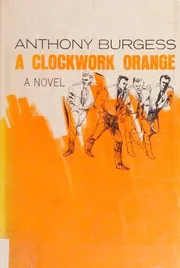
A Clockwork Orange
by Anthony Burgess · 1962
Best suited to mature readers, as it contains graphic violence and sexual assault narrated in a detached, sometimes darkly comic voice.
192 pages, about 3 to 4.5 hours.
A short, savage satire told in a voice you won't forget. 68% taste match
What is inside
Anthony Burgess first published A Clockwork Orange in 1962, and it is a short novel of about 192 pages. A dystopian satire with a streak of black comedy, it imagines a near-future England in which a youth subculture of extreme violence has taken hold. The story is told in the first person by Alex, a teenager who recounts his own brutal escapades, beginning at the Korova Milk Bar.
Alex's life changes when state authorities set out to reform him. The book follows his encounters with figures such as the Prison Chaplain, the Prison Governor, the Minister of the Interior, and the doctors Branom and Brodsky, and it deals with aversion therapy, psychiatric institutions, and the unintended consequences of attempts to change a person. Beethoven's music also plays a part in the story. Much of the text is written in Nadsat, an invented slang shaped by Russian, named after the Russian suffix for "-teen." Burgess described the book as a jeu d'esprit written in three weeks. It has appeared in well over a hundred editions.
'WHAT'S it going to be then, eh?'
Characters
AlexPrison ChaplainPrison GovernorMinister of the InteriorDr. BranomDr. Brodsky
Setting
EnglandKorova Milk Bar
Themes
bibleaversion therapyunintended consequencesBeethoven's Fifth Symphonygang rapepsychiatric hospitalsmaturitymetanoia
- Want to read 1,052
- Reading now 37
- Read 135
- Stopped 1
Most people shelving it are saving it for later.
Of 1225 readers who put it on a shelf, 86% want to read it, 3% are reading it now, 11% have finished it and 0% stopped before the end.
By the numbers
- The median edition runs 192 pages. Counting about 275 words a page and an adult reading pace of 250 words a minute, that is about 3.5 hours of reading.
- Open Library tracks 146 editions from 84 publishers, the earliest dated 1962 and the latest 2023, across 12 languages.
- On reader demand it ranks in the top 1% of the classic books in our catalog (8,749 of them).
- Libraries shelve it under Dewey 823.9 and Library of Congress class PR-6052.00000000.U638C66 1988.
 BookWard’s take
A short, savage satire told in a voice you won't forget
Burgess opens by buttonholing the reader, 'WHAT'S it going to be then, eh?', and never lets up. At 192 pages, A Clockwork Orange is tight, and it hooks at once through Alex, a teenage narrator whose invented slang, Nadsat, gives the book a voice that is unmistakably its own. The opening and the voice are what make it so memorable. It is also strikingly original, since few dystopias sound like this. The cost is effort: the dense slang asks for patience in the first pages, and some readers will find that a hurdle. The violence on the page is heavy, but it serves an argument about aversion therapy and the unintended consequences of reforming a person.
At about 192 pages it is a compact novel, which fits BookWard's love of tight books.
Short and propulsive, it moves from street violence to state reform without lingering, matching BookWard's fast preference.
Nadsat and its brutal comic narrator make it distinctive among dystopias, well above BookWard's high bar.
The language is stylized, inventive and rhythmic, richer than BookWard's usual plain-leaning taste.
Events and Alex's inner life drive it about equally, a balance close to BookWard's character lean.
It leans bleak about human nature and institutions, a shade darker than BookWard's hopeful side.
Told straight in first person with a clear arc, though the invented language gives it a formal edge.
Black comedy runs through the narration, a welcome streak against the horror.
Its content is about as dark as fiction gets, well beyond BookWard's middle comfort.
The tone is cold and controlled, though the stakes land hard.
See all 50 dialsEvery position, side by side with this book
Where it lines up
- LengthBookWard 1 · book 1
- OpeningBookWard 10 · book 10
- PaceBookWard 8 · book 8
Where it pulls apart
- Story or ideasBookWard 3 · book 8
- ViewpointsBookWard 7 · book 1
- SentimentBookWard 8 · book 10
At about 192 pages it is a compact novel, which fits BookWard's love of tight books.
It opens by addressing the reader directly in Alex's voice, which suits BookWard's taste for an immediate grip.
Its slang-driven teenage narrator and satirical premise feel far from stock dystopian furniture, which BookWard prizes.
The premise of aversion therapy and its consequences follows through coherently, which BookWard appreciates.
Short and propulsive, it moves from street violence to state reform without lingering, matching BookWard's fast preference.
Nadsat and its brutal comic narrator make it distinctive among dystopias, well above BookWard's high bar.
Alex is vividly drawn from inside, though the supporting figures are sketched more lightly than BookWard prefers.
The story resolves its central question about reform, which BookWard likes in an ending.
It is entirely unsentimental, even cold, which BookWard strongly favors.
The violence is confronting but is central to the book's argument about choice, so it earns its darkness for the most part.
Alex's Nadsat-flecked narration is one of the most recognizable voices in fiction, a big plus for BookWard.
Story and ideas about free will and state control are woven together, with the ideas pressing hard.
Ideas surface through scenes and Alex's own account, with little outright explaining, as BookWard likes.
At this length it stays taut with no real slack in the middle.
The language is stylized, inventive and rhythmic, richer than BookWard's usual plain-leaning taste.
Events and Alex's inner life drive it about equally, a balance close to BookWard's character lean.
It leans bleak about human nature and institutions, a shade darker than BookWard's hopeful side.
Told straight in first person with a clear arc, though the invented language gives it a formal edge.
Black comedy runs through the narration, a welcome streak against the horror.
Nadsat takes a few pages to decode, so it is more demanding than BookWard usually likes.
Everything is filtered through Alex alone.
The story moves forward in a straight line.
It is a near-future England, recognizable and grounded rather than fantastical.
The focus stays on Alex and a handful of authority figures, a small cast.
The story stays close to one young man's experience, intimate despite its social critique.
Violent action and Alex's thoughts both matter, tilting slightly toward outward events.
Conversation and narration share the load, with lively exchanges in slang.
Romance is essentially absent from the story.
The invented slang and bleak near-future England feel strange, which BookWard enjoys.
Set in a 1960s-imagined near future, it reads as a past vision of tomorrow.
Its questions about free will and state power keep it vital, a long-lasting quality BookWard values.
Alex tells his own story, and his relish for violence makes him a narrator you cannot fully trust.
It refuses easy answers about reform, punishment and choice, which suits BookWard's appetite for ambiguity.
Description is economical and often filtered through slang rather than lavish.
It stands entirely on its own.
Reversals come, but the book is driven more by situation than surprise.
It is deliberately confrontational, pushing readers to question their comfort, in line with BookWard's taste.
Its content is about as dark as fiction gets, well beyond BookWard's middle comfort.
The tone is cold and controlled, though the stakes land hard.
The humor is dry, sardonic and ironic rather than broad.
Extreme violence is on the page throughout and is central to the book.
Sexual violence is part of the story, so the content is substantial.
It is a pointed critique of state power and social engineering, so politics are prominent.
Dense invented slang makes the language difficult at first, far beyond plain.
Alex's strong, self-regarding voice dominates, so the narration is very opinionated.
It is a warning about where society may be heading, though anchored in its own era.
The worldview is skeptical and sharp-edged, wary of easy salvation.
Review written by BookWard, dial version 1, November 2026.
Who is A Clockwork Orange right for?
Best suited to mature readers, as it contains graphic violence and sexual assault narrated in a detached, sometimes darkly comic voice. Readers should be prepared for disturbing content throughout.
Nadsat takes a few pages to decode, so it is more demanding than BookWard usually likes.
Its content is about as dark as fiction gets, well beyond BookWard's middle comfort.
The tone is cold and controlled, though the stakes land hard.
Extreme violence is on the page throughout and is central to the book.
Book CompanionA Clockwork Orange: ideas, characters, themes
Can a person be forced to be good, and is goodness without choice worth anything?
- A narrator who addresses you. Alex tells his story directly to the reader, beginning at the Korova Milk Bar, drawing you into his point of view.
- Nadsat as language. The Russian-influenced slang gives the book its texture and distance, shaping how violence is experienced on the page.
- The state steps in. Authorities set out to reform Alex, turning a story of youth violence into one about institutional power.
- Aversion therapy. The book examines conditioning as a method of change and asks what it costs a person.
- Unintended consequences. Attempts to fix a human being produce effects the reformers did not plan for.
Characters
Alex
Teenage narrator and protagonist
He recounts his own violent exploits and then his encounters with those trying to reform him.
Dim
Member of Alex's circle
One of the figures in Alex's world of street violence.
P.R. Deltoid
Authority figure
One of the officials who appears in Alex's story.
Prison Chaplain
Religious figure in the prison
A voice of moral and spiritual reflection in the story.
Minister of the Interior
State official
Represents the government's interest in reforming offenders.
Themes
Whether choosing evil is more human than being made incapable of it.
How far authorities may go in reshaping individuals for social order.
How a subculture of cruelty arises and how society responds.
How invented slang creates identity, intimacy and distance.
Whether real change comes from within or can be imposed.
Discussion questions
- Does Alex's narration make you complicit, and how does the slang affect that?
- Is a person who cannot choose violence still good?
- What does the book suggest about the state's right to reform offenders?
- How does Nadsat change the way the violence reads?
- Do the consequences of the reform feel like justice, and why?
Personalize your Book Companion
This is the general edition. In BookWard, the Companion is written for you: your reading profile, your notes, and spoiler-safe to the page you are on.
Buy, listen or borrow A Clockwork Orange
Each link opens a search for this book on that store, in a new tab.
Read on a device
Borrow
Reviews and community
If you liked A Clockwork Orange
A strange Kent tideline, and an object that won't hold still
Fight ClubChuck PalahniukA short, savage satire that earns its reputation for bite
Invisible ManRalph EllisonA restless, original classic about identity, race, and being unseen
DispatchesMichael HerrVietnam as one reporter lived it, in prose that burns
Sources: Open Library.
Track A Clockwork Orange and find your next favorite
Add it to your shelf, rate what you have read, and BookWard will recommend what fits you.
Free to start. No credit card needed.