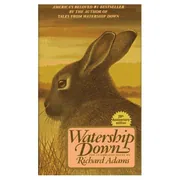
It sits on children's and juvenile shelves but works well for teens and adults who like immersive adventure.
478 pages, about 7.5 to 11 hours.
Rabbits flee a doomed warren in a fully imagined epic. 61% taste match
The story
Watership Down is a fantasy adventure novel by English author Richard Adams, first published in 1972. It is set in Hampshire, in southern England, and centers on a small band of wild rabbits. They live in burrows in their natural surroundings, yet they have their own culture, language, proverbs, poetry, and mythology. The novel follows them as they leave their home at Sandleford Warren, driven out by the threat of human intrusion and the destruction of the warren.
Led by a pair of brothers, Hazel and Fiver, the rabbits travel across the Downs in search of a new place to settle. Along the way they face predators, rival warrens, and temptations, with stops that include Nuthanger Farm and the warren of Efrafa, where General Woundwort holds sway. Bigwig, Captain Holly, Rabscuttle, and the seagull Kehaar also appear. The book is classed as juvenile fiction and children's stories, and it draws on themes of survival, quests, nature, and the effect of human beings on the wild.
I acknowledge with gratitude the help I have received not only from my family but also from my friends Peg Sones and Hal Summers, who read the book before publication and made valuable suggestions.
Setting
Sandleford Warren (England)Watership Down (England)Nuthanger Farm (England)Efrafa (England)
Period
20th century
Themes
RabbitsAdventure and adventurersChildren's storiesSurvivalAdventure storiesNatureEffect of human beings onQuests
- Want to read 563
- Reading now 20
- Read 151
Most people shelving it are saving it for later.
Of 734 readers who put it on a shelf, 77% want to read it, 3% are reading it now, 21% have finished it and 0% stopped before the end.
By the numbers
- The median edition runs 478 pages. Counting about 275 words a page and an adult reading pace of 250 words a minute, that is about 8.8 hours of reading.
- Open Library tracks 108 editions from 85 publishers, the earliest dated 1972 and the latest 2023, across 12 languages.
- On reader demand it ranks in the top 1% of the classic books in our catalog (8,749 of them).
- Libraries shelve it under Dewey [Fic] and Library of Congress class PR-6051.00000000.D345.
 BookWard’s take
Rabbits flee a doomed warren in a fully imagined epic
Watership Down takes a small band of wild rabbits and gives them a language, a mythology and a code, then sends them across the Downs to find a new home. The fantasy here is of a particular kind: the setting is real Hampshire, but the rabbit culture is invented in depth. The originality is striking, since the proverbs, poetry and tales feel built from scratch rather than borrowed. The characters hold up too, because Hazel, Fiver, Bigwig and Holly each carry a distinct way of seeing the world. At 478 pages it runs long, and the opening is gentler than I'd like. Be patient, though, because the pace picks up as trials, rival warrens and General Woundwort's Efrafa press in. It is a book about survival, leadership and what a good society costs.
At 478 pages it is a substantial read for a rabbit adventure, longer than BookWard's taste for tight books.
Flight, pursuit and rival warrens keep things moving, though quieter stretches slow it below BookWard's preferred speed.
Giving wild rabbits their own language, proverbs and myths is a distinctive idea carried through with conviction.
The prose is clear and readable but with a deliberate, storytelling richness, more ornate than BookWard's plain-leaning taste.
Journey events and the rabbits' personalities share the load about evenly.
Danger and loss are real, but the book carries a thread of survival and the promise of a better home.
It follows a conventional quest arc, with inset mythic tales adding some texture.
The tone is mostly serious and earnest, with little comedy.
Predators, a threatened home and the cost of conflict give it real darkness for a children's-shelf book.
Fear, loyalty and loss hit with genuine force.
See all 50 dialsEvery position, side by side with this book
Where it lines up
- OriginalityBookWard 9 · book 9
- Character depthBookWard 8 · book 8
- EndingBookWard 8 · book 8
Where it pulls apart
- LengthBookWard 1 · book 7
- OpeningBookWard 10 · book 6
- Familiar tropesBookWard 10 · book 8
At 478 pages it is a substantial read for a rabbit adventure, longer than BookWard's taste for tight books.
It opens in a settled warren with a sense of unease rather than action, so it builds before it grips.
The quest shape is familiar, but the rabbit culture and mythology keep it from feeling like stock fantasy.
The rabbits' world follows consistent rules of behaviour, danger and custom, which BookWard values highly.
Flight, pursuit and rival warrens keep things moving, though quieter stretches slow it below BookWard's preferred speed.
Giving wild rabbits their own language, proverbs and myths is a distinctive idea carried through with conviction.
Hazel, Fiver, Bigwig and Holly are clearly individuals with different strengths, fears and ways of leading.
The journey reaches a clear resolution about where the rabbits end up, which suits BookWard's taste for closure.
It feels warmly about its rabbits but does not wallow, landing somewhat softer than BookWard's restrained ideal.
The dangers and losses come from the real hazards of the world rather than cheap effect.
This is a novel, so rigor does not apply.
Adams writes with a confident, storyteller's authority that makes the rabbit world feel entirely his own.
Story leads, though ideas about leadership and the societies the rabbits meet run strongly underneath.
Much is shown through the rabbits' actions, with some explaining of their customs and lore along the way.
The travels and encounters keep a steady forward pull, with only occasional lulls in the long middle.
The prose is clear and readable but with a deliberate, storytelling richness, more ornate than BookWard's plain-leaning taste.
Journey events and the rabbits' personalities share the load about evenly.
Danger and loss are real, but the book carries a thread of survival and the promise of a better home.
It follows a conventional quest arc, with inset mythic tales adding some texture.
The tone is mostly serious and earnest, with little comedy.
The story is readable at any age, with a moderate amount of invented vocabulary and lore to absorb.
The narration moves among several rabbits, though the group's shared journey stays central.
Events run in order as the rabbits travel from one place to the next.
The setting is real Hampshire, but the rabbits' speech, culture and mythology make it fantasy.
A sizeable band of rabbits plus rivals, allies and other animals fills the pages.
The stakes are the survival of a community, which feels epic within a small physical landscape.
The book leans toward travel, danger and confrontation more than introspection.
Rabbits talk through plans, disputes and stories often, so conversation carries a good share of the book.
Romance is not a driving force here.
Readers meet a rabbit's-eye view of the Downs, with customs and language that feel unfamiliar.
It was published in 1972 and set in the 20th century, so it reads as a past-leaning rural England.
Its themes of survival, home and leadership have kept it in print for decades as a classic.
The narration is straightforward and trustworthy about what happens.
Right and wrong are fairly clear, though the rival warrens raise real questions about how to live.
The Downs, burrows and weather are drawn in rich, specific detail.
This is fiction, so nonfiction style does not apply.
This is fiction, so perspective as a nonfiction dial does not apply.
It stands as a single complete story.
Dangers and turns arise along the way, but the route is mostly clear.
It asks for some patience and emotional steadiness, yet it is welcoming rather than punishing.
Predators, a threatened home and the cost of conflict give it real darkness for a children's-shelf book.
Fear, loyalty and loss hit with genuine force.
What humor appears is gentle and understated.
Fights and deaths occur and are described plainly, a notable amount for its audience.
Sexual content is minimal.
The contrasting warrens invite questions about governance and power, without being a political tract.
The invented rabbit terms and rural setting add some unfamiliar words, but the language stays accessible.
The narrator tells the story in a measured way, with a gentle point of view showing through.
The rabbits flee a threatened past and a lost home, so the book looks back as much as ahead.
It believes good leadership and loyalty can build a better place, while staying alert to danger.
Review written by BookWard, dial version 1, November 2026.
Who is Watership Down right for?
It sits on children's and juvenile shelves but works well for teens and adults who like immersive adventure. It includes predators, fights and deaths described plainly, which may upset younger or sensitive readers.
The story is readable at any age, with a moderate amount of invented vocabulary and lore to absorb.
Predators, a threatened home and the cost of conflict give it real darkness for a children's-shelf book.
Fear, loyalty and loss hit with genuine force.
Fights and deaths occur and are described plainly, a notable amount for its audience.
Book CompanionWatership Down: ideas, characters, themes
A band of rabbits leaves its doomed warren and journeys across the Downs to found a new home.
- Home under threat. The story begins when human intrusion and the destruction of Sandleford Warren force the rabbits to leave.
- A journey across the Downs. The group travels through open country, facing predators and dangers on the way.
- Rival warrens. Stops such as Efrafa, under General Woundwort, show very different ways a rabbit society can be run.
- A culture of their own. The rabbits have their own language, proverbs, poetry and mythology, including tales of El-ahrairah.
- The search for a better place. The quest is for a promised land and a more perfect society, not just for safety.
Characters
Hazel
Leader of the band
One of the brothers at the head of the group, guiding the rabbits on their journey.
Fiver
Hazel's brother
The other brother leading the way out of Sandleford Warren.
Bigwig
Member of the band
One of the rabbits who travels with the group.
General Woundwort
Ruler of Efrafa
The figure who holds sway over the warren of Efrafa.
Kehaar
A seagull
A seagull character who appears in the story.
Themes
What it takes to stay alive when home and safety are gone.
How different leaders guide, protect or control the group.
The pull of the old warren and the search for a new place to settle.
The effect of human beings on the wild and the creatures who live in it.
How tales and proverbs shape a community's sense of itself.
Discussion questions
- What makes Hazel and Fiver effective as leaders, and how do their strengths differ?
- How do the different warrens the rabbits meet reflect different ways of organising a society?
- Why might Adams give the rabbits their own mythology and language?
- How does the threat from humans shape the rabbits' choices and fears?
- Is the rabbits' final home a true promised land, or a compromise?
Personalize your Book Companion
This is the general edition. In BookWard, the Companion is written for you: your reading profile, your notes, and spoiler-safe to the page you are on.
Buy, listen or borrow Watership Down
Each link opens a search for this book on that store, in a new tab.
Read on a device
Borrow
Reviews and community
If you liked Watership Down
Circe's life told in her own wry, watchful voice
The Devil in the White CityErik LarsonTwo true stories braided together: a fair and a killer
The Plot Against AmericaPhilip RothRoth's alternate 1940s Newark, seen through a frightened child's eyes
JunieErin Crosby EckstineA grieving enslaved girl, a sister's spirit, and a plantation's secrets
Sources: Open Library.
Track Watership Down and find your next favorite
Add it to your shelf, rate what you have read, and BookWard will recommend what fits you.
Free to start. No credit card needed.