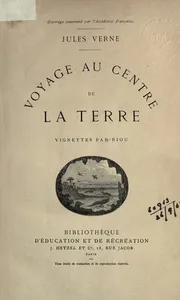
Voyage au Centre de la Terre
by Jules Verne · 1864
This suits younger readers and families, and it is widely issued in juvenile and illustrated formats.
244 pages, about 4 to 5.5 hours.
A bold descent into the earth that still pulls you down. 52% taste match
The story
Voyage au Centre de la Terre is a science fiction adventure by the French author Jules Verne, first published in 1864. It belongs to the tradition of imaginary voyages, following a small party of explorers on a journey into the planet's interior. The novel has been issued in many editions and translations, and it also appears in juvenile and illustrated formats.
The story is set in the 19th century and begins in Germany, where the eccentric scientist Professor Otto Lidenbrock deciphers a coded message left by a 16th century Icelandic alchemist. The message points to a route to the earth's core through the crater of Snæfellsjökull, a volcano in Iceland. Lidenbrock sets out with his nephew Axel and an Icelandic guide named Hans. Their descent brings cave-ins, storms, an underground ocean and prehistoric creatures. Their return to the surface comes by way of an eruption of Stromboli in southern Italy. English-language editions sometimes give the professor's name as Hardwigg. A typical edition runs to roughly 244 pages.
Looking back to all that has occurred to me since that eventful day, I am scarcely able to believe in the reality of my adventures.
Characters
Professor Otto LidenbrockProfessor Hardwigg
Setting
IcelandSnæfelljökull
Period
19th century
Themes
Imaginary VoyagesExplorersCartoons and comicsAdventure and adventurersVoyages and travelsCoreCiencia-ficciónEarth
- Want to read 473
- Reading now 26
- Read 160
Most people shelving it are saving it for later.
Of 659 readers who put it on a shelf, 72% want to read it, 4% are reading it now, 24% have finished it and 0% stopped before the end.
By the numbers
- The median edition runs 244 pages. Counting about 275 words a page and an adult reading pace of 250 words a minute, that is about 4.5 hours of reading.
- Open Library tracks 206 editions from 160 publishers, the earliest dated 1867 and the latest 2022, across 10 languages.
- On reader demand it ranks in the top 1% of the classic books in our catalog (8,749 of them).
- Libraries shelve it under Dewey 448.6421 and Library of Congress class PQ-2469.00000000.V75 E5 1901.
 BookWard’s take
A bold descent into the earth that still pulls you down
Verne sends a small party into an Icelandic volcano and never lets the premise go slack. The opening hooks quickly: a coded message, an eccentric professor, a route to the earth's core. The pace stays brisk and the story barely sags, since every stretch brings a new obstacle, from cave-ins to an underground ocean. The internal logic is carried by Verne's steady scientific reasoning, so the voyage feels worked out rather than improvised. Where it parts ways with my own preferences is in the exposition, which is explained outright, and in the sentiment, which is warmer and more adventurous than restrained. Still, the originality was striking for 1864, and the fantastical journey is built on a grounded, methodical frame. This edition is a graphic one, which trims the length further.
The graphic edition runs a compact 244 pages, close to BookWard's taste for the short and tight.
Each stage of the descent brings a fresh hazard, keeping momentum high, in step with BookWard.
Written in 1864, its premise was striking, though later adventure fiction has made it feel more familiar.
The graphic edition keeps the language plain and direct, a little plainer than BookWard's middle ground.
Events and discoveries lead, with the characters mostly reacting to the next obstacle.
The party perseveres and survives, giving the book a spirited, optimistic outlook.
A straight outbound journey with a conventional shape, close to BookWard's slightly conventional lean.
The tone is mostly earnest adventure, with only mild humor around the eccentric professor.
Danger is present but the tone stays adventurous and gentle enough for young readers.
Feelings run on excitement and tension rather than deep emotional intensity.
See all 50 dialsEvery position, side by side with this book
Where it lines up
- PaceBookWard 8 · book 8
- EndingBookWard 8 · book 8
- Sagging middleBookWard 8 · book 8
Where it pulls apart
- Familiar tropesBookWard 10 · book 6
- ExpositionBookWard 2 · book 8
- Internal logicBookWard 10 · book 7
The graphic edition runs a compact 244 pages, close to BookWard's taste for the short and tight.
A coded message and a mad professor set the expedition in motion almost at once, which BookWard likes.
Many adventure tropes trace back to books like this, though the imaginary-voyage frame is now familiar territory.
The journey follows a stepwise, scientific-minded logic, though some of its geology is a nineteenth-century fantasy.
Each stage of the descent brings a fresh hazard, keeping momentum high, in step with BookWard.
Written in 1864, its premise was striking, though later adventure fiction has made it feel more familiar.
The professor, his nephew and the guide are vivid types more than deeply drawn people, short of BookWard's preference.
The expedition reaches a clear resolution, with the explorers returned to the surface by an eruption.
The tone is hearty adventure with some warmth, a little less restrained than BookWard prefers.
Its dangers arise from the journey itself and feel earned rather than gratuitous.
This is a novel, so the nonfiction rigor dial does not apply.
Verne's confident, explanatory narration is recognizable, though the graphic form dilutes it somewhat.
Story drives the book, but the speculation about the earth's interior is a strong part of the appeal.
Scientific and geographic explanation is delivered outright, which sits far from BookWard's love of scene-based reveals.
New obstacles keep arriving, so the middle holds its energy throughout.
The graphic edition keeps the language plain and direct, a little plainer than BookWard's middle ground.
Events and discoveries lead, with the characters mostly reacting to the next obstacle.
The party perseveres and survives, giving the book a spirited, optimistic outlook.
A straight outbound journey with a conventional shape, close to BookWard's slightly conventional lean.
The tone is mostly earnest adventure, with only mild humor around the eccentric professor.
Accessible, especially in the illustrated juvenile format, and easier than BookWard's middle setting.
The story follows a single point of view, narrower than BookWard likes.
The expedition unfolds in a straightforward sequence with no time shifts.
Prehistoric creatures and an underground ocean make this clearly fantastical, beyond BookWard's mid-range.
Three explorers carry the story, a smaller cast than BookWard's middle position.
A journey to the planet's core feels large, giving it more scope than BookWard's moderate mark.
The book is dominated by action and exploration rather than introspection.
Dialogue appears regularly but the book leans on narration and incident, a bit lighter than BookWard's taste.
The underground landscapes are deeply unfamiliar, which matches what BookWard enjoys.
Set in the nineteenth century and first published in 1864, so it sits firmly in the past.
The sense of wonder at exploration has kept it in print in many editions and formats.
The aims are clear and the explorers are on one side, with little moral ambiguity.
Strange caverns and seas are described vividly, giving it somewhat richer detail than BookWard's midpoint.
This is fiction, so the nonfiction style dial does not apply.
This is fiction, so the nonfiction perspective dial does not apply.
Surprises come from discoveries along the way, though the broad route is easy to follow.
A comforting, adventurous read with little to unsettle the reader, more cozy than BookWard's challenge setting.
Danger is present but the tone stays adventurous and gentle enough for young readers.
Feelings run on excitement and tension rather than deep emotional intensity.
Humor is gentle and mild, tilting toward the dry side of BookWard's taste.
Peril comes from nature and prehistoric animals, with little graphic violence.
There is no sexual content here.
The language is plain, especially in the illustrated edition.
The narration is mostly neutral reporting of the journey with a touch of enthusiasm.
It looks outward toward discovery and the unknown frontier, leaning forward, close to BookWard's slightly forward-looking mark.
A faith in science and exploration gives the book an idealistic streak.
Review written by BookWard, dial version 1, November 2026.
Who is Voyage au Centre de la Terre right for?
This suits younger readers and families, and it is widely issued in juvenile and illustrated formats. It contains peril and creature encounters but little else sensitive.
Accessible, especially in the illustrated juvenile format, and easier than BookWard's middle setting.
Danger is present but the tone stays adventurous and gentle enough for young readers.
Feelings run on excitement and tension rather than deep emotional intensity.
Peril comes from nature and prehistoric animals, with little graphic violence.
Book CompanionVoyage au Centre de la Terre: ideas, characters, themes
A small party follows a coded alchemist's message into an Icelandic volcano and discovers a hidden world beneath the surface.
- The coded message. Professor Lidenbrock deciphers a message from a 16th century Icelandic alchemist, and it sets the whole expedition in motion.
- The entry point. The route into the earth runs through the crater of Snæfellsjökull, the Icelandic volcano.
- Three travelers. Lidenbrock, his nephew Axel and the Icelandic guide Hans make the descent together.
- Hazards below. The party contends with cave-ins, storms, an underground ocean and prehistoric creatures.
- The way back. They return to the surface by way of an eruption of Stromboli in southern Italy.
Characters
Professor Otto Lidenbrock
Eccentric scientist and leader
He decodes the message and drives the expedition. Some English editions name him Hardwigg.
Axel
The professor's nephew
He accompanies his uncle on the journey into the volcano.
Hans
Icelandic guide
He joins the party as their guide for the descent.
Themes
The drive to reach the unknown, and the cost of getting there.
Reasoning and observation as tools for facing a strange world.
The prehistoric life below suggests a world far older than the surface.
Pushing on through danger when turning back is hard.
Discussion questions
- Why does the story begin with a coded message rather than the journey itself?
- How do the three travelers differ in how they respond to danger?
- What does the prehistoric life suggest about the age of the world?
- How does the eruption ending change how we see the journey?
- How does a graphic edition change the experience of reading it?
Personalize your Book Companion
This is the general edition. In BookWard, the Companion is written for you: your reading profile, your notes, and spoiler-safe to the page you are on.
Buy, listen or borrow Voyage au Centre de la Terre
Each link opens a search for this book on that store, in a new tab.
Read on a device
Borrow
Reviews and community
If you liked Voyage au Centre de la Terre
A brisk Narnia road trip with a talking horse
The Silver ChairC. S. LewisA quest through Narnia that rewards the sharp-eyed and the stubborn
The Wonderful Wizard of OzL. Frank BaumA short, odd, restless road-trip fairy tale that earned its classic status
The Thief of AlwaysClive BarkerA short, sharp fable about boredom, bargains and stolen youth
Sources: Open Library.
Track Voyage au Centre de la Terre and find your next favorite
Add it to your shelf, rate what you have read, and BookWard will recommend what fits you.
Free to start. No credit card needed.