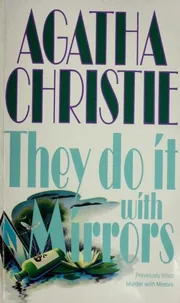
They Do It with Mirrors
by Agatha Christie · 1952
It suits adult and older teen readers who enjoy classic detective fiction, and its mild treatment makes it an easy entry to Christie.
207 pages, about 3.5 to 5 hours.
A tidy Marple puzzle with misdirection as its main trick. 55% taste match
The story
They Do It with Mirrors is a detective novel by Agatha Christie, first published in 1952 and set in England. It is a traditional mystery in the Miss Marple series, following the elderly amateur sleuth as she turns her attention to a household that includes an old friend of hers, Carrie Louise.
Her friend lives in a large Victorian house that also serves as a rehabilitation centre for young offenders. During one eventful stretch, a resident tries to shoot the administrator but misses. In a different part of the house, a visitor who arrived without explanation is killed. Miss Marple sets out to learn why the man came and who was responsible for his death, while keeping her friend safe from further harm.
The book appeared in the United States under the title Murder with Mirrors, and the Collins Crime Club issued the British edition in November of that year. It runs to roughly 207 pages in its typical edition and has been reprinted many times over the decades. Readers who follow Christie's female detective, or who enjoy puzzles set in English country houses, will find a classic example of the form here.
MRS VAN RYDOCK moved a little back from the mirror and sighed.
Setting
England
Themes
Jane Marple (Fictitious character)Women detectivesDetective and mystery storiesMysteryEnglish literatureEnglish languageGrowth (Plants)Arabis holboellii
- Want to read 210
- Reading now 14
- Read 45
Most people shelving it are saving it for later.
Of 269 readers who put it on a shelf, 78% want to read it, 5% are reading it now, 17% have finished it and 0% stopped before the end.
By the numbers
- The median edition runs 207 pages. Counting about 275 words a page and an adult reading pace of 250 words a minute, that is about 3.8 hours of reading.
- Open Library tracks 114 editions from 73 publishers, the earliest dated 1952 and the latest 2023, across 9 languages.
- On reader demand it ranks in the top 6% of the classic books in our catalog (8,749 of them).
- Libraries shelve it under Dewey 823.912 and Library of Congress class PR-6005.00000000.H66.
 BookWard’s take
A tidy Marple puzzle with misdirection as its main trick
This is Christie working in her most reliable mode: a country house, a closed circle of suspects, and Miss Marple quietly watching from the sidelines. At 207 pages it is tight, which suits a reader who prefers short books. The opening lands well, since a failed shooting and a murder in another wing arrive almost together. The real strength is the plotting, because the whole thing rests on a single piece of misdirection that a fair-minded reader can solve. Where I part ways with it is in how familiar everything feels: the Victorian mansion, the gathered family and the elderly sleuth are the genre's furniture. The characters stay thin, since the suspects serve the puzzle more than they live on the page.
At 207 pages it is compact and unpadded, which matches BookWard's preference for short books.
Events come briskly and the short length keeps things moving, though it is a talky kind of speed rather than an action one.
The central trick is ingenious, but the setting and cast are well-worn Christie ground, so it lands mid-scale.
Christie writes clean, plain sentences built to carry plot, with little ornament.
Plot clearly leads here, with people serving the mystery's mechanics rather than the reverse.
Murder sits at the centre, but the tone is orderly and restoring, with justice done and a gentle note to the friendship.
A conventional whodunit shape: crime, investigation, gathering, reveal.
Marple's gentle observations add dry wit, but this is a serious puzzle rather than a comic one.
Murder drives the plot, but the treatment is restrained and off-stage in feel.
Feeling is kept at a polite distance, with concern for Carrie Louise the main warm thread.
See all 50 dialsEvery position, side by side with this book
Where it lines up
- LengthBookWard 1 · book 2
- Internal logicBookWard 10 · book 9
- PaceBookWard 8 · book 7
Where it pulls apart
- Familiar tropesBookWard 10 · book 3
- OriginalityBookWard 9 · book 5
- Character depthBookWard 8 · book 4
At 207 pages it is compact and unpadded, which matches BookWard's preference for short books.
A shooting attempt and a murder arrive in the same stretch, so the story is moving early, close to BookWard's taste.
The Victorian house, the gathered household and the genteel sleuth are staples of the form, so it sits on the trope-leaning side.
The mystery rests on a clever mechanism built to be solvable, which fits BookWard's love of airtight plotting.
Events come briskly and the short length keeps things moving, though it is a talky kind of speed rather than an action one.
The central trick is ingenious, but the setting and cast are well-worn Christie ground, so it lands mid-scale.
Suspects are sketched sharply enough to be distinct, but they exist mainly to serve the puzzle, short of BookWard's deeper preference.
A Marple novel closes with the culprit named and the loose ends explained, a fully resolved finish BookWard values.
Warmth toward Carrie Louise shows, but the book stays crisp rather than weepy.
The violence serves the puzzle and is never lingered on, so darkness is earned by plot rather than for effect.
This is a novel, so the dial does not apply.
Christie's brisk, dry, observant manner is recognisable, though less singular than her best-known works.
This is firmly story-led: the puzzle drives everything, and ideas stay in the background.
Clues surface through conversation and scene, though the closing explanation does lay things out directly.
The short length and steady stream of questioning keep the middle from drifting, a sustained read overall.
Christie writes clean, plain sentences built to carry plot, with little ornament.
Plot clearly leads here, with people serving the mystery's mechanics rather than the reverse.
Murder sits at the centre, but the tone is orderly and restoring, with justice done and a gentle note to the friendship.
A conventional whodunit shape: crime, investigation, gathering, reveal.
Marple's gentle observations add dry wit, but this is a serious puzzle rather than a comic one.
Prose is easy and the plot is clear, though keeping track of suspects takes some attention.
Events unfold in straightforward order over a short span.
Everything is grounded in an ordinary English household, with no fantasy element.
A country-house mystery needs a sizable household of suspects, so the cast is moderately large.
The action stays inside one house and its grounds, an intimate canvas.
The focus is on events, interviews and deductions more than on interior reflection.
Much of the detection happens through conversation, so dialogue carries a heavy share.
Romantic strands exist among the household but stay in the background.
A familiar English country-house setting, likely cosy ground for most readers.
Published in 1952 and set in its own period, it reads as a mid-century piece rather than a present-day one.
The puzzle-box form has lasted for generations, and the reprints show this one still travels.
The narration plays fair with the reader and does not trick through the telling itself.
Right and wrong are clearly drawn, and the book ends with the guilty identified.
Setting is sketched economically, with enough detail to place scenes but little lingering.
This is a novel, so the dial does not apply.
This is a novel, so the dial does not apply.
It is a Miss Marple entry, though it can be read on its own.
Misdirection is the whole game, with reversals aimed at keeping the culprit hidden.
It is a comforting, familiar read that asks little beyond following the clues.
Murder drives the plot, but the treatment is restrained and off-stage in feel.
Feeling is kept at a polite distance, with concern for Carrie Louise the main warm thread.
Humor is dry and observational, never broad.
Violence occurs but is handled with the mild reserve typical of the period.
There is essentially no sexual content on the page.
Politics is not a focus, though the rehabilitation setting touches on social questions.
The language is plain and accessible throughout.
The narration mostly stays neutral, with Marple's own views coming through in her remarks.
It looks back at its own era's manners and institutions rather than ahead.
A slight idealism in the reform-minded house, tempered by the cold fact of murder.
Review written by BookWard, dial version 1, November 2026.
Who is They Do It with Mirrors right for?
It suits adult and older teen readers who enjoy classic detective fiction, and its mild treatment makes it an easy entry to Christie. It involves murder and an attempted shooting, though neither is graphic.
Prose is easy and the plot is clear, though keeping track of suspects takes some attention.
Murder drives the plot, but the treatment is restrained and off-stage in feel.
Feeling is kept at a polite distance, with concern for Carrie Louise the main warm thread.
Violence occurs but is handled with the mild reserve typical of the period.
Book CompanionThey Do It with Mirrors: ideas, characters, themes
Miss Marple investigates a murder and a shooting attempt inside a Victorian house that doubles as a rehabilitation centre for young offenders, while trying to protect her old friend.
- A house with two purposes. The mansion is both a family home and a rehabilitation centre for young offenders, which gives the cast an unusual mix of residents.
- Two events at once. A failed shooting in one part of the house happens as a visitor is killed in another, setting the central puzzle.
- The unexplained visitor. The man who arrives without explanation is the thread Marple pulls to understand why he came.
- Marple and a friend. Her concern for Carrie Louise gives the investigation a personal stake beyond curiosity.
- Two titles. The book appeared in the United States as Murder with Mirrors and in Britain under Christie's original title, They Do It with Mirrors.
Characters
Miss Marple
Amateur detective
The elderly sleuth who investigates the visitor's death and works to keep her friend safe.
Carrie Louise
Marple's old friend
The friend who lives in the large Victorian house and whom Marple wants to protect.
The administrator
Target of a shooting attempt
The person a resident tries and fails to shoot dead.
The visitor
Murder victim
A man who arrives without explanation and is killed in a different part of the house.
Themes
How attention can be steered away from what is really happening.
Marple's loyalty to Carrie Louise drives her involvement.
The house's role as a centre for young offenders raises questions about rehabilitation.
What a household shows outwardly differs from what lies beneath.
Discussion questions
- Did you spot the central trick before the reveal, and what gave it away?
- How does setting the crime in a rehabilitation centre change how you read the suspects?
- Why does Marple's friendship with Carrie Louise matter to the investigation?
- Is the puzzle fair to the reader, and does that make the ending more satisfying?
- How does this compare with other Marple novels you have read?
Personalize your Book Companion
This is the general edition. In BookWard, the Companion is written for you: your reading profile, your notes, and spoiler-safe to the page you are on.
Buy, listen or borrow They Do It with Mirrors
Each link opens a search for this book on that store, in a new tab.
Read on a device
Borrow
Reviews and community
If you liked They Do It with Mirrors
A tight, tidy Marple puzzle built around a nursery rhyme
Death in the CloudsAgatha ChristieA murder on a short flight, with Poirot in the next seat
The Mystery of the Blue TrainAgatha ChristieA luxury train, a dead heiress, and Poirot at his methodical best
The Murder at the VicarageAgatha ChristieThe village mystery where Miss Marple first sits down with her knitting
Sources: Open Library.
Track They Do It with Mirrors and find your next favorite
Add it to your shelf, rate what you have read, and BookWard will recommend what fits you.
Free to start. No credit card needed.