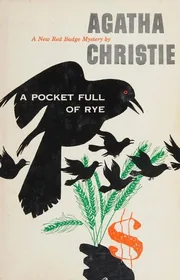
A Pocket Full of Rye
by Agatha Christie · 1953
A good fit for teens and adults who enjoy classic mysteries.
203 pages, about 3 to 4.5 hours.
A tight, tidy Marple puzzle built around a nursery rhyme. 55% taste match
The story
A Pocket Full of Rye is a traditional detective novel by Agatha Christie, first published in 1953 by the Collins Crime Club in the UK, with a US edition from Dodd, Mead & Co. the following year. It belongs to the series featuring her amateur sleuth Miss Marple and is set in England.
The story concerns the murder of Rex Fortescue, a case in which the evidence appears to point toward a single culprit. Miss Marple takes up the investigation and finds that an old nursery rhyme helps her make sense of what happened. The book follows the questioning of those around the victim and the gradual piecing together of the crime, as in much of Christie's work in the mystery and detective tradition. It opens in a quiet, everyday scene, with a woman named Miss Somers taking her turn to make the tea.
The novel runs to roughly 203 pages in a typical edition, and it has appeared in 104 editions over the years. It suits readers who enjoy women sleuths, English settings, and puzzles built around a murder and a methodical search for the truth.
It was Miss Somers' turn to make the tea.
Setting
England
Themes
FicciónJane Marple (Fictitious character)Marple, Jane (Personaje literario)Novela de misterioWomen detectivesEnglish Detective and mystery storiesMurderInvestigation
- Want to read 71
- Reading now 4
- Read 43
Readers are split between finishing it and saving it for later.
Of 118 readers who put it on a shelf, 60% want to read it, 3% are reading it now, 36% have finished it and 0% stopped before the end.
By the numbers
- The median edition runs 203 pages. Counting about 275 words a page and an adult reading pace of 250 words a minute, that is about 3.7 hours of reading.
- Open Library tracks 104 editions from 63 publishers, the earliest dated 1953 and the latest 2023, across 8 languages.
- On reader demand it ranks in the top 10% of the classic books in our catalog (8,749 of them).
- Libraries shelve it under Dewey 823.91 and Library of Congress class PZ-0003.00000000.C4637 Pm2.
 BookWard’s take
A tight, tidy Marple puzzle built around a nursery rhyme
At 203 pages, A Pocket Full of Rye is short enough that there's no room for padding. Rex Fortescue's murder arrives early, so the hook is quick and the pace stays brisk. The real draw is Christie's internal logic: a puzzle that plays fair and resolves fully, which is exactly what you want from an airtight ending. Where it holds less appeal is in its familiar tropes. This is traditional English detective fiction, comfortably inside its genre's conventions, and it leans on them rather than sidestepping them. Miss Marple, working from an old nursery rhyme, is a pleasure, though the cast are drawn as types more than as fully rounded people. Restrained, clever and clean, with a hint of dry wit.
At 203 pages it is compact and efficient, which matches BookWard's love of tight books.
Questioning of suspects moves steadily and the short length keeps the investigation brisk.
The nursery-rhyme device adds a distinctive touch, but the overall shape is classic detective fare.
The prose is clear and unadorned, built to carry the puzzle rather than draw attention.
Plot comes first; characters exist chiefly to be questioned, suspected and solved.
Justice is served, but the story is about crime and its causes, so it lands neutral to mildly hopeful.
A conventional crime, investigation and solution arc with no formal experiments.
Mostly serious, with dry observation of manners rather than outright comedy.
There is a murder, but treatment is restrained and drawing-room polite.
Feeling stays muted beneath the cool, deductive surface.
See all 50 dialsEvery position, side by side with this book
Where it lines up
- LengthBookWard 1 · book 2
- Internal logicBookWard 10 · book 9
- PaceBookWard 8 · book 7
Where it pulls apart
- Familiar tropesBookWard 10 · book 3
- OpeningBookWard 10 · book 7
- OriginalityBookWard 9 · book 5
At 203 pages it is compact and efficient, which matches BookWard's love of tight books.
A murder case drives the story from early on, though it begins in a quiet domestic scene rather than an instant jolt.
It sits squarely in the traditional English detective mould, which leans on genre conventions BookWard would rather see avoided.
Christie builds a fair-play puzzle where the clues, including the nursery rhyme, are meant to add up cleanly.
Questioning of suspects moves steadily and the short length keeps the investigation brisk.
The nursery-rhyme device adds a distinctive touch, but the overall shape is classic detective fare.
Suspects and family members serve the puzzle and read more as types than deeply drawn people.
Mysteries of this kind finish with the culprit exposed and the case fully explained.
The tone is cool and composed, with feeling kept well in check.
The darkness serves the puzzle and is not played for gratuitous effect.
This is a novel, so the nonfiction rigor dial does not apply.
Christie's plain, confident, quietly witty narration is instantly recognizable.
The book is story-led: a murder, suspects and a methodical hunt for the truth.
Information comes through interviews and Marple's reasoning, with some outright explanation near the close.
A short length and steady stream of questioning keep the middle from drifting.
The prose is clear and unadorned, built to carry the puzzle rather than draw attention.
Plot comes first; characters exist chiefly to be questioned, suspected and solved.
Justice is served, but the story is about crime and its causes, so it lands neutral to mildly hopeful.
A conventional crime, investigation and solution arc with no formal experiments.
Mostly serious, with dry observation of manners rather than outright comedy.
Straightforward language and a clear storyline make it an easy read.
The narration moves among several characters around the victim as the case unfolds.
Events unfold in a straightforward forward sequence.
It is firmly grounded in an ordinary English setting.
A household of family members and associates around the victim gives a moderately sized cast.
The stakes stay domestic and intimate, centered on one family and one crime.
The focus falls on what people do and say during the investigation more than on inner life.
Much of the book runs through interviews and conversation among suspects and the investigator.
Romance is a minor strand in a book driven by the murder case.
The English settings are familiar territory for readers of the genre.
First published in 1953, it reads as a mid-century period piece.
Christie's puzzles have endured, and this one still works as a classic Marple outing.
The narration is a reliable, third-person guide to the investigation.
Right and wrong are clear: a murder was committed and the truth must come out.
Setting and appearance are sketched lightly, enough to ground the scenes.
This is fiction, so the nonfiction style dial does not apply.
This is fiction, so the nonfiction perspective dial does not apply.
It belongs to the Miss Marple series, though it can be read on its own.
Misdirection and a surprising solution are the whole point of the form.
A comforting, familiar puzzle that asks to be solved rather than to unsettle.
There is a murder, but treatment is restrained and drawing-room polite.
Feeling stays muted beneath the cool, deductive surface.
Any humor is dry and understated, found in manners and observation.
The crime is central but kept mostly off the page.
There is essentially no sexual content.
Politics stays out of the way of the whodunit.
The language is plain and accessible.
The narration mostly stays neutral, letting the investigation speak.
The book looks backward to old rhymes and past wrongs that explain the present.
Marple's quiet faith that truth will surface balances a view of human failings.
Review written by BookWard, dial version 1, November 2026.
Who is A Pocket Full of Rye right for?
A good fit for teens and adults who enjoy classic mysteries. It involves a murder but handles it in a restrained, non-graphic way.
Straightforward language and a clear storyline make it an easy read.
There is a murder, but treatment is restrained and drawing-room polite.
Feeling stays muted beneath the cool, deductive surface.
The crime is central but kept mostly off the page.
Book CompanionA Pocket Full of Rye: ideas, characters, themes
A murder in a wealthy English household is solved when Miss Marple connects the crime to an old nursery rhyme.
- The victim. Rex Fortescue is murdered, and the evidence appears to point toward one culprit.
- An amateur sleuth. Miss Marple steps in as an observant outsider who sees what others miss.
- The nursery rhyme. An old rhyme becomes the key that helps her make sense of the crime.
- The method. The story follows questioning of those around the victim and the gradual assembly of clues.
- The setting. It unfolds in England within the traditional detective-fiction tradition.
Characters
Miss Marple
Amateur detective
Jane Marple investigates the murder and uses a nursery rhyme to untangle it.
Rex Fortescue
The victim
His murder sets the whole case in motion.
Miss Somers
Opening-scene character
She appears in the book's quiet opening, taking her turn to make the tea.
Themes
The drive to expose the truth and name the guilty.
Small details noticed by a patient mind can solve a crime.
Evidence that seems to point one way may mislead.
The past, even in a children's song, can illuminate the present.
Discussion questions
- Why does the nursery rhyme make such an effective clue?
- How does Miss Marple's outsider status help her?
- Did the evidence pointing to one culprit make you suspicious?
- How does the English setting shape the kind of crime this is?
- What makes a fair-play mystery satisfying to solve?
Personalize your Book Companion
This is the general edition. In BookWard, the Companion is written for you: your reading profile, your notes, and spoiler-safe to the page you are on.
Buy, listen or borrow A Pocket Full of Rye
Each link opens a search for this book on that store, in a new tab.
Read on a device
Borrow
Reviews and community
If you liked A Pocket Full of Rye
A tidy Marple puzzle with misdirection as its main trick
The Mystery of the Blue TrainAgatha ChristieA luxury train, a dead heiress, and Poirot at his methodical best
Death in the CloudsAgatha ChristieA murder on a short flight, with Poirot in the next seat
The Murder at the VicarageAgatha ChristieThe village mystery where Miss Marple first sits down with her knitting
Sources: Open Library.
Track A Pocket Full of Rye and find your next favorite
Add it to your shelf, rate what you have read, and BookWard will recommend what fits you.
Free to start. No credit card needed.