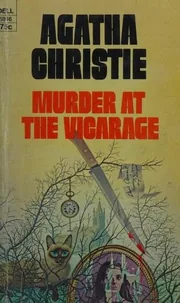
The Murder at the Vicarage
by Agatha Christie · 1930
Suits teenagers and adults who enjoy classic mysteries; the pace and language are accessible.
256 pages, about 4 to 6 hours.
The village mystery where Miss Marple first sits down with her knitting. 58% taste match
The story
The Murder at the Vicarage is a detective novel by Agatha Christie, first published in 1930. It is the book that introduces Miss Jane Marple, an observant spinster who lives in the village of St. Mary Mead and has a habit of reading crime through what she knows of human nature. The story belongs to the classic English mystery tradition and carries a vein of humour alongside its investigation.
The victim is Colonel Protheroe, a magistrate whom almost no one in the district liked. He is found shot in his study, and nobody heard anything. His wife Anne and the newly arrived artist Lawrence Redding, who is an old acquaintance of hers, each confess to the crime. A local inspector works the case, and Miss Marple joins him in sorting through the claims. The setting is a quiet English village in the early twentieth century, where tea and gossip fill most days. The novel runs to roughly 256 pages in a typical edition and has appeared in many forms, including audiobook, braille and DVD.
It is difficult to know quite where to begin this story, but I have fixed my choice on a certain Wednesday at luncheon at the Vicarage.
Setting
EnglandLondon (England)
Period
20th Century
Themes
Women detectivesClassicLiteratureAudiobookBraileDVDMurderMystery
- Want to read 258
- Reading now 21
- Read 79
Most people shelving it are saving it for later.
Of 358 readers who put it on a shelf, 72% want to read it, 6% are reading it now, 22% have finished it and 0% stopped before the end.
By the numbers
- The median edition runs 256 pages. Counting about 275 words a page and an adult reading pace of 250 words a minute, that is about 4.7 hours of reading.
- Open Library tracks 127 editions from 88 publishers, the earliest dated 1930 and the latest 2025, across 10 languages.
- On reader demand it ranks in the top 3% of the classic books in our catalog (8,749 of them).
- Libraries shelve it under Dewey 822 and Library of Congress class MLC0000.00000000 R CP00788.
Read it
The text of this edition is free to read online.
1 ebook provider carry it and a scanned copy is on the Internet Archive.
 BookWard’s take
The village mystery where Miss Marple first sits down with her knitting
This is the book that introduces Miss Marple, and it shows why the classic village mystery lasts. Colonel Protheroe is despised, shot in his study, and nobody heard a thing. Two people then confess, which is a hook at once. Where it really earns its place is the logic: it is a fair-play puzzle built to be solved. The pace is brisk for its era, and the humour in the gossip keeps the tone lighter than the crime suggests. Familiar tropes are the genre's furniture here, so it is less original than I usually like, but the ending is fully resolved. At about 256 pages it stays tight.
At roughly 256 pages it is compact for a full detective novel, which suits BookWard's taste for tight books.
The investigation moves steadily through interviews and confessions, close to BookWard's preferred quick tempo without rushing.
It founded a famous detective, but the form is the classic English mystery, so it sits below BookWard's love of the new.
Clear, plain and uncluttered, never ornate, which sits near BookWard's mildly plain preference.
The mystery drives everything, with characters serving the investigation, so it leans toward plot over BookWard's slight character lean.
Order is restored once the crime is solved, giving a mildly hopeful close in a gentle village world.
A conventional linear detective structure, more traditional than the structural play BookWard tolerates.
Gossip and village manners bring gentle humour alongside the crime, close to BookWard's taste for wit.
See all 50 dialsEvery position, side by side with this book
Where it lines up
- Internal logicBookWard 10 · book 9
- PaceBookWard 8 · book 7
- SentimentBookWard 8 · book 7
Where it pulls apart
- Familiar tropesBookWard 10 · book 4
- OriginalityBookWard 9 · book 5
- LengthBookWard 1 · book 3
At roughly 256 pages it is compact for a full detective novel, which suits BookWard's taste for tight books.
A despised magistrate shot in his study and two confessions give it a strong pull, though less instant than BookWard's top mark.
The village, the gossip and the amateur sleuth are the genre's own conventions, so this leans on trope more than BookWard likes.
A clue-based puzzle in the fair-play tradition, built so the solution holds together, which matches BookWard's love of airtight plotting.
The investigation moves steadily through interviews and confessions, close to BookWard's preferred quick tempo without rushing.
It founded a famous detective, but the form is the classic English mystery, so it sits below BookWard's love of the new.
Village figures are drawn crisply and economically, with Miss Marple distinct, though most remain types serving the puzzle.
A detective novel resolves its crime and explains the truth, which fits BookWard's liking for full resolution.
Warm in its village setting but not tearful, keeping feeling in check, which suits BookWard's restrained taste.
The murder and the confessions provide shock, but it serves the puzzle rather than dwelling on darkness.
This is fiction, so the nonfiction rigor dial does not apply.
Christie's plain, wry narration and gossip-laden village life give it a recognisable, distinctive feel.
It is story-led, built around a crime and its solution, which is the side BookWard favors.
Clues surface through conversation and scene, though a detective eventually explains the answer outright.
A tight puzzle keeps new suspects and clues arriving, so the middle holds up, as BookWard wants.
Clear, plain and uncluttered, never ornate, which sits near BookWard's mildly plain preference.
The mystery drives everything, with characters serving the investigation, so it leans toward plot over BookWard's slight character lean.
Order is restored once the crime is solved, giving a mildly hopeful close in a gentle village world.
A conventional linear detective structure, more traditional than the structural play BookWard tolerates.
Gossip and village manners bring gentle humour alongside the crime, close to BookWard's taste for wit.
Easy to read in short scenes and plain language, with the puzzle as the only real effort.
Told from one narrator's vantage, so the viewpoint stays single, below BookWard's preference for many.
Events unfold in order across the investigation with no jumps in time.
A grounded, realistic village setting with no fantastical element at all.
A village full of suspects and neighbours gives a fair-sized cast, a little larger than BookWard's middle.
The action stays within one small village and its households, firmly intimate rather than epic.
Balanced between investigation and talk, with plenty of observation of how people think and behave.
Much of the story runs through interviews, conversation and gossip, so dialogue is heavy, as BookWard likes.
A past flame is part of the mystery, but romance is a side thread, not the centre.
A quiet English village is familiar ground for crime readers, less unfamiliar than BookWard's usual settings.
First published in 1930 and set in that period, so it is firmly a book from the past.
The puzzle and the Marple character have endured and been adapted many times, giving strong staying power.
Right and wrong are fairly clear: a crime has been done and a culprit is found.
Setting is sketched lightly, enough to place the village, with the story carried by action and talk.
Review written by BookWard, dial version 1, November 2026.
Who is The Murder at the Vicarage right for?
Suits teenagers and adults who enjoy classic mysteries; the pace and language are accessible. It involves a murder but keeps violence off the page and is gentle in tone.
Easy to read in short scenes and plain language, with the puzzle as the only real effort.
Book CompanionThe Murder at the Vicarage: ideas, characters, themes
A quiet village hides a murder, and the observant Miss Marple reads the truth through what she knows of human nature.
- The setup. Colonel Protheroe, a magistrate nobody liked, is found shot in his study with no one having heard anything.
- Two confessions. His wife Anne and the artist Lawrence Redding each admit to the crime, which complicates the case at once.
- The investigators. A local inspector works the case while Miss Marple sorts through what people say and do.
- The village setting. St. Mary Mead is a place where tea and gossip fill the days, and gossip becomes a source of clues.
- A series beginning. This is the first appearance of Miss Marple, who went on to appear in many more stories and adaptations.
Characters
Miss Jane Marple
Amateur detective
An observant spinster of St. Mary Mead who reads crime through human nature.
Colonel Protheroe
The victim
A magistrate whom almost no one in the district liked.
Anne Protheroe
The victim's wife
Admits she once knew the artist and confesses to the murder.
Lawrence Redding
Newly arrived artist
An old acquaintance of Anne who also confesses to the crime.
Themes
Miss Marple solves crime by understanding how people behave, not by forensic method.
Village talk is both entertainment and a way of learning what others hide.
What people claim and confess may differ from what is true.
The classic mystery moves from disruption toward a settled explanation.
Discussion questions
- Why might two people confess to the same murder, and what does that do to the puzzle?
- How does gossip help or mislead the investigation?
- What makes Miss Marple's method different from the inspector's?
- Does a village setting make a crime feel more or less shocking?
- How well does a 1930 mystery hold up against modern crime fiction?
Personalize your Book Companion
This is the general edition. In BookWard, the Companion is written for you: your reading profile, your notes, and spoiler-safe to the page you are on.
Buy, listen or borrow The Murder at the Vicarage
Each link opens a search for this book on that store, in a new tab.
Read on a device
Borrow
Reviews and community
If you liked The Murder at the Vicarage
A tidy Marple puzzle with misdirection as its main trick
Death in the CloudsAgatha ChristieA murder on a short flight, with Poirot in the next seat
A Pocket Full of RyeAgatha ChristieA tight, tidy Marple puzzle built around a nursery rhyme
Poirot investigatesAgatha ChristiePoirot's early cases: short, sharp puzzles with a fair-play spine
Sources: Open Library.
Track The Murder at the Vicarage and find your next favorite
Add it to your shelf, rate what you have read, and BookWard will recommend what fits you.
Free to start. No credit card needed.