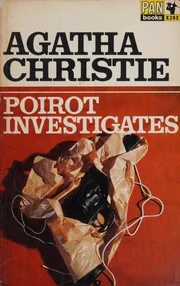
Poirot investigates
by Agatha Christie · 1924
Suitable for most teens and adults who enjoy classic mysteries.
192 pages, about 3 to 4.5 hours.
Poirot's early cases: short, sharp puzzles with a fair-play spine. 56% taste match
The story
Poirot Investigates is a collection of short detective stories by Agatha Christie, first published in 1924. It belongs to the classic English mystery tradition and sits third among the Christie novels and collections that feature Hercule Poirot, the Belgian private investigator whose cases fill the series.
Set in England, the stories follow Poirot as he works through a range of puzzles. Captain Hastings narrates, and the opening finds him at the window of Poirot's rooms, looking down at the street. Chief Inspector Japp also appears among the characters. The cases touch on greed, jealousy, and revenge, and the original edition contained eleven stories. A later American edition added three more to the lineup.
The Bodley Head issued the first edition in March 1924, and the dust jacket carried an illustration of Poirot by W. Smithson Broadhead. Editions of the book run to roughly 192 pages, and more than two hundred editions have appeared over the years. It suits readers who enjoy short-form mysteries built around a single detective and his companion, and those curious to see how Poirot's career begins to take shape in the early part of the series.
I was standing at the window of Poirot's rooms looking out idly on the street below.
Setting
England
Themes
Hercule Poirot (Fictitious character)Private investigatorsBelgiansEnglish Detective and mystery storiesDetective and mystery storiesCaptain Hastings (Fictitious character)English Short storiesMystery
- Want to read 331
- Reading now 25
- Read 72
Most people shelving it are saving it for later.
Of 428 readers who put it on a shelf, 77% want to read it, 6% are reading it now, 17% have finished it and 0% stopped before the end.
By the numbers
- The median edition runs 192 pages. Counting about 275 words a page and an adult reading pace of 250 words a minute, that is about 3.5 hours of reading.
- Open Library tracks 216 editions from 78 publishers, the earliest dated 1924 and the latest 2024, across 7 languages.
- On reader demand it ranks in the top 3% of the classic books in our catalog (8,749 of them).
- Libraries shelve it under Dewey 823 and Library of Congress class PR-6005.00000000.H66P648 2021.
 BookWard’s take
Poirot's early cases: short, sharp puzzles with a fair-play spine
Poirot Investigates gathers eleven short mysteries in the original 1924 edition, each built around a single puzzle and solved by Hercule Poirot with Captain Hastings alongside. Its greatest strengths are the openings and the logic: each story states its problem almost at once and plays fair with its clues. The length helps too, since a story ends before it can sag. Where it is less satisfying is originality. It leans on familiar genre conventions, though those conventions are much of the pleasure here, and the characters stay fairly thin because the format favours the detective's method over anyone's inner life. It is brisk, resolved and easy to dip into.
Eleven short stories at about 192 pages keep each case compact, which BookWard values.
Short-story form keeps every case moving briskly from problem to solution.
The prose is plain and functional, built for clarity rather than ornament.
The mysteries drive everything, with character serving the puzzle.
Justice generally prevails, though the motives on show include greed, jealousy and revenge.
A conventional collection of self-contained stories in a familiar detective format.
Poirot's vanity and fussiness bring gentle comedy, but the stories remain basically serious.
Crimes are present but handled in a light, classic-mystery manner.
Feeling stays restrained, with intellect leading the way.
See all 50 dialsEvery position, side by side with this book
Where it lines up
- PaceBookWard 8 · book 8
- SentimentBookWard 8 · book 8
- Shock for effectBookWard 9 · book 9
Where it pulls apart
- Familiar tropesBookWard 10 · book 3
- OriginalityBookWard 9 · book 5
- Character depthBookWard 8 · book 4
Eleven short stories at about 192 pages keep each case compact, which BookWard values.
Each story puts its puzzle in front of the reader quickly, matching BookWard's taste for an immediate hook.
It helped set the conventions of the classic English detective story, so tropes are central rather than avoided.
The cases are built as fair puzzles where the solution follows from the clues, which BookWard prizes.
Short-story form keeps every case moving briskly from problem to solution.
Poirot and Hastings are vivid, but the format favours type and method over deep interior portraits.
Every story closes with Poirot explaining the solution, so nothing is left open, as BookWard likes.
The tone is brisk and unsentimental, with feeling kept well in the background.
The darkness stays within puzzle conventions and serves the mystery rather than shocking for effect.
Fiction, so this dial does not apply.
Christie's clean, confident narration and Poirot's eccentric manner are instantly recognisable.
These are plot-and-puzzle stories first, with ideas about human motive coming through the cases.
Poirot explains his reasoning aloud at the close, which sits more explained than BookWard prefers.
With short stories there is no long middle to sag, and each case stays taut.
The prose is plain and functional, built for clarity rather than ornament.
The mysteries drive everything, with character serving the puzzle.
Justice generally prevails, though the motives on show include greed, jealousy and revenge.
A conventional collection of self-contained stories in a familiar detective format.
Poirot's vanity and fussiness bring gentle comedy, but the stories remain basically serious.
Clear, straightforward storytelling makes this an easy read.
Captain Hastings narrates, so the view stays with one voice.
Each case unfolds in a straightforward sequence from problem to solution.
Entirely grounded in an ordinary English world of everyday crimes.
Each story needs only a handful of suspects, plus Poirot, Hastings and sometimes Japp.
Cases are personal and domestic rather than world-shaking.
Investigation, interviews and deduction keep attention on action and evidence over inner thought.
Questioning of suspects and Poirot's conversations carry much of each story.
Romance is a minor thread at most, set well behind the puzzle.
A familiar English setting of flats, houses and ordinary society.
Written in the early 1920s, it is firmly a period piece.
The puzzle format still works a century on, which shows real staying power.
Hastings is a sincere, straightforward narrator who tells things as he sees them.
Right and wrong are clear, and Poirot sets matters straight.
Description is economical, giving just enough setting to support the case.
Fiction, so this dial does not apply.
Fiction, so this dial does not apply.
It is the third Poirot book, though each story stands comfortably alone.
Every case is built around a reveal that overturns the obvious reading.
This is comfortable, entertaining reading with a puzzle at its core.
Crimes are present but handled in a light, classic-mystery manner.
Feeling stays restrained, with intellect leading the way.
The humour is dry, drawn from Poirot's manner and Hastings's slowness.
Crime happens, but it stays largely offstage and understated.
There is essentially no sexual content.
Politics barely register, with the focus on personal motive.
The language is plain, with period flavour but little density.
Narration is mostly neutral, with Hastings's views colouring things lightly.
It captures a moment of its own era and looks back more than forward.
Human weakness drives the crimes, yet order is restored by the end.
Review written by BookWard, dial version 1, November 2026.
Who is Poirot investigates right for?
Suitable for most teens and adults who enjoy classic mysteries. The crimes are handled in a restrained, old-fashioned way with little graphic content.
Clear, straightforward storytelling makes this an easy read.
Crimes are present but handled in a light, classic-mystery manner.
Feeling stays restrained, with intellect leading the way.
Crime happens, but it stays largely offstage and understated.
Book CompanionPoirot investigates: ideas, characters, themes
Hercule Poirot solves a series of varied English mysteries through observation and reasoning, with Captain Hastings alongside.
- Collection of short stories. The original 1924 edition contains eleven stories, each a separate case.
- Early Poirot. It is the third Christie book featuring Poirot, showing the detective's career taking shape.
- Hastings as narrator. Captain Hastings tells the stories, giving readers a companion's view of Poirot's methods.
- Motives at the core. The cases turn on greed, jealousy and revenge.
- Editions differ. The American edition from 1925 added three more stories to the UK line-up.
Characters
Hercule Poirot
Belgian private detective
An eccentric investigator who solves cases through careful reasoning.
Captain Hastings
Narrator and companion
Poirot's friend, who tells the stories and often misses what Poirot sees.
Chief Inspector Japp
Police inspector
A Scotland Yard figure who appears in the stories alongside Poirot.
Themes
Money and gain as the engine behind crime.
Resentment and rivalry that push people to act.
Old grievances paid back through crime.
Careful thinking sees through what looks obvious.
The working partnership between Poirot and Hastings.
Discussion questions
- Why does the short story form suit a detective like Poirot?
- How does Hastings as narrator shape what we see and miss?
- Which motive among greed, jealousy and revenge feels most convincing, and why?
- Do the stories play fair with the clues they give the reader?
- What makes Poirot memorable compared with other fictional detectives?
Personalize your Book Companion
This is the general edition. In BookWard, the Companion is written for you: your reading profile, your notes, and spoiler-safe to the page you are on.
Buy, listen or borrow Poirot investigates
Each link opens a search for this book on that store, in a new tab.
Read on a device
Borrow
Reviews and community
If you liked Poirot investigates
A murder on a short flight, with Poirot in the next seat
They Do It with MirrorsAgatha ChristieA tidy Marple puzzle with misdirection as its main trick
The Mystery of the Blue TrainAgatha ChristieA luxury train, a dead heiress, and Poirot at his methodical best
Murder in MesopotamiaAgatha ChristiePoirot in the Iraqi desert: a classic puzzle in a closed circle
Sources: Open Library.
Track Poirot investigates and find your next favorite
Add it to your shelf, rate what you have read, and BookWard will recommend what fits you.
Free to start. No credit card needed.