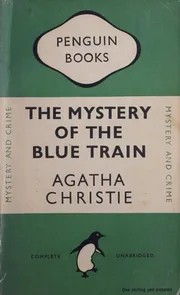
The Mystery of the Blue Train
by Agatha Christie · 1928
It suits adult and older teen readers who like classic puzzle mysteries.
257 pages, about 4 to 6 hours.
A luxury train, a dead heiress, and Poirot at his methodical best. 54% taste match
The story
The Mystery of the Blue Train is a detective novel by Agatha Christie, first published in 1928. It belongs to her Hercule Poirot series and is a classic whodunit in the tradition of the railway mystery, with much of the story set aboard Le Train Bleu, the luxury express running toward the Riviera.
Poirot is travelling south on the train when he comes across Ruth Kettering, an American heiress whose marriage is ending. She is making her way to meet a former lover. By the next morning she has been found dead in her private compartment, and Poirot has little to work from beyond talk of an unknown man seen near her. As he looks into her affairs, the story takes in a stolen jewel, a failing marriage, and the secrets of a married woman's life. The action moves between France, Belgium and England.
The novel runs to roughly 257 pages in a typical edition and has appeared in well over a hundred editions. It suits readers who enjoy puzzle-driven crime fiction, travel by rail, and the Belgian detective's methodical way of working through a case.
IT was close on midnight when a man crossed the Place de la Concorde.
Setting
EnglandFranceBelgium
Themes
Crimes againstDetective and mystery storiesDivorceHercule Poirot (Fictitious character)Jewelry theftMarried womenPrivate investigatorsRailroad stories
- Want to read 437
- Reading now 43
- Read 92
Most people shelving it are saving it for later.
Of 572 readers who put it on a shelf, 76% want to read it, 8% are reading it now, 16% have finished it and 0% stopped before the end.
By the numbers
- The median edition runs 257 pages. Counting about 275 words a page and an adult reading pace of 250 words a minute, that is about 4.7 hours of reading.
- Open Library tracks 124 editions from 79 publishers, the earliest dated 1928 and the latest 2024, across 10 languages.
- On reader demand it ranks in the top 2% of the classic books in our catalog (8,749 of them).
- Libraries shelve it under Dewey 823.912 and Library of Congress class PR-6005.00000000.H66.
 BookWard’s take
A luxury train, a dead heiress, and Poirot at his methodical best
Christie's 1928 Poirot novel opens on a note of glamour: Le Train Bleu heading for the Riviera, an American heiress dead in her compartment by morning. It's a strong hook, and at 257 pages the book stays tight, which is a point in its favor for anyone who likes a short read. The logic is the draw. This is a puzzle built to be solved, with a stolen jewel, a failing marriage and a married woman's secrets all feeding the case. Where it falls short is originality. The luxury-train whodunit is a familiar form, and the book leans on its conventions, with characters sketched quickly rather than drawn in depth. Still, Poirot does the thinking, the pace holds, and the ending is fully resolved.
At 257 pages it is compact for a mystery with this many suspects, which matches BookWard's liking for tight books.
Poirot moves the case along steadily across France, Belgium and England, close to BookWard's quick preferred pace.
The railway whodunit was already a familiar form in 1928, so it feels classic rather than fresh by BookWard's measure.
The prose is plain and transparent, built for clarity, a little plainer than BookWard's middle setting.
The mystery drives everything and character follows plot, which runs against BookWard's lean toward character.
Justice is restored by the end, giving a mildly hopeful close despite the murder at its heart.
A straightforward investigation from crime to solution, more conventional than BookWard's middle preference.
There is some dry wit around Poirot's vanity, but the book is mainly a serious puzzle.
A murder starts the story, but the treatment is mild and the tone stays light.
Feelings stay in the background while the case takes priority.
See all 50 dialsEvery position, side by side with this book
Where it lines up
- SentimentBookWard 8 · book 8
- LengthBookWard 1 · book 2
- PaceBookWard 8 · book 7
Where it pulls apart
- Familiar tropesBookWard 10 · book 4
- OriginalityBookWard 9 · book 4
- Character depthBookWard 8 · book 4
At 257 pages it is compact for a mystery with this many suspects, which matches BookWard's liking for tight books.
A murdered heiress on a luxury express gives the story a strong early pull, close to what BookWard wants from an opening.
The train mystery and its jewel-and-marriage motives are well-worn ground, so it falls short of BookWard's wish to avoid tropes.
It is a whodunit built on clues and deduction, which is the kind of airtight puzzle BookWard rewards.
Poirot moves the case along steadily across France, Belgium and England, close to BookWard's quick preferred pace.
The railway whodunit was already a familiar form in 1928, so it feels classic rather than fresh by BookWard's measure.
Characters serve the puzzle and are sketched efficiently, which is lighter than the deeply drawn people BookWard likes.
Classic Poirot closes with the case fully explained, in line with BookWard's taste for resolution.
The tone stays cool and brisk rather than tender, which sits comfortably with BookWard's restrained preference.
The darkness serves the puzzle, not spectacle: a murder drives the plot without lingering on it.
Not applicable to a work of fiction.
Christie's brisk, dry narration is recognisable, though less singular than the strongest voices BookWard likes.
This is plot-first storytelling, with the mystery itself as the engine, which is where BookWard also leans.
Poirot explains his reasoning aloud in classic detective fashion, more telling than BookWard's preference for showing.
The case keeps new leads coming, so the middle holds up well, in step with BookWard's taste.
The prose is plain and transparent, built for clarity, a little plainer than BookWard's middle setting.
The mystery drives everything and character follows plot, which runs against BookWard's lean toward character.
Justice is restored by the end, giving a mildly hopeful close despite the murder at its heart.
A straightforward investigation from crime to solution, more conventional than BookWard's middle preference.
There is some dry wit around Poirot's vanity, but the book is mainly a serious puzzle.
Easy to read in short chapters, and a touch lighter than BookWard's middle setting.
The story mostly follows the investigation from a limited set of angles, fewer than BookWard prefers.
Events unfold in order from the train journey onward, which is more linear than BookWard's middle setting.
Entirely realistic, set in trains, hotels and drawing rooms, a little more grounded than BookWard's preference.
A moderate pool of suspects fits the genre, around BookWard's own middle setting.
The crime is personal and domestic in nature even as the locations range across Europe.
Attention falls on action, questioning and observation rather than inner reflection.
Interviews and conversation carry the detective work, so talk dominates, close to BookWard's heavier dialogue taste.
Romance is part of the backstory and motive but not the point of the book.
The Riviera express and 1920s society feel somewhat removed from daily life, nearer BookWard's unfamiliar preference.
Written in 1928 with period detail throughout, well away from the present day.
The puzzle format still works, though the setting and social detail date it.
Third-person narration plays fair with the reader, far from the unreliable end.
Right and wrong are fairly clear: a crime is committed and justice is the aim.
Setting is sketched enough to place the scene without lavish detail, matching BookWard's middle setting.
Not applicable to a work of fiction.
Not applicable to a work of fiction.
It belongs to the Hercule Poirot series, though the mystery stands on its own.
Reversals and misdirection are the genre's core and this book delivers them, in line with BookWard.
A comfortable, puzzle-driven read that entertains more than it unsettles.
A murder starts the story, but the treatment is mild and the tone stays light.
Feelings stay in the background while the case takes priority.
Humor is mostly dry, centered on Poirot's mannerisms and pride.
The killing happens off the page and is handled discreetly.
There is essentially no sexual content, only affairs implied as plot motives.
Politics barely registers beyond class and money among the wealthy.
The language is plain and easy to follow, with little dialect or density.
The narration stays fairly neutral, letting Poirot and the clues carry the story.
The book belongs to its own period and looks mainly to resolving the present case.
Poirot's faith in order and reason gives the story a quietly hopeful streak.
Review written by BookWard, dial version 1, November 2026.
Who is The Mystery of the Blue Train right for?
It suits adult and older teen readers who like classic puzzle mysteries. It deals with a murder, theft and marital breakdown, but the treatment is discreet and mild.
Easy to read in short chapters, and a touch lighter than BookWard's middle setting.
A murder starts the story, but the treatment is mild and the tone stays light.
Feelings stay in the background while the case takes priority.
The killing happens off the page and is handled discreetly.
Book CompanionThe Mystery of the Blue Train: ideas, characters, themes
A murder aboard a luxury train sends Hercule Poirot into a case of jewels, a failing marriage and a married woman's hidden life.
- The luxury train setting. Le Train Bleu offers an elegant, closed space heading for the Riviera, which makes the crime feel contained and the suspects close at hand.
- An heiress with a private life. Ruth Kettering is an American heiress leaving a doomed marriage to meet a former lover, and her secrets shape the investigation.
- A thin trail of clues. Poirot begins with little more than talk of an unknown man seen near the victim, so the case grows from small details.
- A jewel at the center. Jewel theft sits alongside the murder, tying money and motive together as the story widens.
- Europe as the stage. The action moves between France, Belgium and England, giving a travelling case rather than a single locked setting.
Characters
Hercule Poirot
Belgian detective
He is on the train bound for the Riviera when he meets the victim, and he works through the case methodically.
Ruth Kettering
American heiress and victim
She is leaving a doomed marriage to reconcile with a former lover when she is found dead in her compartment.
Themes
A failing marriage and the pressures around it sit at the heart of the motive.
A stolen jewel links money, status and crime.
A woman's hidden life is gradually uncovered as the case unfolds.
Poirot's careful method cuts through what people claim to have seen.
Discussion questions
- How does the closed setting of a luxury train shape the way suspects are watched?
- Which clues did you notice early, and which did the book keep hidden?
- How much does knowing Ruth Kettering's secrets change how you read the other characters?
- Does a detective who explains his reasoning aloud make the puzzle more or less satisfying?
- What does the story suggest about wealth and the motives it creates?
Personalize your Book Companion
This is the general edition. In BookWard, the Companion is written for you: your reading profile, your notes, and spoiler-safe to the page you are on.
Buy, listen or borrow The Mystery of the Blue Train
Each link opens a search for this book on that store, in a new tab.
Read on a device
Borrow
Reviews and community
If you liked The Mystery of the Blue Train
A murder on a short flight, with Poirot in the next seat
They Do It with MirrorsAgatha ChristieA tidy Marple puzzle with misdirection as its main trick
A Pocket Full of RyeAgatha ChristieA tight, tidy Marple puzzle built around a nursery rhyme
Murder in MesopotamiaAgatha ChristiePoirot in the Iraqi desert: a classic puzzle in a closed circle
Sources: Open Library.
Track The Mystery of the Blue Train and find your next favorite
Add it to your shelf, rate what you have read, and BookWard will recommend what fits you.
Free to start. No credit card needed.