Best suited to adult readers comfortable with sustained dread and grim subject matter.
770 pages, about 12 to 18 hours.
Franklin's doomed Arctic voyage, with something hunting in the dark. 50% taste match
The story
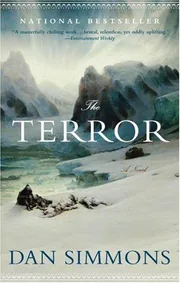
The Terror is a 2007 historical horror novel by Dan Simmons, set during the 1845 to 1848 Arctic voyage of Sir John Franklin. Two ships, HMS Erebus and HMS Terror, set out to find the Northwest Passage and become trapped in the ice of the Arctic Archipelago, not far from King William Island. Supplies and coal dwindle as the months pass, and the crews face starvation, illness, mutiny and cannibalism.
Francis Crozier, captain of HMS Terror, is at the center of the story, alongside figures such as James Fitzjames, Harry Goodsir, Cornelius Hickey, Thomas Blanky and Lady Silence. When Franklin dies, command passes to Crozier, who must lead the survivors while a creature stalks the ships and the men across the frozen landscape. The book combines a fictionalized account of a real nineteenth century expedition with shipwreck survival and thriller elements. It runs to roughly 770 pages and has appeared in 39 editions.
Captain Crozier comes up on deck to find his ship under attack by celestial ghosts.
Characters
Cornelius HickeyThomas BlankyLady Silence
Setting
ArcticArctic regionsArctic OceanArctic ArchipelagoKing William Island
Period
19th century1845-1848
Themes
HorrorThrillerShipwrecksShipwreck survivalSurvivalSea storiesSea monstersShips
- Want to read 174
- Reading now 7
- Read 31
Most people shelving it are saving it for later.
Of 212 readers who put it on a shelf, 82% want to read it, 3% are reading it now, 15% have finished it and 0% stopped before the end.
By the numbers
- The median edition runs 770 pages. Counting about 275 words a page and an adult reading pace of 250 words a minute, that is about 14 hours of reading.
- Open Library tracks 39 editions from 31 publishers, the earliest dated 2007 and the latest 2025, across 5 languages.
- On reader demand it ranks in the top 4% of the modern books in our catalog (15,152 of them).
- Libraries shelve it under Dewey 813.6 and Library of Congress class PS-3569.00000000.I47292.
 BookWard’s take
Franklin's doomed Arctic voyage, with something hunting in the dark
At 770 pages, The Terror is the opposite of tight, and anyone after a lean read should look elsewhere. What it offers in return is a superb setting: two ships locked in Arctic ice, coal and food running down, command passing to Francis Crozier. It is a survival story first, and the premise alone is enough to hook you. The most interesting part is how it blends history and invention, since a real expedition meets a creature stalking the men, and that mix is more original than the genre usually manages. The darkness here (starvation, mutiny, cannibalism) is part of the situation rather than decoration, which gives the grimmest scenes real weight instead of shock for its own sake. Expect a heavy, patient, immersive read rather than a quick one.
At 770 pages it is long and expansive, the opposite of BookWard's taste for tight books.
Dread builds slowly across a long, grinding ordeal, which runs slower than BookWard likes.
Blending the real Franklin expedition with a stalking monster is a distinctive pairing.
The writing is rich and atmospheric without turning ornate, close to BookWard's middle ground.
Survival events propel it, but Crozier and the crew carry it emotionally.
Starvation, scurvy and madness leave little light, so it runs bleak against BookWard's lean toward hope.
A chronological ordeal with a conventional shape, close to BookWard's comfortable middle.
This is a grim survival story with almost no humor, away from BookWard's lighter leanings.
Starvation, cannibalism and madness make this about as dark as the dial goes.
The suffering lands with real intensity, a bit above BookWard's balance.
See all 50 dialsEvery position, side by side with this book
Where it lines up
- Character depthBookWard 8 · book 8
- SentimentBookWard 8 · book 8
- Story or ideasBookWard 3 · book 3
Where it pulls apart
- LengthBookWard 1 · book 10
- Familiar tropesBookWard 10 · book 6
- OpeningBookWard 10 · book 7
At 770 pages it is long and expansive, the opposite of BookWard's taste for tight books.
The ships are already trapped in the ice and something is taking men, so the situation grips early.
Lost-expedition horror and sea-monster tropes are familiar, though the real-history frame gives them fresh weight.
A real expedition's dwindling supplies and ice drive the plot, though the creature asks for some faith.
Dread builds slowly across a long, grinding ordeal, which runs slower than BookWard likes.
Blending the real Franklin expedition with a stalking monster is a distinctive pairing.
A large crew led by Crozier gets real attention, which BookWard rewards.
The ordeal is rendered grimly with little room for softness, which suits BookWard.
The horrors of starvation, mutiny and cannibalism come from the situation rather than gratuitous effect.
Anchored in a real expedition, though the monster makes it fiction first.
Simmons gives the long ordeal a confident, immersive and recognizable narrative presence.
This is plot-first survival horror, a story-led book that BookWard's taste favors.
A period expedition with ships and supplies calls for some explaining, more than BookWard's show-it preference.
Seven hundred seventy pages of confinement risks a stretch where the dread slackens.
The writing is rich and atmospheric without turning ornate, close to BookWard's middle ground.
Survival events propel it, but Crozier and the crew carry it emotionally.
Starvation, scurvy and madness leave little light, so it runs bleak against BookWard's lean toward hope.
A chronological ordeal with a conventional shape, close to BookWard's comfortable middle.
This is a grim survival story with almost no humor, away from BookWard's lighter leanings.
Length and density make it a committed read, somewhat more demanding than BookWard's usual.
The story moves among Crozier, Fitzjames, Goodsir and others, giving it many perspectives.
The 1845 to 1848 voyage unfolds in order, more linear than BookWard's slightly shifting taste.
A historical frame carries a monstrous presence, so it sits above BookWard's grounded-leaning middle.
Two ships' worth of officers and crew make for a large cast, beyond BookWard's smaller preference.
Trapped ships and a fleeing crew give it weight and scope, a touch beyond intimate.
External threats and survival action dominate, with some interior moments for the leads.
Officers, crew and conflict generate steady talk, close to BookWard's liking for dialogue.
Survival and dread leave romance as a minor presence, far below BookWard's middle.
The Arctic ice and a period naval expedition are unfamiliar territory, which BookWard enjoys.
Set in the 1840s, it is firmly in the past, well away from BookWard's lean toward present day.
A real expedition and enduring survival themes give it staying power.
Mutiny and desperate choices muddy right and wrong, which BookWard appreciates.
The frozen landscape and ships are drawn in rich, immersive detail, beyond BookWard's middle.
This is a novel, so the dial does not apply to its style.
The story is rendered through characters in the thick of it, not from a detached distance.
It is a standalone novel, below BookWard's middle on the series dial.
Creature attacks and shifting loyalties keep unpredictability moderate, below what BookWard likes.
The grim subject matter challenges more than it comforts, in line with BookWard.
Starvation, cannibalism and madness make this about as dark as the dial goes.
The suffering lands with real intensity, a bit above BookWard's balance.
There is almost no humor, so it sits low on the humor-style dial.
Mutilation and cannibalism bring heavy violence, well above BookWard's middle.
Sexual content is minimal, below BookWard's middle.
The book is concerned with survival over politics, below BookWard's middle.
Period naval language adds some density, a little above BookWard's plain-leaning middle.
Narration mostly keeps its distance from the events, under BookWard's lightly opinionated lean.
Set in the past and facing doom, it looks backward more than forward.
A bleak, survival-driven worldview sits at the cynical end of the dial.
Review written by BookWard, dial version 1, November 2026.
Who is The Terror right for?
Best suited to adult readers comfortable with sustained dread and grim subject matter. It includes violence, starvation, mutilation and cannibalism.
Length and density make it a committed read, somewhat more demanding than BookWard's usual.
Starvation, cannibalism and madness make this about as dark as the dial goes.
The suffering lands with real intensity, a bit above BookWard's balance.
Mutilation and cannibalism bring heavy violence, well above BookWard's middle.
Book CompanionThe Terror: ideas, characters, themes
Trapped in Arctic ice, the crews of Erebus and Terror face starvation, mutiny and a creature that hunts them.
- The expedition. Sir John Franklin's 1845 voyage sets out to find the Northwest Passage with two steam-driven ships.
- Trapped in ice. HMS Erebus and HMS Terror are locked in the Arctic Archipelago as coal and provisions dwindle.
- The creature. Something stalks the ships and the men across the frozen landscape.
- Command passes. When Franklin dies, Francis Crozier of HMS Terror takes charge of the survivors.
- Real history, fiction layered on. The novel fictionalizes a real 1845 to 1848 expedition while adding a monster.
Characters
Francis Crozier
Captain of HMS Terror
He takes command of the survivors after Franklin dies.
James Fitzjames
Expedition officer
One of the central figures alongside Crozier.
Harry Goodsir
Expedition member
One of the central figures aboard the ships.
Cornelius Hickey
Crew member
Part of the cast caught up in the expedition's breakdown.
Lady Silence
Eskimo woman who cannot speak
She travels with the survivors and may be key to survival or a harbinger of death.
Themes
What people will do to stay alive when supplies and hope run out.
How command holds, or fails, when a crew is starving and afraid.
The cost of an ambitious expedition meeting an unforgiving environment.
How confinement and the Arctic wear down the mind.
The ice and cold as an enemy as relentless as the creature.
Discussion questions
- Does the monster make the real history more frightening, or does it compete with it?
- How does Crozier's leadership hold up as conditions worsen?
- Is the novel's darkness earned by the situation, or does it tip into excess?
- What does the story suggest about human nature when survival is at stake?
- Does the book's length strengthen the sense of confinement, or test patience?
Personalize your Book Companion
This is the general edition. In BookWard, the Companion is written for you: your reading profile, your notes, and spoiler-safe to the page you are on.
Buy, listen or borrow The Terror
Each link opens a search for this book on that store, in a new tab.
Read on a device
Borrow
Reviews and community
If you liked The Terror
Rabbits flee a doomed warren in a fully imagined epic
King SorrowJoe HillA dragon pact among friends, stretched across a very big book
The Starving SaintsCaitlin StarlingA besieged castle, a feast of dark origin, three women
The Guns of AugustBarbara TuchmanThirty days in 1914, told as high drama with real authority
Sources: Open Library.
Track The Terror and find your next favorite
Add it to your shelf, rate what you have read, and BookWard will recommend what fits you.
Free to start. No credit card needed.