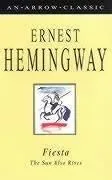
The Sun Also Rises
by Ernest Hemingway · 1926
Best suited to older teens and adults who can read between the lines of its understated style.
249 pages, about 4 to 6 hours.
Spare, restless Lost Generation novel that trusts what it leaves unsaid. 58% taste match
The story
The Sun Also Rises, first published in 1926, is Ernest Hemingway's first novel and belongs to the historical and literary fiction of American writing between the wars. It follows American and British expatriates living in Paris in the 1920s, among them Jake Barnes and Brett Ashley, whose lives are drawn into the world of the Lost Generation on the Left Bank.
The group leaves France and travels to Pamplona, Spain, for the Festival of San Fermín, where they watch the running of the bulls and the bullfights. The story is set during the reign of Alfonso XIII and deals with expatriate life, the aftermath of war, and the moral and spiritual drift of a generation. Charles Scribner's Sons issued it in the United States in October 1926, and Jonathan Cape brought it out in London a year later under the title Fiesta. The novel followed Hemingway's In Our Time, which appeared in 1925. It runs to roughly 249 pages and has appeared in 215 editions.
Setting
ParisFrancePamplonaSpainUnited States
Period
Alfonso XIII, 1886-1931
Themes
AmericansHistoryBrett Ashley (Fictitious character)Ashley, Brett (Fictitious character)American literatureClassicsLiteraryWar & Military
- Want to read 478
- Reading now 25
- Read 77
Most people shelving it are saving it for later.
Of 580 readers who put it on a shelf, 82% want to read it, 4% are reading it now, 13% have finished it and 0% stopped before the end.
By the numbers
- The median edition runs 249 pages. Counting about 275 words a page and an adult reading pace of 250 words a minute, that is about 4.6 hours of reading.
- Open Library tracks 215 editions from 109 publishers, the earliest dated 1926 and the latest 2024, across 11 languages.
- On reader demand it ranks in the top 2% of the classic books in our catalog (8,749 of them).
- Libraries shelve it under Dewey 813.52 and Library of Congress class PZ-0003.00000000.H3736 Su.
 BookWard’s take
Spare, restless Lost Generation novel that trusts what it leaves unsaid
Hemingway's first novel follows American and British expatriates from the cafes of Paris to the fiesta in Pamplona, and it still reads as lean as its reputation says. At 249 pages it is pleasingly short. The prose is plain, because the sentences are stripped and repetitive on purpose, and the book prefers showing to explaining: feelings surface through drinks, dialogue and small gestures rather than commentary. Character depth is the real strength, since Jake Barnes and Brett Ashley are drawn by what they avoid saying. The ending is where some readers may part ways, because the book closes on mood rather than resolution. Expect a slow-drifting first stretch rather than an instant hook, and a bleak outlook beneath the sunlit surface.
At 249 pages and written in short, clipped sentences, it is compact, which matches BookWard's taste for tight books.
The travel from Paris to Pamplona keeps things moving, but the rhythm is unhurried and conversational.
Its stripped-down style and portrait of a postwar generation were distinctive for an early modernist novel.
The prose is deliberately plain and stripped back, far from ornate, which BookWard finds a little too bare.
Little happens in plot terms; the book is driven by its characters and their relationships.
Its outlook is melancholy, centred on moral and spiritual dissolution after the war.
The structure is conventional, a travel narrative in a straightforward sequence.
There is dry banter among the friends, but the book is overwhelmingly serious.
It is shadowed by war's aftermath and spiritual drift, without graphic bleakness.
Feelings run deep but are kept deliberately understated.
See all 50 dialsEvery position, side by side with this book
Where it lines up
- Character depthBookWard 8 · book 8
- ExpositionBookWard 2 · book 2
- LengthBookWard 1 · book 2
Where it pulls apart
- OpeningBookWard 10 · book 4
- EndingBookWard 8 · book 3
- Familiar tropesBookWard 10 · book 7
At 249 pages and written in short, clipped sentences, it is compact, which matches BookWard's taste for tight books.
It opens in the Paris expatriate circle and takes its time settling in, so it is not a grab-you-at-once opener.
Its expatriate drifters and bullfight setting were fresh in 1926 and have since shaped a lot of imitation.
Events follow plainly from the characters' choices and circumstances, with nothing that strains belief.
The travel from Paris to Pamplona keeps things moving, but the rhythm is unhurried and conversational.
Its stripped-down style and portrait of a postwar generation were distinctive for an early modernist novel.
Jake and Brett are drawn through what they dodge and deflect, which gives them real depth.
It closes on a quiet, unresolved note rather than tying things up, which sits against BookWard's preference.
Emotion is held back and understated throughout, which is exactly the restraint BookWard values.
Its darkness comes from damaged lives and drift, not from shock for effect.
Not applicable: this is a novel, not a work of nonfiction.
Hemingway's voice is among the most recognisable in American fiction, which BookWard rates highly.
It is story-led, but the ideas about a disillusioned generation sit just beneath the scenes.
Almost nothing is explained outright; meaning is carried by scene, gesture and dialogue.
The Paris stretch can feel aimless, though the fiesta section gives the book a sustained second half.
The prose is deliberately plain and stripped back, far from ornate, which BookWard finds a little too bare.
Little happens in plot terms; the book is driven by its characters and their relationships.
Its outlook is melancholy, centred on moral and spiritual dissolution after the war.
The structure is conventional, a travel narrative in a straightforward sequence.
There is dry banter among the friends, but the book is overwhelmingly serious.
The sentences are simple and easy to follow, though the unspoken subtext rewards attention.
The story is told from a single point of view, that of Jake Barnes.
The story moves forward in a linear way from Paris to Spain.
It is wholly grounded in a real 1920s Europe.
A small circle of friends and acquaintances carries the story.
The focus is a close, personal circle, even with the festival as backdrop.
The action is mostly cafes, travel and bullfights, but the weight sits on what characters feel and suppress.
Much of the book plays out in conversation, much of it spare and repetitive by design.
The tangled attachments around Brett Ashley are central to the story.
The Paris expatriate scene and the San Fermin festival in Pamplona are vivid and specific.
It is set in the 1920s, during the reign of Alfonso XIII.
It remains in print and is widely regarded as Hemingway's most important novel.
The narration is plain and largely trustworthy, though Jake withholds his feelings.
The characters' choices are judged lightly, leaving their drift and dissolution morally unsettled.
Description is economical, with just enough detail on place, food and drink to anchor the scenes.
It is a standalone novel, not part of a series.
The book offers few plot surprises; it is a study of mood and relationships.
The emotional emptiness and aimlessness are uncomfortable rather than consoling.
It is shadowed by war's aftermath and spiritual drift, without graphic bleakness.
Feelings run deep but are kept deliberately understated.
Where humour appears it is dry and understated, never broad.
The bullfights are brutal on the page, but the rest is largely free of violence.
Desire drives the plot, but it is handled with reticence rather than explicitness.
Politics sits well in the background.
The language is plain and accessible throughout.
The narration observes rather than editorialises.
The book looks back at a generation shaped and scarred by the war.
The mood is disillusioned and cynical about what the generation has left to believe in.
Review written by BookWard, dial version 1, November 2026.
Who is The Sun Also Rises right for?
Best suited to older teens and adults who can read between the lines of its understated style. It deals with heavy drinking, romantic entanglement and the brutality of bullfighting.
The sentences are simple and easy to follow, though the unspoken subtext rewards attention.
It is shadowed by war's aftermath and spiritual drift, without graphic bleakness.
Feelings run deep but are kept deliberately understated.
The bullfights are brutal on the page, but the rest is largely free of violence.
Book CompanionThe Sun Also Rises: ideas, characters, themes
A circle of aimless expatriates drifts from Paris to Pamplona, their unspoken wounds shaping every conversation.
- The Lost Generation. The novel portrays postwar expatriates on the Left Bank adrift in moral and spiritual dissolution.
- Paris to Pamplona. The group travels from France to Spain for the Festival of San Fermin and its running of the bulls.
- Restraint as style. Hemingway's spare prose lets feeling live in what the characters leave out.
- Bullfighting. The bullfights bring the book's brutality and ritual into the open.
- Publication. Scribner's issued it in October 1926, and Jonathan Cape published it in London a year later as Fiesta.
Characters
Jake Barnes
Central figure
An American expatriate whose quiet view shapes the story.
Brett Ashley
Object of attention
A charismatic woman at the centre of the group's tangled attachments.
Themes
The sense of a generation emptied out by war.
Life lived abroad without purpose or roots.
Emotion that surfaces only through gesture and omission.
The bullfight as a stark counterpoint to the characters' lives.
Discussion questions
- Why might Hemingway choose such plain, repetitive sentences, and what do they conceal or reveal?
- How does the shift from Paris to Pamplona change the mood of the group?
- What do the bullfights suggest about the characters' own lives?
- Is the novel's title hopeful, ironic, or both?
- How does the book portray a generation shaped by war without describing the war itself?
Personalize your Book Companion
This is the general edition. In BookWard, the Companion is written for you: your reading profile, your notes, and spoiler-safe to the page you are on.
Buy, listen or borrow The Sun Also Rises
Each link opens a search for this book on that store, in a new tab.
Read on a device
Borrow
Reviews and community
If you liked The Sun Also Rises
A flat, unflinching ledger of addiction from Burroughs's debut
Ham on RyeCharles BukowskiA blunt, funny, bruising Depression-era boyhood in Los Angeles
FleshDavid SzalayA spare, watchful portrait of a drifting immigrant's rise
PassingNella LarsenA short, sharp novel about friendship, identity, and a secret in Harlem
Sources: Open Library.
Track The Sun Also Rises and find your next favorite
Add it to your shelf, rate what you have read, and BookWard will recommend what fits you.
Free to start. No credit card needed.