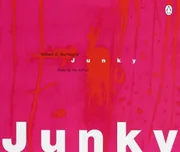
Junky
by William S. Burroughs, Oliver Harris · 1951
Best suited to adult readers and older teens.
159 pages, about 2.5 to 3.5 hours.
A flat, unflinching ledger of addiction from Burroughs's debut. 56% taste match
The story
Junky is the debut novel of William S. Burroughs, an American writer associated with the Beat Generation. It follows a narrator named William Lee through a life dominated by morphine and heroin. Burroughs drew on his own experience, and the book appeared under the pen name William Lee. Readers have long debated whether Lee is simply the author himself, which would make the book close to a memoir, or a fictional figure modeled on him.
The story moves through the 1950s across several settings: the streets of New York, a treatment hospital in Kentucky, New Orleans, and finally Mexico. Its scenes deal with the daily work of finding drugs, money troubles, and the narrator's relationships and encounters with other men. The tone is flat and unadorned, with events reported plainly rather than dramatized. First published in 1951, it pushed at the limits of what publishers were willing to print at the time. Shelved as American fiction, it is also read as an account of drug addiction in postwar America. About 159 pages in the median edition, it has appeared in 48 editions.
Setting
New YorkNew Orleans (La.)KentuckyMexico
Period
1950's
Themes
Drug addictsHeroin abuseDrug useBiographyDrug abuseHeroinDrogenabhängigkeitPs3552.u75 j86 2003
- Want to read 173
- Reading now 10
- Read 39
Most people shelving it are saving it for later.
Of 222 readers who put it on a shelf, 78% want to read it, 5% are reading it now, 18% have finished it and 0% stopped before the end.
By the numbers
- The median edition runs 159 pages. Counting about 275 words a page and an adult reading pace of 250 words a minute, that is about 2.9 hours of reading.
- Open Library tracks 48 editions from 28 publishers, the earliest dated 1953 and the latest 2012, across 7 languages.
- On reader demand it ranks in the top 5% of the classic books in our catalog (8,749 of them).
- Libraries shelve it under Dewey 818.54 and Library of Congress class J--0086.00000000.
 BookWard’s take
A flat, unflinching ledger of addiction from Burroughs's debut
Junky reports a life run by morphine and heroin without ornament, and that plainness is the point. Burroughs narrates as William Lee, moving from New York to a Kentucky treatment hospital, then New Orleans and Mexico. At about 159 pages it is as lean as I like a book to be. The prose is spare, with events stated rather than dramatized, and the voice is distinctive precisely because it refuses to perform. Emotion stays restrained, and the coldness of the telling is something I admire here rather than hold against it. It will not satisfy anyone wanting a tidy arc or a redemptive turn, because the book's subtitle already promises an unredeemed addict. Read it as a document of the early 1950s underworld as much as a story.
At about 159 pages it is short and compact, which suits BookWard's preference for tight books.
Short episodic chapters keep it moving, though the mood is flat and repetitive by design, below BookWard's brisk preference.
For 1951 it pushed the limits of what could be published, and its matter-of-fact approach was unusual.
The prose is plain and unadorned, with events reported rather than dressed up.
It follows one man's routine and relationships more than a built plot, leaning character-driven.
Addiction is presented without rescue or uplift, so the outlook is bleak.
It moves along a conventional chronological path through its settings.
The tone is serious, though a dry detachment sometimes shows through.
Addiction, desperation and degradation are central to the book.
The affect is deliberately flat, holding feeling at arm's length.
See all 50 dialsEvery position, side by side with this book
Where it lines up
- LengthBookWard 1 · book 1
- Authorial voiceBookWard 9 · book 9
- OriginalityBookWard 9 · book 8
Where it pulls apart
- OpeningBookWard 10 · book 6
- EndingBookWard 8 · book 3
- Familiar tropesBookWard 10 · book 7
At about 159 pages it is short and compact, which suits BookWard's preference for tight books.
It opens straight into the narrator's drug life without scene-setting, though it builds through episodes rather than a single gripping question.
It avoids redemption-story conventions, and its subtitle announces an unredeemed addict, which BookWard values.
Events follow cause and effect through the practical grind of getting drugs and money, so the internal logic holds.
Short episodic chapters keep it moving, though the mood is flat and repetitive by design, below BookWard's brisk preference.
For 1951 it pushed the limits of what could be published, and its matter-of-fact approach was unusual.
Lee is drawn through his habits and routines rather than deep interior exploration, so it falls short of BookWard's character depth.
The book follows a drifting life from place to place and resolves less cleanly than BookWard prefers.
The narration reports events with no sentimentality at all, which is exactly the restraint BookWard rewards.
The darkness comes from honest reporting of addiction rather than staged shock, which BookWard respects.
This is a novel, so the nonfiction rigor dial does not apply.
The flat, deadpan reporting voice is unmistakably Burroughs and stands apart from other fiction.
It is driven by episodes of a life rather than by an argument, though it carries a strong implicit view of addiction.
The narrator often explains how addiction and the drug trade work, more than BookWard's show-in-scene preference.
Short episodes keep it from sagging, though the repeated cycle of need and supply flattens the middle.
The prose is plain and unadorned, with events reported rather than dressed up.
It follows one man's routine and relationships more than a built plot, leaning character-driven.
Addiction is presented without rescue or uplift, so the outlook is bleak.
It moves along a conventional chronological path through its settings.
The tone is serious, though a dry detachment sometimes shows through.
The prose is easy to read, but the subject matter makes it a challenging experience.
Everything comes through one narrator, William Lee.
The story moves forward in time from New York through Kentucky and New Orleans to Mexico.
It is firmly grounded in real streets, hospitals and bars.
Lee meets a modest run of dealers, users and acquaintances across several cities.
It stays close to one man's daily survival rather than any wide historical sweep.
It dwells on the practical action of finding drugs and money more than on introspection.
Conversation is a regular part of the scenes, though narration carries much of the book.
Relationships and encounters appear, but romance is not the focus.
The 1950s drug underworld will be unfamiliar territory for most readers.
It is set in the 1950s and reads as a period account.
Its subject and unvarnished voice still read as relevant decades later.
Lee reports plainly, though readers have long debated how closely he matches Burroughs himself.
It neither condemns nor glorifies, leaving judgment to the reader.
Description is spare and functional rather than lush.
This is fiction, so the nonfiction style dial does not apply.
The narration is a first-person account, close and personal in its viewpoint.
It stands alone as Burroughs's debut novel.
Events unfold as a stream of episodes rather than a plot of reversals.
It is an uncomfortable, uncompromising look at heroin and morphine addiction.
Addiction, desperation and degradation are central to the book.
The affect is deliberately flat, holding feeling at arm's length.
Any humor is dry and deadpan rather than broad.
Hardship and risk are present, but graphic violence is not the focus.
Homosexual encounters appear among the narrator's relationships.
It is concerned with the drug world rather than overt political argument.
The slang of the underworld adds some density, but the sentences are plain.
The narration mostly reports and holds back from commenting.
It looks back at a specific stretch of the author's life in postwar America.
The worldview is hard-bitten and unillusioned.
Review written by BookWard, dial version 1, November 2026.
Who is Junky right for?
Best suited to adult readers and older teens. It contains frank depictions of drug use and sexual encounters.
The prose is easy to read, but the subject matter makes it a challenging experience.
Addiction, desperation and degradation are central to the book.
The affect is deliberately flat, holding feeling at arm's length.
Hardship and risk are present, but graphic violence is not the focus.
Book CompanionJunky: ideas, characters, themes
Addiction is presented as a daily routine of need and supply, reported without judgment or redemption.
- A debut under a pen name. Burroughs published it as William Lee, the same name as its narrator.
- Autobiography or fiction?. Readers debate whether Lee is Burroughs himself or a character modeled on him.
- A journey across places. The story moves from New York to a Kentucky treatment hospital, New Orleans and Mexico.
- The work of getting drugs. Much of the book concerns finding drugs and managing money rather than the highs.
- Pushing publishing limits. First published in 1951, it stretched the boundaries of what was publishable.
Characters
William Lee
Narrator
The addict at the center of the story, whose life is shaped by morphine and heroin.
Themes
The physical and daily grip of morphine and heroin on a life.
A flat, reportorial tone that withholds judgment and sentiment.
The underworld of dealers, users and drifters in postwar America.
The blurred line between author and narrator.
Constant movement between cities as a way of life.
Discussion questions
- Does the flat tone make addiction feel more honest or more distant?
- Does it matter whether Lee is Burroughs or a fictional character?
- Why might Burroughs have refused any redemptive turn?
- How does moving between cities shape the narrator's experience?
- What made this material so hard to publish in 1951?
Personalize your Book Companion
This is the general edition. In BookWard, the Companion is written for you: your reading profile, your notes, and spoiler-safe to the page you are on.
Buy, listen or borrow Junky
Each link opens a search for this book on that store, in a new tab.
Read on a device
Borrow
Reviews and community
If you liked Junky
Orwell's first book, and a clear-eyed look at poverty
The Sun Also RisesErnest HemingwaySpare, restless Lost Generation novel that trusts what it leaves unsaid
The StrangerAlbert CamusA cold, short novella that still unsettles
Ham on RyeCharles BukowskiA blunt, funny, bruising Depression-era boyhood in Los Angeles
Sources: Open Library.
Track Junky and find your next favorite
Add it to your shelf, rate what you have read, and BookWard will recommend what fits you.
Free to start. No credit card needed.