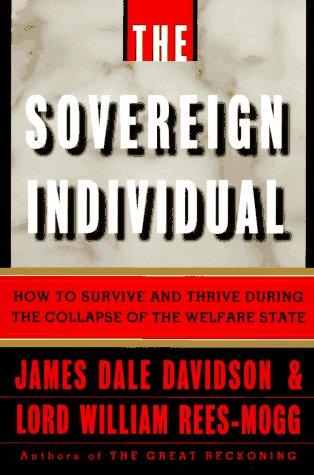
The Sovereign Individual
by James Dale Davidson
★ Top 25 book of 1997 · #21 on Best Books of 1997
Two investment advisors argue that the shift from an industrial to an information-based society will free individuals and weaken government power. They offer strategies for adapting financially to this coming stage of civilization.
Best for: Investors and big-picture thinkers interested in economic and political change ahead
The Sovereign Individual is #21 on BookWard's Best Books of 1997, out of 28 1997 books that cleared our data bar.
What The Sovereign Individual is about
This book tries to forecast the 21st century. William Rees-Mogg and James Dale Davidson argue that the rise of the information society will shift power away from nation-states and toward individuals. They predict that private digital money will replace government-issued currency, that taxes will become harder for governments to collect, and that states will respond badly as their grip loosens.
It is a speculative, deliberately provocative argument, and it has found a second life among readers interested in cryptocurrency and decentralization, with a 2020 reprint carrying a preface by Peter Thiel. It suits anyone curious about how technology might reshape politics and money, whether they come to agree with the authors or want to test their claims.
The Sovereign Individual on the Best Books of 1997
The Sovereign Individual came out in 1997. Of the 28 books first published in 1997 that met BookWard's data bar, it ranks #21 on our Best Books of 1997 list.
Why it made the list: 164 readers have shelved it on Open Library. The list ranks each year’s books on how many readers have picked them up, how highly readers rate them, and how many are reading them right now.
Nearby on the 1997 list
- Ella Enchanted Gail Carson Levine, #19
- The Perfect Storm Sebastian Junger, #20
- Story Robert McKee, #22
- Essential Cell Biology Bruce Alberts, #23
See all Best Books of 1997 Best books by year
More years: Best Books of 1996 Best Books of 1998.
The numbers behind it
- Readers: 152 want to read it, 8 are reading it now and 3 have read it, according to Open Library.
| Signal | This book (0 to 100) | Weight |
|---|---|---|
| Reach | 18 | 55% |
| Reader love | 57 | 25% |
| Being read right now | 36 | 20% |
Questions about The Sovereign Individual
When was The Sovereign Individual published?
The Sovereign Individual by James Dale Davidson was first published in 1997.
Was The Sovereign Individual one of the best books of 1997?
The Sovereign Individual is #21 on BookWard's Best Books of 1997, out of 28 1997 books that cleared our data bar. 164 readers have shelved it on Open Library.
Why is The Sovereign Individual on the Best Books of 1997 list?
164 readers have shelved it on Open Library.
More of the best books of 1997
- Harry Potter and the Philosopher's Stone J. K. Rowling, #1
- Rich Dad, Poor Dad Robert T. Kiyosaki, #2
- Guns, Germs, and Steel Jared Diamond, #3
- The Adventures of Captain Underpants Dav Pilkey, #4
- The Power of Now Eckhart Tolle, #5
- Into Thin Air Jon Krakauer, #6
See the full Best Books of 1997, the Top 100, or new books on Rising.
How we know
This page uses public data: Open Library reader counts and ratings, and Wikipedia page views for recent years. The description is paraphrased from real source text. Rankings reflect reading interest, not quality or sales, and can be affected by data gaps. Lists update monthly.
Best suited to adult readers and older teens with an interest in economics, technology or politics.
Depends on the edition you pick.
A bold 1997 forecast of the internet's threat to the state. 36% taste match
 BookWard’s take
A bold 1997 forecast of the internet's threat to the state
This is a book of sweeping prediction, idea-led from its first pages. Davidson and Rees-Mogg argue that the shift to an information society will free individuals from government and bring about the end of the nation-state. The voice is distinctive and confident, and the narration is openly opinionated, never neutral. It is also strikingly original, having anticipated cybermoney and decentralization decades before they became common talk. Where it falls short is rigor: the argument leans on bold historical sweep and forecasting rather than tight evidence, so it reads as provocation more than proof. Its outlook is optimistic about the individual and cool toward the collective, and its politics are front and center. Expect an argument to wrestle with rather than a settled account.
Cybermoney, decentralization and the decline of the nation-state were rare predictions in 1997, which BookWard rewards.
Clear and declarative with an occasional flourish, neither plain nor ornate.
There is no plot or cast to drive it, so this dial does not apply.
Hopeful for the capable individual, bleak for the state and for those who depend on it.
A conventional run of chapters building one extended case.
It is earnest and serious in tone, with little attempt at humor.
The subject is the collapse of existing structures, but the tone stays analytical rather than grim.
It is cool and argumentative, aiming at the reader's reason more than feelings.
See all 50 dialsEvery position, side by side with this book
Where it lines up
- OriginalityBookWard 9 · book 8
- SentimentBookWard 8 · book 9
- Authorial voiceBookWard 9 · book 8
Where it pulls apart
- LengthBookWard 1 · book 6
- Internal logicBookWard 10 · book 5
- Story or ideasBookWard 3 · book 10
The central thesis was unusual in 1997, though it draws on a familiar libertarian outlook.
The argument is coherent as a thesis, but its forecasts rest on assertion and sweep more than airtight reasoning, which BookWard weighs heavily.
Cybermoney, decentralization and the decline of the nation-state were rare predictions in 1997, which BookWard rewards.
This is an argument about systems and societies, not people, so character depth does not apply.
A forecast book has no plot to resolve, so an ending in the story sense does not apply.
The prose is unsentimental and analytical, treating the end of the welfare state without nostalgia.
It provokes with bold claims about the fall of nations, but the provocation serves the argument rather than shock for its own sake.
Its history is wide and its forecasts bold, but they lean on broad claims over detailed evidence, short of what BookWard prizes.
The authors write in a confident, unmistakable register that is plainly their own, which BookWard values.
The whole book is a thesis about where society is heading, with no story at all, far from BookWard's story-led leaning.
The argument is stated outright and at length rather than dramatized, the opposite of BookWard's preference for showing.
Clear and declarative with an occasional flourish, neither plain nor ornate.
There is no plot or cast to drive it, so this dial does not apply.
Hopeful for the capable individual, bleak for the state and for those who depend on it.
A conventional run of chapters building one extended case.
It is earnest and serious in tone, with little attempt at humor.
Reasonably demanding, with big historical and economic ideas you must hold across long stretches.
The authors argue from one consistent position throughout.
It moves between historical eras and the near future, so time shifts as the argument needs.
Everything is presented as real history and plausible forecast.
There is no cast in the usual sense, only societies and the individual as an idea.
It deals with civilizations, nation-states and the arc of Western history, which is epic in scope.
This is an argument about society, so inner thoughts versus outer action does not apply.
As an argued nonfiction work it has no dialogue.
There is no romance in this book.
The terrain is global economics, technology and politics, mostly familiar ground but pushed to unfamiliar conclusions.
Written in 1997 about the coming millennium, it is firmly of the late twentieth century, though still discussed today.
Parts have aged into relevance with the rise of digital currency, though its forecasts are tied to their moment.
The authors speak directly and plainly in their own voices, with no unreliable narrator in play.
The authors take a clear side for individual sovereignty, though readers may find the implications troubling.
Argument and history carry the book rather than scenic detail.
It reads as analysis and forecast far more than storytelling.
The authors argue from a distance and do not bring in their own lives.
It stands alone.
Its forecasts can surprise, but there are no plot twists to speak of.
It pushes against conventional views of the state, taxation and nationalism and invites disagreement.
The subject is the collapse of existing structures, but the tone stays analytical rather than grim.
It is cool and argumentative, aiming at the reader's reason more than feelings.
There is no humor to place.
There is no sexual content.
Politics is the whole subject, from the end of the nation-state to the future of money.
The language is plain, with occasional economic and technical terms.
The authors state their views forcefully and do not pretend to neutrality.
The entire book looks ahead to the information age and the new millennium.
It is idealistic about the freed individual yet cold toward collective institutions.
Review written by BookWard, dial version 1, November 2026.
Who is The Sovereign Individual right for?
Best suited to adult readers and older teens with an interest in economics, technology or politics. It makes sharp political claims and is not a balanced overview, so readers may want to weigh it against other views.
Reasonably demanding, with big historical and economic ideas you must hold across long stretches.
The subject is the collapse of existing structures, but the tone stays analytical rather than grim.
It is cool and argumentative, aiming at the reader's reason more than feelings.
Book CompanionThe Sovereign Individual: ideas, characters, themes
The authors argue that the rise of the information society will free individuals from the power of the state and bring about the end of the nation-state.
- The end of the nation-state. The authors forecast that nations and the welfare state will lose their hold as the information society grows.
- Self-ownership. Their central thesis rests on the individual's independence from the state and control over their own destiny.
- Cybermoney replaces fiat. They predict that digital currency controlled by private markets will supersede money issued by governments.
- A critique of nationalism. A chapter on nationalism and the new Luddites argues for individual control over collective identity.
- A new stage of civilization. They present the turn of the millennium as the birth of a new stage of Western civilization.
Themes
The idea that people should own and direct their own lives, free of state control.
How the internet and digital tools shift power away from governments.
The forecast that welfare states and nations will weaken as the economy goes digital.
The prediction that private cybermoney will replace government currency.
The claim that anonymity in cyberspace lets ability count over appearance and prejudice.
Discussion questions
- Which of the book's predictions about the internet and money seem to have come true, and which have not?
- Is the book's picture of an anonymous, prejudice-free cyberspace convincing?
- What does the book assume about people who cannot compete in the information economy?
- How persuasive is the argument that nation-states will fade?
- Does a bold forecast need rigorous evidence to be worth reading?
Personalize your Book Companion
This is the general edition. In BookWard, the Companion is written for you: your reading profile, your notes, and spoiler-safe to the page you are on.
Buy, listen or borrow The Sovereign Individual
Each link opens a search for this book on that store, in a new tab.
Read on a device
Borrow
Reviews and community
If you liked The Sovereign Individual
A sweeping history of information, and why AI raises the stakes
The Road to SerfdomFriedrich A. von HayekHayek's 1944 warning that planning the economy endangers freedom itself
The Beauty MythNaomi WolfA landmark argument that beauty standards police women as they gain power
Die Entwicklung des Sozialismus von der Utopie zur WissenschaftFriedrich EngelsEngels's short, argumentative primer on how socialism claimed to become a science
Find your own best books
Add what you have read, rate it, and BookWard will recommend what to read next.
Free to start. No credit card needed.