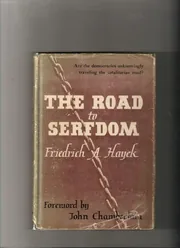
The Road to Serfdom
by Friedrich A. von Hayek · 1944
Best suited to adult and older teen readers interested in politics, economics and history.
248 pages, about 4 to 6 hours.
Hayek's 1944 warning that planning the economy endangers freedom itself. 40% taste match
What it covers
The Road to Serfdom is a work of political and economic argument by Friedrich A. von Hayek, an Austrian-British economist and philosopher. It first appeared in 1944 and sits within history and politics, drawing on economic theory, political science, and public policy. Its central concern is central planning and the question of how far a government should direct economic life.
Hayek maintains that handing economic decisions to the state tends to erode individual freedom and opens the way to dictatorship. He sets his case against the background of the 1930s and 1940s, looking at Nazi Germany and the USSR, and he treats fascism, Nazism, and state socialism as sharing common roots in economic planning. In doing so he disputes the view held by many British Marxists that fascism arose as a capitalist reaction to socialism.
The book has gone through 34 editions, with a median length of around 248 pages. One anniversary edition carries a new introduction by Milton Friedman. It suits readers interested in totalitarianism, the history of economic thought, and the debates over planning and liberty in the mid twentieth century.
Setting
USSRnazi-Germany
Period
1930s1940s
Themes
Economic policyInstitute of Economic AffairsTotalitarianismPolitical aspectsPolitical aspects of Central planningCentral planningLong Now Manual for CivilizationFascism & Nazism
- Want to read 160
- Reading now 7
- Read 18
Most people shelving it are saving it for later.
Of 185 readers who put it on a shelf, 86% want to read it, 4% are reading it now, 10% have finished it and 0% stopped before the end.
By the numbers
- The median edition runs 248 pages. Counting about 275 words a page and an adult reading pace of 250 words a minute, that is about 4.5 hours of reading.
- Open Library tracks 34 editions from 21 publishers, the earliest dated 1944 and the latest 2007, across 3 languages.
- On reader demand it ranks in the top 8% of the classic books in our catalog (8,749 of them).
- Libraries shelve it under Dewey 338.9 and Library of Congress class HD-0082.00000000.H38 1944a.
 BookWard’s take
Hayek's 1944 warning that planning the economy endangers freedom itself
This is an argument book, and it behaves like one. Hayek makes a single case, that central economic planning erodes liberty and opens the way to dictatorship, and he builds it chapter by chapter against the backdrop of Nazi Germany and the USSR. It is about as far toward ideas and away from story as a book can get: there is no plot, only a thesis pressed with steady logic. The voice is distinctive and the reasoning is rigorous, though it is argued rather than tested against data. It is openly opinionated, and politics is front and center throughout. At 248 pages it is a moderate length, and the reading takes real effort without becoming a slog. I admire the airtight case and miss any sense of scene; expect to be persuaded or provoked, rarely bored.
At 248 pages it is mid-sized for a book of political argument, long enough to build the case but not sprawling.
The argument moves at a measured, deliberate pace, more steady than brisk.
Linking Nazism, fascism and state socialism through shared roots in planning was a bold reframing in 1944.
The prose is clear and workmanlike rather than ornate, built to carry an argument.
It is a warning about a dark path, so the outlook leans bleak even as it defends liberty.
It follows a conventional progression of chapters building one case.
It is wholly serious, with no humor to speak of.
Its subject is totalitarianism and tyranny, which gives it a dark undertone without graphic detail.
The register is cool and rational, not emotionally intense.
See all 50 dialsEvery position, side by side with this book
Where it lines up
- SentimentBookWard 8 · book 9
- Shock for effectBookWard 9 · book 8
- Authorial voiceBookWard 9 · book 8
Where it pulls apart
- ExpositionBookWard 2 · book 10
- OpeningBookWard 10 · book 5
- Story or ideasBookWard 3 · book 10
At 248 pages it is mid-sized for a book of political argument, long enough to build the case but not sprawling.
It opens straight into its thesis about planning and freedom, though as an argument rather than a gripping scene.
Its claims have become familiar through decades of debate, but the framing of fascism and socialism as kin was a deliberate challenge.
Each step follows from the last, building one chain from planning to loss of liberty, which BookWard rewards.
The argument moves at a measured, deliberate pace, more steady than brisk.
Linking Nazism, fascism and state socialism through shared roots in planning was a bold reframing in 1944.
It closes by pressing its case to a firm conclusion rather than leaving the question open.
The tone is cool and reasoned, not sentimental, which suits BookWard.
Its warnings are stark but argued from evidence and reasoning rather than used for effect.
It is a serious work of economic and political theory, though more argued than empirically tested.
Hayek writes with a clear, confident, unmistakable authorial stance that BookWard likes.
This is almost purely idea-led, with a thesis in place of a narrative, the opposite of BookWard's story lean.
It explains its reasoning outright and at length, which BookWard finds the weak spot in an otherwise strong book.
The argument holds together, though a theory-heavy stretch can slow the middle.
The prose is clear and workmanlike rather than ornate, built to carry an argument.
It is a warning about a dark path, so the outlook leans bleak even as it defends liberty.
It follows a conventional progression of chapters building one case.
It is wholly serious, with no humor to speak of.
The ideas and economic reasoning ask for sustained attention, more than a casual read.
One author argues one position throughout.
It moves forward through a linear argument, with only background reference to the 1930s and 1940s.
Entirely grounded in real politics and history.
It addresses the fate of whole societies and systems, an epic canvas for an argument.
It concerns institutions, policy and events in the world rather than private inner life.
As an argumentative work it has no dialogue.
There is no romance.
The settings of Nazi Germany, the USSR and mid-century Britain are historical but well documented.
Written in 1944, it belongs to the mid twentieth century, though it continues to be argued over today.
It has stayed in print and in debate for decades, speaking to each era's arguments about state and market.
The author argues in his own plain voice, with nothing hidden.
Hayek takes a firm side on liberty and planning rather than leaving the question ambiguous.
Description is sparse; the book argues rather than paints scenes.
It is analytical argument, not narrative history or storytelling.
Hayek keeps a detached, theoretical stance rather than telling a personal story.
A standalone work.
An argument builds rather than surprises, so there are few twists.
It was seen as heretical in its day and still provokes disagreement, so it challenges more than comforts.
Its subject is totalitarianism and tyranny, which gives it a dark undertone without graphic detail.
The register is cool and rational, not emotionally intense.
There is no humor to place on this scale.
Violence appears only as historical background, not as scenes on the page.
There is no sexual content.
Politics is the entire subject, argued from the first page.
The language is plain but the economic and philosophical vocabulary can be dense.
Hayek argues a clear position and never pretends to neutrality.
It looks both back at recent history and forward as a warning about where policy leads.
It defends individual liberty as a principle, though it expects the worst of state power.
Review written by BookWard, dial version 1, November 2026.
Who is The Road to Serfdom right for?
Best suited to adult and older teen readers interested in politics, economics and history. It deals with totalitarianism and tyranny, though without graphic detail.
The ideas and economic reasoning ask for sustained attention, more than a casual read.
Its subject is totalitarianism and tyranny, which gives it a dark undertone without graphic detail.
The register is cool and rational, not emotionally intense.
Violence appears only as historical background, not as scenes on the page.
Book CompanionThe Road to Serfdom: ideas, characters, themes
Hayek argues that handing economic decisions to the state erodes individual freedom and tends toward dictatorship.
- Planning and liberty. The book's central claim is that central control of economic life undermines personal freedom.
- Fascism and socialism as kin. Hayek treats fascism, Nazism and state socialism as sharing common roots in economic planning.
- A challenge to British Marxists. He disputes the view that fascism was a capitalist reaction against socialism.
- Lessons from the 1930s and 1940s. He draws on Nazi Germany and the USSR as evidence for how planning can go wrong.
- Classical liberalism defended. He argues that abandoning individualism and classical liberalism leads to an oppressive society.
Themes
Individual freedom from state control over daily and economic life.
Government direction of economic decisions, and what Hayek believes follows from it.
The concentration of power in a dictator and an oppressive state.
The view that the individual, not the collective, is the basis of a free society.
How economic arrangements shape political freedom.
Discussion questions
- Is Hayek right that economic control and personal freedom are so tightly linked?
- How convincing is the claim that fascism and socialism share common roots?
- Which of his warnings feel most relevant to politics today?
- Does an argument written in 1944 hold up against later events and policy?
- Where would you draw the line between useful planning and the road he warns about?
Personalize your Book Companion
This is the general edition. In BookWard, the Companion is written for you: your reading profile, your notes, and spoiler-safe to the page you are on.
Buy, listen or borrow The Road to Serfdom
Each link opens a search for this book on that store, in a new tab.
Read on a device
Borrow
Reviews and community
If you liked The Road to Serfdom
Lenin's short, fierce argument that the state serves one class
Die Entwicklung des Sozialismus von der Utopie zur WissenschaftFriedrich EngelsEngels's short, argumentative primer on how socialism claimed to become a science
The True Believer:Thoughts on the Nature of Mass MovementsEric HofferA short, sharp study of why people surrender to causes
Amusing Ourselves to DeathNeil PostmanA short, sharp case against turning everything into a show
Sources: Open Library.
Track The Road to Serfdom and find your next favorite
Add it to your shelf, rate what you have read, and BookWard will recommend what fits you.
Free to start. No credit card needed.