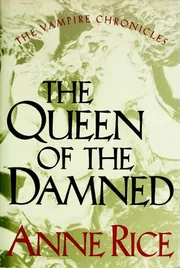
The Queen of the Damned
by Anne Rice · 1988
Best suited to adult readers and mature older teens comfortable with gothic horror.
573 pages, about 9 to 13.5 hours.
Anne Rice's sprawling vampire myth, braided from three storylines. 43% taste match
The story
The Queen of the Damned is a horror and gothic novel by Anne Rice, first published in 1988. It is the third book in The Vampire Chronicles, following Interview with the Vampire and The Vampire Lestat, and it picks up from the cliffhanger that closed the previous volume. The story centers on Lestat de Lioncourt, a vampire who has become a rock star, and draws on the history and mythology of the vampire race, reaching back to Ancient Egypt.
The novel braids three storylines. Lestat prepares for a concert in San Francisco where vampires in the audience want to destroy him. Vampires and mortals around the world share a dream of red-haired twins and begin traveling toward one another. After Lestat's descent into a cavern beneath a Greek island, Akasha, the mother of all vampires, wakes from a sleep of six thousand years with plans to elevate herself to the level of the gods. Characters include Louis, Armand, Gabrielle, Pandora, Maharet, and David Talbot, with settings that range from New Orleans and France to London, Sonoma, and Night Island. Print editions run to about 573 pages.
I'M THE Vampire Lestat. Remember me?
Characters
MaharetArmandLouisDavid TalbotLestat de LioncourtAkasha
Setting
New OrleansFranceSan FranciscoGreeceSonoma
Themes
VampiresHorror taleshorrorrock musicspiritsNew World OrderLestat (Fictitious character)
- Want to read 292
- Reading now 11
- Read 72
Most people shelving it are saving it for later.
Of 375 readers who put it on a shelf, 78% want to read it, 3% are reading it now, 19% have finished it and 0% stopped before the end.
By the numbers
- The median edition runs 573 pages. Counting about 275 words a page and an adult reading pace of 250 words a minute, that is about 11 hours of reading.
- Open Library tracks 55 editions from 38 publishers, the earliest dated 1988 and the latest 2021, across 6 languages.
- On reader demand it ranks in the top 1% of the modern books in our catalog (15,152 of them).
- Libraries shelve it under Dewey [Fic] and Library of Congress class PS-3568.00000000.I265Q44 1988.
 BookWard’s take
Anne Rice's sprawling vampire myth, braided from three storylines
This is a big, ambitious third volume, and it asks that you have read the first two. At 573 pages it sprawls, and it will frustrate anyone who prefers a tight book. The braided plot, with Lestat's concert, the dreamers and Akasha's waking, brings a large cast and several points of view, and the Egyptian-rooted mythology is genuinely original. But the three strands pull against each other, the middle drifts, and the book lingers where a leaner one would push on. The prose is ornate and the scale is epic, both a long way from plain-spoken storytelling. What you get in return is an unmistakable authorial voice and a vampire history that few books attempt on this scale.
At 573 pages it sprawls, which runs against BookWard's preference for tight, short books.
Three storylines converge slowly across a long book, so the pace is measured rather than the fast clip BookWard favors.
Tracing vampire origins to Ancient Egypt and making a vampire a rock star is a bold, distinctive take on the genre.
The language is lush, ornate and gothic, well past plain, which sits further out than BookWard's taste.
Plot and character share the load, with Akasha's scheme driving events and the vampires' histories giving them depth.
Akasha plans to remake the world by force and the tone is dark, so hope is scarce.
Three parallel threads converge across the book, a more intricate structure than a straight telling.
This is a serious, brooding book with little room for humor.
Vampire violence, a vengeful queen and a threatened humanity make it dark.
Grief, obsession and longing run high through the immortals' stories.
See all 50 dialsEvery position, side by side with this book
Where it lines up
- Authorial voiceBookWard 9 · book 9
- Character depthBookWard 8 · book 7
- EndingBookWard 8 · book 7
Where it pulls apart
- LengthBookWard 1 · book 9
- OpeningBookWard 10 · book 6
- Familiar tropesBookWard 10 · book 6
At 573 pages it sprawls, which runs against BookWard's preference for tight, short books.
Vampires, ancient queens and gods are familiar gothic stock, though Rice reshapes them with her own mythology, so it avoids tropes only partly.
The mythology of the vampire race holds together across the series, but its grand cosmology asks for some belief, short of airtight.
Three storylines converge slowly across a long book, so the pace is measured rather than the fast clip BookWard favors.
Tracing vampire origins to Ancient Egypt and making a vampire a rock star is a bold, distinctive take on the genre.
Lestat, Akasha and the dreamers carry real inner lives, though the large cast spreads that depth thin in places.
The converging threads are brought to a decisive confrontation in the twentieth century, a largely resolved ending.
The tone runs lush and operatic, leaning toward feeling over restraint, which sits a little warmer than BookWard prefers.
The darkness serves the mythology and the stakes rather than existing for its own sake, so it mostly earns its place.
This is a novel, so the nonfiction rigor dial does not apply.
Rice's rich, immersive style is unmistakable, which BookWard values highly.
It is story-led, but the mythology and the idea of a god-queen remaking humanity carry real weight.
Much of the vampire history arrives through recounting and explanation rather than purely in scene, leaning toward telling.
Moving between three storylines across 573 pages leaves some stretches slack, short of the sustained drive BookWard likes.
The language is lush, ornate and gothic, well past plain, which sits further out than BookWard's taste.
Plot and character share the load, with Akasha's scheme driving events and the vampires' histories giving them depth.
Akasha plans to remake the world by force and the tone is dark, so hope is scarce.
Three parallel threads converge across the book, a more intricate structure than a straight telling.
This is a serious, brooding book with little room for humor.
The length, the cast and the dependence on earlier volumes make it a demanding read.
Lestat, the dreamers and Akasha give it several threads and many perspectives.
It moves between the present day and ancient history, so time keeps shifting.
Immortal vampires and a six-thousand-year-old queen make this wholly fantastical.
Louis, Armand, Gabrielle, Maharet, David Talbot and many more make a large ensemble.
The fate of mankind and the vampire race is at stake across millennia, which is epic scale.
Interior reflection and external events are balanced, with vampires brooding as the plot rushes ahead.
Conversation carries a good share of the history and the confrontations, so it is fairly heavy on dialogue.
Lestat and Akasha's bond and other attachments matter, but romance is one thread among several.
Ancient Egypt, a hidden vampire society and Night Island make for an unfamiliar world.
It is set partly in the late twentieth century and partly in the ancient past, mostly a past-leaning mix.
Its gothic mythology has lasting appeal, though some of its late-1980s flavor shows.
The voices are largely trustworthy storytellers recounting their own histories, so reliability is moderate.
Akasha's plan to save humanity through domination is a morally ambiguous goal, and the book keeps it unclear who is right.
Rice describes places, bodies and ancient scenes in rich, sensory detail.
This is fiction, so the nonfiction style dial does not apply.
This is fiction, so the nonfiction perspective dial does not apply.
It is the third Vampire Chronicles book and picks up the previous cliffhanger.
Revelations about vampire origins and Akasha's plans arrive throughout, though the big picture is signposted.
It asks you to take on a grand mythology and a morally unsettling queen, more challenge than comfort.
Vampire violence, a vengeful queen and a threatened humanity make it dark.
Grief, obsession and longing run high through the immortals' stories.
What humor there is runs toward theatrical flourish rather than dry wit.
Vampire killings and the threat of mass death put violence regularly on the page.
Vampire sensuality and desire are woven through, and the subjects point to erotic elements.
Akasha's plan to remake the social order has political overtones, but politics is not the focus.
The language is elaborate and dense in places, though not dialect-heavy.
The narrators speak with strong, personal attitudes about immortality and humanity.
It keeps digging back into ancient history even as the plot races toward a twentieth-century showdown.
Akasha's utopian ambition is dark and coercive, and the book leans more cynical than idealistic.
Review written by BookWard, dial version 1, November 2026.
Who is The Queen of the Damned right for?
Best suited to adult readers and mature older teens comfortable with gothic horror. It includes graphic vampire violence, intense themes and sensual content.
The length, the cast and the dependence on earlier volumes make it a demanding read.
Vampire violence, a vengeful queen and a threatened humanity make it dark.
Grief, obsession and longing run high through the immortals' stories.
Vampire killings and the threat of mass death put violence regularly on the page.
Book CompanionThe Queen of the Damned: ideas, characters, themes
A vampire rock star, an awakened ancient queen and a global dream draw the vampire world toward a reckoning over its own origins.
- Three threads converge. Lestat's concert, the dreamers' pilgrimage and Akasha's awakening move separately before meeting in the twentieth century.
- The origin myth. The book traces the vampire race back to Ancient Egypt, revealing its history and mythology.
- A cliffhanger continued. It resumes the story left open at the end of The Vampire Lestat.
- A queen's plan. Akasha wakes after six thousand years intent on saving mankind from itself by raising herself and a chosen consort to godhood.
- Vampires and mortals entangled. The reach of vampires into the mortal world is shown across settings from New Orleans and France to London and Night Island.
Characters
Lestat de Lioncourt
Vampire and rock star
He prepares for a San Francisco concert while other vampires plot against him.
Akasha
Queen of the Damned
The mother of all vampires, she wakes from a six-thousand-year sleep with plans to become godlike.
Maharet
Ancient vampire
She is among the figures drawn into the story of the red-haired twins.
Louis
Fellow vampire
He is one of the vampires caught up in these events.
David Talbot
Human-linked figure
He is one of the characters moving through the book's settings.
Themes
Where a people and its powers come from, and why that history matters.
Akasha's wish to remake the world by raising herself above humanity.
What endless life does to love, loyalty and conscience.
A vampire in the spotlight risks revealing a hidden world.
Strangers pulled by a shared vision toward a common destination.
Discussion questions
- Is Akasha's plan to save humanity a rescue or a conquest?
- Why would Lestat risk exposure by becoming a rock star?
- How does the mythology of the vampires' origins change what you thought of them?
- What draws the dreamers toward one another, and what does that say about fate?
- Does the book work without having read the earlier two?
Personalize your Book Companion
This is the general edition. In BookWard, the Companion is written for you: your reading profile, your notes, and spoiler-safe to the page you are on.
Buy, listen or borrow The Queen of the Damned
Each link opens a search for this book on that store, in a new tab.
Read on a device
Borrow
Reviews and community
If you liked The Queen of the Damned
A long, lush Mayfair sequel where the supernatural gets a body
The Witching HourAnne RiceA vast, hypnotic New Orleans witch saga that rewards patience
The Vampire LestatAnne RiceA rock-star vampire tells his own story, grandly and unapologetically
The Wise Man’s FearPatrick RothfussA sprawling, voice-rich fantasy middle volume that rewards patience over speed
Sources: Open Library.
Track The Queen of the Damned and find your next favorite
Add it to your shelf, rate what you have read, and BookWard will recommend what fits you.
Free to start. No credit card needed.