This suits young readers who enjoy puns and big ideas, and it works well read aloud.
255 pages, about 4 to 6 hours.
A wordplay-packed quest where idioms turn literal and boredom ends. 55% taste match
About the book
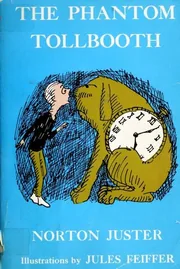
The Phantom Tollbooth is a children's fantasy adventure by Norton Juster, first published in 1961 with illustrations by Jules Feiffer. It begins with Milo, a boy who never knows what to do with himself. One afternoon a magic tollbooth turns up, and he drives his toy car through it into the Kingdom of Wisdom, a land that was once prosperous and has since fallen on hard times.
Milo travels with a dog named Tock and the Humbug on a quest to the Castle in the Air, where the kingdom's exiled princesses, Rhyme and Reason, are to be found. Along the way he passes through places such as Dictionopolis, Digitopolis, the Doldrums, the Word Market, and the Mountains of Ignorance, and meets figures including King Azaz the Unabridged, the Spelling Bee, Officer Shrift, the Mathemagician, Alec Bings, and Chroma the Great. Letters, numbers, and orchestras all figure in the journey. The story plays with puns and wordplay, taking familiar idioms literally, as when Milo jumps to Conclusions, an island in Wisdom. Boredom, imagination, and the pleasures of discovery and learning run through the adventure. It is an American fantasy for young readers, available in many editions.
There was once a boy named Milo who didn't know what to do with himself-not just sometimes, but always.
Characters
HumbugMiloTockKing Azaz the UnabridgedSpelling BeeOfficer Shrift
Setting
Castle in the AirDictionopolisDigitopolisDoldrumsMountains of Ignorance
Themes
lettersnumbersorchestraschildren's literatureadventureCreativity and ImaginationBoredomMagic and Supernatural
- Want to read 714
- Reading now 70
- Read 148
Most people shelving it are saving it for later.
Of 932 readers who put it on a shelf, 77% want to read it, 8% are reading it now, 16% have finished it and 0% stopped before the end.
By the numbers
- The median edition runs 255 pages. Counting about 275 words a page and an adult reading pace of 250 words a minute, that is about 4.7 hours of reading.
- Open Library tracks 65 editions from 44 publishers, the earliest dated 1961 and the latest 2022, across 8 languages.
- On reader demand it ranks in the top 1% of the classic books in our catalog (8,749 of them).
- Libraries shelve it under Dewey [Fic] and Library of Congress class PZ-0007.00000000.J9865 Ph 1996.
 BookWard’s take
A wordplay-packed quest where idioms turn literal and boredom ends
Milo starts out not knowing what to do with himself, and the first sentence says so plainly. That is the hook, and it works at once: a tollbooth appears and he drives through it. What follows is a quest for the exiled princesses Rhyme and Reason, built almost entirely from puns taken at their word, so that jumping to Conclusions means landing on an island. Few books turn language itself into geography with this much invention. The logic holds up too, because every joke follows rules the book sets for itself. It is driven more by ideas than by story, and it tends to explain outright where I would rather see a point shown in scene. A book to read for its ideas, which it carries lightly.
At 255 pages it is compact and brisk for a quest, close enough to BookWard's love of tight books.
Milo moves from one strange place to the next without lingering, though the talky stops slow it a touch.
Taking idioms literally and mapping them as places is a distinctive idea that BookWard admires.
The prose is clear and playful, with word games adding a sheen but not heavy ornament.
The quest structure and its sequence of places drive the book more than Milo's inner life does.
It ends on curiosity and delight, a clearly hopeful outlook that fits BookWard's leaning.
It follows a straightforward there-and-back quest, which is more conventional than BookWard's taste.
Boredom and a troubled kingdom are about as shadowy as it gets; it stays gentle.
Feelings are light and warm, with wonder rather than heavy intensity.
See all 50 dialsEvery position, side by side with this book
Where it lines up
- OriginalityBookWard 9 · book 9
- Shock for effectBookWard 9 · book 9
- Authorial voiceBookWard 9 · book 9
Where it pulls apart
- Story or ideasBookWard 3 · book 8
- ExpositionBookWard 2 · book 7
- LengthBookWard 1 · book 4
At 255 pages it is compact and brisk for a quest, close enough to BookWard's love of tight books.
The opening line names Milo's boredom, and the magic tollbooth arrives almost immediately, matching BookWard's appetite for an instant grip.
Its fantasy land is built from wordplay rather than stock dragons and chosen heroes, so it feels fresh to BookWard.
Each pun-made place follows its own literal rules, which gives the invention a firm logic that BookWard rewards.
Milo moves from one strange place to the next without lingering, though the talky stops slow it a touch.
Taking idioms literally and mapping them as places is a distinctive idea that BookWard admires.
Milo changes, but most companions and rulers are drawn as comic types, which is below what BookWard prefers.
The quest for Rhyme and Reason has a clear destination, and that resolution suits BookWard well.
It has warmth and a gentle lesson, but it keeps its tenderness light rather than syrupy.
Nothing here is dark for effect; the menace is mild and the book plays fair.
Juster's playful, pun-loving narration is unmistakable and easy to recognise on any page.
The book exists to explore language, numbers and learning, with the quest as a vehicle for them.
Characters often explain how things work at length, which runs against BookWard's liking for showing in scene.
The journey keeps finding new places and jokes, so the middle stays lively throughout.
The prose is clear and playful, with word games adding a sheen but not heavy ornament.
The quest structure and its sequence of places drive the book more than Milo's inner life does.
It ends on curiosity and delight, a clearly hopeful outlook that fits BookWard's leaning.
It follows a straightforward there-and-back quest, which is more conventional than BookWard's taste.
Dense wordplay asks for some attention, though the story itself is easy to follow.
We stay with Milo throughout, a single viewpoint where BookWard likes a little more range.
The journey unfolds in order, with no jumps in time.
Whole kingdoms of letters, numbers and idioms make this thoroughly fantastical, beyond BookWard's usual middle.
Milo meets a long parade of kings, mathemagicians and odd characters, giving it a fairly large cast.
A kingdom's fate is at stake, yet the tone stays playful and close to one boy's trip.
The story is carried by travel and encounters more than by Milo's private thoughts.
Conversations with each new figure are the main engine of the comedy and the ideas.
No romance appears; the bonds are friendship and curiosity.
Dictionopolis, Digitopolis and the Doldrums make a setting as unfamiliar as it gets.
Published in 1961, it uses a toy car and tollbooth, but its settings are invented rather than dated.
Wordplay and a boy discovering the joy of learning age very little, so it still reads fresh.
A trustworthy storyteller guides Milo's quest without tricking us.
Its lessons about curiosity and learning are stated plainly, without grey areas.
The strange places and creatures are painted with lively, inventive detail.
It stands complete on its own as a single adventure.
Surprises come as fresh puns and places rather than plot reversals.
It is warm and inviting, and its challenges are playful ones about thinking and language.
Boredom and a troubled kingdom are about as shadowy as it gets; it stays gentle.
Feelings are light and warm, with wonder rather than heavy intensity.
Pun-driven wit runs through it, with a few broader gags mixed in.
There is next to no violence on the page.
There is no sexual content.
A kingdom's rulers appear, but politics is only a backdrop.
The language is plain, with the difficulty coming from the wordplay rather than dense prose.
The narrator delights in having a point of view about words, numbers and boredom.
Its gaze is on Milo's present discoveries and what he will carry forward.
It believes in curiosity and learning as something worth wanting, which is plainly idealistic.
Review written by BookWard, dial version 1, November 2026.
Who is The Phantom Tollbooth right for?
This suits young readers who enjoy puns and big ideas, and it works well read aloud. It contains nothing especially sensitive.
Dense wordplay asks for some attention, though the story itself is easy to follow.
Boredom and a troubled kingdom are about as shadowy as it gets; it stays gentle.
Feelings are light and warm, with wonder rather than heavy intensity.
There is next to no violence on the page.
Book CompanionThe Phantom Tollbooth: ideas, characters, themes
A bored boy learns that learning itself is an adventure when he crosses into a kingdom built from words and numbers.
- The tollbooth. A magic tollbooth appears one afternoon, and Milo drives his toy car through it into the Kingdom of Wisdom.
- A kingdom in trouble. The Kingdom of Wisdom was once prosperous but has fallen on hard times, and its princesses Rhyme and Reason are exiled.
- The quest. Milo sets out with Tock and the Humbug to reach the Castle in the Air and bring the princesses home.
- Wordplay as place. Idioms become landscape, as when Milo jumps to Conclusions, an island in Wisdom.
- A changed Milo. Along the way he moves from boredom toward a real love of learning.
Characters
Milo
The boy who goes through the tollbooth
He begins unable to settle on anything and gradually becomes curious about the world.
Tock
Milo's dog companion
A faithful dog who travels with Milo on the quest.
The Humbug
Milo's other companion
A fellow traveller who joins Milo and Tock on the way to the Castle in the Air.
King Azaz the Unabridged
A ruler in Dictionopolis
One of the many figures Milo meets in the world of words.
The Mathemagician
A figure from Digitopolis
Stands for the kingdom's world of numbers.
Themes
How having nothing to do can feel like a problem, and how curiosity answers it.
The power of creative thinking to make the world richer.
Words, puns and idioms as a source of play and meaning.
Discovering things as a pleasure rather than a chore.
The balance of feeling and logic that the exiled princesses represent.
Discussion questions
- Why does Milo begin the story so bored, and what changes that?
- Which wordplay or literal idiom was your favourite, and why?
- What do Rhyme and Reason stand for in the kingdom?
- How do Tock and the Humbug differ as companions?
- What would your own tollbooth lead to?
Personalize your Book Companion
This is the general edition. In BookWard, the Companion is written for you: your reading profile, your notes, and spoiler-safe to the page you are on.
Buy, listen or borrow The Phantom Tollbooth
Each link opens a search for this book on that store, in a new tab.
Read on a device
Borrow
Reviews and community
If you liked The Phantom Tollbooth
A bold descent into the earth that still pulls you down
The Silver ChairC. S. LewisA quest through Narnia that rewards the sharp-eyed and the stubborn
Ella EnchantedGail Carson LevineA Cinderella retelling where obedience is the curse, and Ella fights back
HogfatherTerry PratchettDeath plays Father Christmas, and belief itself is at stake
Sources: Open Library.
Track The Phantom Tollbooth and find your next favorite
Add it to your shelf, rate what you have read, and BookWard will recommend what fits you.
Free to start. No credit card needed.