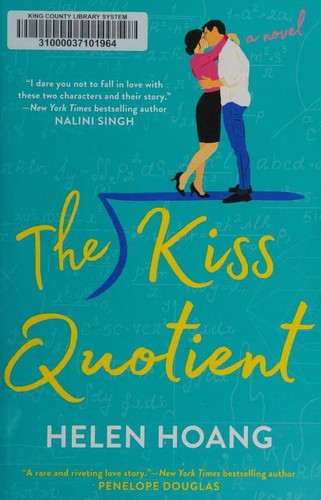
The Kiss Quotient
by Helen Hoang
★ Top 25 book of 2018 · #18 on Best Books of 2018
Stella Lane, a math-minded woman who builds algorithms for a living, has little dating experience and decides to hire an escort, Michael Phan, to teach her. Their arrangement begins as a practical lesson plan but starts to feel like something more.
Best for: Romance readers who like a math-loving heroine and a heartwarming love story
The Kiss Quotient is #18 on BookWard's Best Books of 2018, out of 60 2018 books that cleared our data bar.
What The Kiss Quotient is about
Stella Lane believes math is the one thing that unites the universe. She writes algorithms that predict what customers will buy, and the work has made her richer than she knows what to do with. At thirty, though, she has far less dating experience than most people her age, and she has Asperger's.
Her solution is practical: she will get practice from a professional. She hires Michael Phan, an escort who is Vietnamese and Swedish and who can't afford to turn down her offer. Together they work through a lesson plan, from foreplay to more-than-missionary positions. But Stella finds herself enjoying his kisses and wanting the other things he makes her feel, which no algorithm predicted. This debut novel is warm and steamy, and it looks at love and logic, neurodiversity and intimacy.
The Kiss Quotient on the Best Books of 2018
The Kiss Quotient came out in 2018. Of the 60 books first published in 2018 that met BookWard's data bar, it ranks #18 on our Best Books of 2018 list.
Why it made the list: 642 readers have shelved it on Open Library; readers rate it 3.9 out of 5 (10 ratings); 38 are reading it right now. The list ranks each year’s books on how many readers have picked them up, how highly readers rate them, and how many are reading them right now.
Nearby on the 2018 list
- Monday's Not Coming Tiffany D. Jackson, #16
- Front Desk Kelly Yang, #17
- Everything I Know About Love Dolly Alderton, #19
- The Priory of the Orange Tree Samantha Shannon, #20
See all Best Books of 2018 Best books by year
More years: Best Books of 2017 Best Books of 2019.
The numbers behind it
- Readers: 593 want to read it, 38 are reading it now and 11 have read it, according to Open Library.
- Ratings: 3.9 out of 5 from 10 Open Library ratings.
| Signal | This book (0 to 100) | Weight |
|---|---|---|
| Reach | 77 | 55% |
| Reader love | 28 | 25% |
| Being read right now | 80 | 20% |
Questions about The Kiss Quotient
When was The Kiss Quotient published?
The Kiss Quotient by Helen Hoang was first published in 2018.
Was The Kiss Quotient one of the best books of 2018?
The Kiss Quotient is #18 on BookWard's Best Books of 2018, out of 60 2018 books that cleared our data bar. 642 readers have shelved it on Open Library; readers rate it 3.9 out of 5 (10 ratings); 38 are reading it right now.
Why is The Kiss Quotient on the Best Books of 2018 list?
642 readers have shelved it on Open Library; readers rate it 3.9 out of 5 (10 ratings); 38 are reading it right now.
More of the best books of 2018
- Heartstopper, Volume 1 Alice Oseman, #1
- Where the Crawdads Sing Delia Owens, #2
- The Laws of Human Nature Robert Greene, #3
- Atomic Habits James Clear, #4
- Five Feet Apart Rachael Lippincott, #5
- Verity Colleen Hoover, #6
See the full Best Books of 2018, the Top 100, or new books on Rising.
How we know
This page uses public data: Open Library reader counts and ratings, and Wikipedia page views for recent years. The description is paraphrased from real source text. Rankings reflect reading interest, not quality or sales, and can be affected by data gaps. Lists update monthly.
Best suited to adult readers, as the story includes frank and explicit sexual content.
Depends on the edition you pick.
A warm, funny romance that swaps formulas for feeling. 55% taste match
 BookWard’s take
A warm, funny romance that swaps formulas for feeling
The Kiss Quotient is a contemporary romance built on a neat premise: Stella Lane, a gifted mathematician with Asperger's, hires an escort to teach her about intimacy. It leans on a familiar romance shape, more comfortably than I'd like. Where it earns attention is in its characters, since Stella and Michael are drawn with real specificity rather than as types. The book is hopeful throughout, and its warmth never turns syrupy. Expect plenty of dialogue and a romance that is central, not a side thread. The ending is satisfying and resolved. It is a gentle, absorbing read that rewards readers who want feeling over fireworks.
A mid-length contemporary romance that moves along without sprawling, which suits BookWard's preference for tightness reasonably well.
Scenes turn over briskly as the arrangement deepens, keeping momentum close to what BookWard enjoys.
The core premise is distinctive, but the overall arc stays within familiar romance territory, so it falls short of BookWard's high bar.
The writing is clear and accessible, closer to plain than ornate, similar to BookWard's lean preference.
The story runs on the growing bond between two people, making it strongly character-driven, as BookWard likes.
It is a heartening, optimistic story about connection, a little warmer than BookWard's already hopeful lean.
A straightforward structure that follows the relationship forward without formal experiments.
There is gentle, good-natured humour in the awkward lessons, though the book is not primarily a comedy.
Mostly gentle in tone, with some emotional vulnerability but little grimness.
The feelings run strong as the relationship deepens, more intense than restrained.
See all 50 dialsEvery position, side by side with this book
Where it lines up
- Character depthBookWard 8 · book 8
- Story or ideasBookWard 3 · book 3
- PaceBookWard 8 · book 7
Where it pulls apart
- Familiar tropesBookWard 10 · book 4
- Internal logicBookWard 10 · book 6
- LengthBookWard 1 · book 4
A mid-length contemporary romance that moves along without sprawling, which suits BookWard's preference for tightness reasonably well.
The setup of a mathematician hiring an escort to learn intimacy gives it an immediate pull, close to BookWard's taste.
It works within established romance conventions, though the lead characters and their circumstances freshen the formula somewhat.
The emotional and practical beats follow sensibly from the premise, with the lesson-plan structure giving the story a clear internal order.
Scenes turn over briskly as the arrangement deepens, keeping momentum close to what BookWard enjoys.
The core premise is distinctive, but the overall arc stays within familiar romance territory, so it falls short of BookWard's high bar.
Stella's neurodivergent perspective and Michael's circumstances give both leads real specificity, matching BookWard's liking for drawn characters.
The romance resolves cleanly and satisfyingly, in line with BookWard's preference for closure.
It is openly warm and heartfelt, sitting more sentimental than the restraint BookWard tends to prefer.
Its emotional turns come from character, not manufactured shocks, which BookWard values.
This dial does not apply to a novel.
Stella's analytical way of seeing intimacy gives the narration a recognisable, individual flavour.
This is firmly story-led, driven by the relationship rather than by an argument, which suits BookWard.
Stella's thinking is shown through scenes and her own logic more than lectured, though some inner explanation appears.
The relationship keeps developing through the middle, so momentum mostly holds, with only mild dips.
The writing is clear and accessible, closer to plain than ornate, similar to BookWard's lean preference.
The story runs on the growing bond between two people, making it strongly character-driven, as BookWard likes.
It is a heartening, optimistic story about connection, a little warmer than BookWard's already hopeful lean.
A straightforward structure that follows the relationship forward without formal experiments.
There is gentle, good-natured humour in the awkward lessons, though the book is not primarily a comedy.
An easy, quick read that asks little of the reader, which sits comfortably with BookWard.
The story moves between its two leads' perspectives, giving a moderate spread of viewpoints.
Events unfold in a linear order from the first arrangement onward.
Entirely grounded in contemporary, real-world life.
The story centres on a tight circle around the two leads rather than a wide ensemble.
A deeply intimate story about two people, with no epic ambitions.
Much of the interest lies in Stella's thoughts and feelings, tilting toward the inner.
Conversations between the leads carry much of the relationship, making dialogue a major component.
Romance is the entire engine of the book.
A recognisable contemporary setting that will feel familiar to most readers.
Set in the present day with modern workplaces and dating culture.
Its warmth will endure, though its contemporary specifics tie it somewhat to its moment.
The narration is straightforward and trustworthy, with no deception about events.
The ethical lines are fairly clear, centred on honesty, respect and care.
Description serves the characters and romance, staying moderate rather than lavish.
This dial does not apply to a novel.
This dial does not apply to a novel.
It launched a series of related romances, though this story reads as complete on its own.
Its pleasures come from the relationship unfolding, not from surprises.
A comforting read that rarely pushes the reader out of their comfort zone.
Mostly gentle in tone, with some emotional vulnerability but little grimness.
The feelings run strong as the relationship deepens, more intense than restrained.
The humour leans dry and situational, rising from awkward moments between the leads.
Violence is essentially absent from the story.
Intimacy is central to the premise, so sexual content is prominent and explicit.
Politics sits well in the background, with the focus on personal lives.
The language is plain and easy to follow throughout.
The narration stays close to the characters' feelings and perspectives without much editorialising.
The story looks ahead toward growth and a shared future for its leads.
It believes in connection and acceptance, taking a clearly idealistic view of love.
Review written by BookWard, dial version 1, November 2026.
Who is The Kiss Quotient right for?
Best suited to adult readers, as the story includes frank and explicit sexual content. It also deals with themes of neurodivergence and emotional vulnerability.
An easy, quick read that asks little of the reader, which sits comfortably with BookWard.
Mostly gentle in tone, with some emotional vulnerability but little grimness.
The feelings run strong as the relationship deepens, more intense than restrained.
Violence is essentially absent from the story.
Book CompanionThe Kiss Quotient: ideas, characters, themes
A gifted but socially anxious woman hires an escort to learn about intimacy and discovers that love follows its own kind of logic.
- The premise. Stella Lane, a mathematician who builds purchase-prediction algorithms, decides she needs practice with intimacy and hires an escort named Michael Phan.
- A lesson plan. The arrangement is organised like a project, with Stella setting out a structured plan for what she wants to learn.
- Neurodivergent lead. Stella has Asperger's, and her way of experiencing touch and affection shapes how the relationship unfolds.
- An unlikely pairing. Michael, of Vietnamese and Swedish background, takes the job out of need, and the partnership begins to feel like more than a transaction.
- Love versus data. The book sets Stella's faith in numbers against feelings that resist prediction.
Characters
Stella Lane
Protagonist
A thirty-year-old mathematician who designs algorithms and has little dating experience.
Michael Phan
Love interest
An escort of Vietnamese and Swedish heritage whom Stella hires to teach her about intimacy.
Themes
The tension between Stella's analytical mind and feelings that cannot be calculated.
How a different way of perceiving the world shapes connection and desire.
Learning to be close to another person and to trust them.
How an arrangement built on payment can grow into something genuine.
Discussion questions
- How does Stella's way of analysing the world shape the way she approaches romance?
- Does the lesson-plan structure make the relationship feel more honest or more artificial?
- What does the book suggest about whether love can be predicted?
- How does the story handle the gap between a paid arrangement and real feeling?
- Which romance conventions does the book embrace, and which does it quietly update?
Personalize your Book Companion
This is the general edition. In BookWard, the Companion is written for you: your reading profile, your notes, and spoiler-safe to the page you are on.
Buy, listen or borrow The Kiss Quotient
Each link opens a search for this book on that store, in a new tab.
Read on a device
Borrow
Reviews and community
If you liked The Kiss Quotient
A second-chance hockey romance, set in small-town Nova Scotia
Right MoveLiz TomfordeA fake-dating NBA romance that trades on familiar, well-loved tropes
Just for the SummerAbby JimenezA fake-dating curse premise with real family weight underneath
Play AlongLiz TomfordeA fake-marriage baseball romance that plays by the genre's rules
Find your own best books
Add what you have read, rate it, and BookWard will recommend what to read next.
Free to start. No credit card needed.