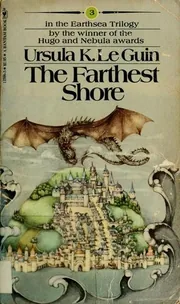
It suits older children, teens and adults who enjoy reflective fantasy.
223 pages, about 3.5 to 5 hours.
Le Guin's quietest Earthsea book asks what death is for. 61% taste match
The story
The Farthest Shore is a fantasy novel by Ursula K. Le Guin, first published in 1972. It is the third book in the Earthsea Cycle, following A Wizard of Earthsea and The Tombs of Atuan. Because the next Earthsea novel, Tehanu, did not appear until 1990, it has often been grouped as the last volume of an Earthsea trilogy. The story is aimed at younger readers as well as adults, and it runs to roughly 223 pages in a typical edition.
The setting is Earthsea, a world of islands and sea travel where magic is fading and the wizards who practice it are losing their power. Ged, the Archmage, a wizard and dragonlord, sets out by boat with Arren, a highborn young prince. Together they sail far from home in search of what is draining the magic from the world and how it might be restored, a voyage that carries them beyond the realm of death. Wizards, sea journeys and the struggle against encroaching darkness shape this installment of the series.
In the court of the fountain the sun of march shone through young leaves of ash and elm, and water leapt and fell through shadow and clear light.
Themes
MagicMagiaFantasyWizardsChildren's storiesFicciónGed (Fictitious character)Imaginary places
- Want to read 104
- Reading now 4
- Read 78
Readers are split between finishing it and saving it for later.
Of 186 readers who put it on a shelf, 56% want to read it, 2% are reading it now, 42% have finished it and 0% stopped before the end.
By the numbers
- The median edition runs 223 pages. Counting about 275 words a page and an adult reading pace of 250 words a minute, that is about 4.1 hours of reading.
- Open Library tracks 65 editions from 42 publishers, the earliest dated 1972 and the latest 2025, across 11 languages.
- On reader demand it ranks in the top 6% of the classic books in our catalog (8,749 of them).
- Libraries shelve it under Dewey [Fic] and Library of Congress class PS-3562.00000000.E42 F37 1973.
 BookWard’s take
Le Guin's quietest Earthsea book asks what death is for
The Farthest Shore is short, at 223 pages, and it spends them on a single sea voyage rather than a sprawl of set pieces. That tightness is a point in its favor. The prose is plain and clear rather than ornate, and Le Guin's voice is unmistakable: calm, grave, unhurried. It does not open with a hook, and the pace is measured, so it asks for a patience that some readers will not always want to give. Where it earns its place is in how it handles a familiar setup. A fading-magic quest could easily lean on well-worn tropes, but here loss and mortality are treated as real questions instead of plot fuel. The characterization rests mostly on Ged and the young Arren, and the outlook is sober but not despairing. This is a thoughtful, restrained fantasy more than a fast one.
At 223 pages it is compact for a fantasy quest, which suits BookWard's taste for tight books.
The voyage unfolds at a steady, reflective rhythm, slower than BookWard's preferred drive.
Making the threat the draining of magic itself, and journeying beyond death, feels fresh within fantasy.
Clean, clear sentences with quiet beauty rather than ornament.
The quest matters less than how Ged and Arren change along the way.
The tone is somber and elegiac, yet leans toward a cautious hope.
A straightforward voyage narrative with little structural experiment.
Serious throughout, with little room for jokes.
A pervasive sense of loss and dread, handled gravely.
Feeling runs deep but is expressed with restraint.
See all 50 dialsEvery position, side by side with this book
Where it lines up
- Character depthBookWard 8 · book 8
- SentimentBookWard 8 · book 8
- Shock for effectBookWard 9 · book 9
Where it pulls apart
- OpeningBookWard 10 · book 4
- PaceBookWard 8 · book 4
- Familiar tropesBookWard 10 · book 8
At 223 pages it is compact for a fantasy quest, which suits BookWard's taste for tight books.
It opens with a patient, grave tone rather than a jolt, which sits below BookWard's wish to be gripped at once.
A fading-magic quest could be generic, but Le Guin treats it as a meditation on loss, which BookWard rewards.
Magic and its costs follow the rules the series has built, so the world holds together firmly.
The voyage unfolds at a steady, reflective rhythm, slower than BookWard's preferred drive.
Making the threat the draining of magic itself, and journeying beyond death, feels fresh within fantasy.
Ged and Arren carry the book, and their bond is drawn with care and weight.
The journey reaches a clear conclusion to its central question, in line with BookWard's liking for resolution.
Emotion is kept restrained and quiet instead of milked, which BookWard appreciates.
Its darkness comes from the premise and its meaning, not from gratuitous shocks.
This is fiction, so rigor does not apply.
Le Guin's calm, measured narration is distinctive and instantly recognizable, a strong match for BookWard.
It is a story first, but one that keeps circling large ideas about death and balance.
Much is conveyed through scene and journey, with some plain explanation of magic's stakes.
The sea voyage keeps a through-line, though the reflective stretches can feel slow.
Clean, clear sentences with quiet beauty rather than ornament.
The quest matters less than how Ged and Arren change along the way.
The tone is somber and elegiac, yet leans toward a cautious hope.
A straightforward voyage narrative with little structural experiment.
Serious throughout, with little room for jokes.
Accessible to read, though its ideas reward slow attention.
The story keeps close to a single central perspective.
Events move forward in order without time shifts.
Wizards, dragonlords and a realm beyond death place it deep in fantasy.
The story centers on a small core, with others met along the voyage.
The stakes are world-wide, though the telling stays personal.
Reflection and conversation outweigh battle and action.
Conversation between Ged and Arren carries a good share of the book.
Romance plays no real part in this voyage.
Earthsea's islands and seas are richly unfamiliar, a strength BookWard enjoys.
An invented, pre-modern world far from the present day.
Its questions about mortality and loss outlast its 1972 publication.
A steady, trustworthy narrator guides the story.
Good and evil are fairly clear, though the cost of choices is weighed carefully.
Seas, islands and landscapes are evoked with generous detail.
This is fiction, so nonfiction style does not apply.
This is fiction, so perspective as a nonfiction dial does not apply.
Third in the Earthsea Cycle, though it works with some independence.
The unfolding mystery gives some surprises, but it is not twist-driven.
It asks serious questions about death and balance without offering easy comfort.
A pervasive sense of loss and dread, handled gravely.
Feeling runs deep but is expressed with restraint.
What humor appears is dry and sparing.
Peril exists, but violence is not the focus.
Essentially absent.
Power and order matter in the background, but politics is not front and center.
The language is plain and clear throughout.
The narration stays fairly neutral, letting events speak.
It dwells on what is fading, so it leans toward the past.
Despite the gloom, it believes in duty and the worth of keeping balance.
Review written by BookWard, dial version 1, November 2026.
Who is The Farthest Shore right for?
It suits older children, teens and adults who enjoy reflective fantasy. Its themes of death and loss are serious, though the book is not graphically violent.
Accessible to read, though its ideas reward slow attention.
A pervasive sense of loss and dread, handled gravely.
Feeling runs deep but is expressed with restraint.
Peril exists, but violence is not the focus.
Book CompanionThe Farthest Shore: ideas, characters, themes
As magic fades from Earthsea, the Archmage Ged and young Prince Arren sail toward the source of the loss.
- A fading world. Wizards across Earthsea are losing their power, and the book follows the search for why.
- An unlikely pair. Ged, an experienced Archmage, travels with Arren, a highborn young prince.
- The sea as road. The journey is made by boat, carrying them far from the familiar islands.
- Beyond death. Their search leads past the ordinary limits of the living world.
- Third in a series. It follows A Wizard of Earthsea and The Tombs of Atuan in the Earthsea Cycle.
Characters
Ged
Archmage
A powerful wizard and dragonlord who leads the search for the cause of the lost magic.
Arren
Young prince
A highborn youth who joins Ged on the voyage.
Themes
How the story treats death as part of life, not only an enemy.
What happens to a world and its people when their gifts fade.
The relationship between an experienced guide and a young companion.
The idea that magic and the world depend on a careful order.
Discussion questions
- Why might the author make fading magic the central threat instead of a villain?
- How does the bond between Ged and Arren change what the journey means?
- What does the sea voyage add compared to a land-based quest?
- How does the book treat death differently from typical fantasy?
- Does it stand alone, or does it depend on the earlier Earthsea books?
Personalize your Book Companion
This is the general edition. In BookWard, the Companion is written for you: your reading profile, your notes, and spoiler-safe to the page you are on.
Buy, listen or borrow The Farthest Shore
Each link opens a search for this book on that store, in a new tab.
Read on a device
Borrow
Reviews and community
If you liked The Farthest Shore
A short, sure-footed fantasy about pride and its cost
Gathering BlueLois LowryA quiet dystopia where art and truth collide
Northern LightsPhilip PullmanA girl, a truth-telling compass, and an Arctic rescue that earns its stakes
The High KingLloyd AlexanderA fantasy finale where the hero's growing up is the real quest
Sources: Open Library.
Track The Farthest Shore and find your next favorite
Add it to your shelf, rate what you have read, and BookWard will recommend what fits you.
Free to start. No credit card needed.