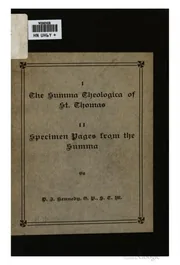
Summa Theologica
by Thomas Aquinas, Kennedy, Daniel Joseph, 1862-1930 · 1274
Best suited to mature readers, such as advanced students and adults, willing to work through dense abstract argument.
227 pages, about 3.5 to 5.5 hours.
Aquinas builds all of Catholic theology, one numbered question at a time. 44% taste match
What it covers
Summa Theologica is a work of scholastic theology by Thomas Aquinas, the thirteenth-century friar and Doctor of the Church, first published in 1274. It belongs to the Middle Ages and sits within Catholic theology, doctrinal writing, and Christian ethics, with Aquinas working in the tradition of Aristotle and bringing that philosophy into conversation with Christian belief.
The text sets out the main teachings of the Catholic Church in an ordered sequence. It begins with God and his attributes, moves on to creation and human nature, then turns to the purpose of human life, to Christ, and to the sacraments. Along the way it takes up questions of law and morality and the relationship between God, the world, and people. Its sections are built from numbered points that raise a question and then work through it, such as whether prophecy counts as a form of knowledge. The book has been issued in a large number of editions, and a typical volume runs to a little over two hundred pages.
THE FIRST POINT: 1. Prophecy is apparently not a form of knowledge, for we read of Elisha, when he was dead his body prophesied, and a little further on it is said of Joseph, his bones were visited and they prophesied.
Period
Middle Ages 600-1500
Themes
AnthropologyAttributesCatholic ChurchCatholic TheologyCatholic authorsChristian ethicsChristianityChristianity and law
- Want to read 258
- Reading now 20
- Read 15
Most people shelving it are saving it for later.
Of 293 readers who put it on a shelf, 88% want to read it, 7% are reading it now, 5% have finished it and 0% stopped before the end.
By the numbers
- The median edition runs 227 pages. Counting about 275 words a page and an adult reading pace of 250 words a minute, that is about 4.2 hours of reading.
- Open Library tracks 277 editions from 87 publishers, the earliest dated 1467 and the latest 2009, across 8 languages.
- On reader demand it ranks in the top 7% of the classic books in our catalog (8,749 of them).
- Libraries shelve it under Dewey 081 s and Library of Congress class K--0447.00000000.T45A2 2002.
 BookWard’s take
Aquinas builds all of Catholic theology, one numbered question at a time
Summa Theologica is not a book you read for story or surprise. It is a system, and the system is the point. Aquinas moves from God to creation, human nature, the purpose of life, Christ and the sacraments, raising each question and answering it in order. That is where it may frustrate some readers: the exposition is explained outright, the opening builds slowly, and the pace is deliberate. Where it earns its place is in its internal logic, which is as airtight as writing gets, and in its rigor, since every claim is argued step by step. It is driven by ideas from start to finish, demanding to read, and has real staying power. Take it in small portions, one question at a time, rather than front to back.
This edition runs a little over two hundred pages, though the full work is vast; BookWard favors tight, so it lands in the middle.
It moves one measured argument at a time and never rushes, a slower rhythm than BookWard usually enjoys.
Bringing Aristotle's philosophy into conversation with Christian belief was an ambitious synthesis, though it draws on existing traditions.
The prose is plain and functional, built for clarity of argument, not ornament.
There is no plot or character here, so this dial does not apply.
It is oriented toward human purpose and ultimate good, which gives it a quietly hopeful outlook.
The numbered question-and-response format is distinctive and highly systematic, if rigidly conventional for its era.
This is entirely serious, with no comic intent.
The content is theological and abstract, not dark.
The register is calm and reasoned, with little visible feeling.
See all 50 dialsEvery position, side by side with this book
Where it lines up
- Internal logicBookWard 10 · book 10
- EndingBookWard 8 · book 8
- Shock for effectBookWard 9 · book 9
Where it pulls apart
- OpeningBookWard 10 · book 2
- ExpositionBookWard 2 · book 10
- Story or ideasBookWard 3 · book 10
This edition runs a little over two hundred pages, though the full work is vast; BookWard favors tight, so it lands in the middle.
It opens with God and his attributes, not a scene or a question that grabs. That is the opposite of BookWard's taste for an immediate hook.
Its question-and-answer format is the scholastic standard of its day, so it follows a convention but not a fictional trope.
Each numbered point raises a question and works through it stepwise, which is exactly the airtight reasoning BookWard prizes.
It moves one measured argument at a time and never rushes, a slower rhythm than BookWard usually enjoys.
Bringing Aristotle's philosophy into conversation with Christian belief was an ambitious synthesis, though it draws on existing traditions.
It is a work of argument with no characters to draw, so this dial does not apply.
The cycle runs from God back to God, a fully planned and resolved structure, which suits BookWard well.
Aquinas argues rather than emotes, and the text is about as restrained as writing gets.
Nothing is there for effect; the aim is exposition and proof, so it never leans on shock.
Every claim is set out as a question, objections and a reasoned answer, which meets BookWard's high standard for rigor.
The method is distinctive in form, but the voice itself is impersonal and shaped by the genre.
It is pure ideas, with no plot at all, which is further from story than BookWard prefers.
Everything is explained outright and nothing is shown in scene, which runs against BookWard's preference for showing.
The structure keeps a steady pattern throughout, though a reader may tire of the repeated format.
The prose is plain and functional, built for clarity of argument, not ornament.
There is no plot or character here, so this dial does not apply.
It is oriented toward human purpose and ultimate good, which gives it a quietly hopeful outlook.
The numbered question-and-response format is distinctive and highly systematic, if rigidly conventional for its era.
This is entirely serious, with no comic intent.
The abstract reasoning and scholastic vocabulary make this a demanding read, more so than BookWard usually chooses.
One author presents the argument, though objections are voiced within each point.
It follows a logical order, not a story timeline, and is organized by topic.
It deals with God and the soul as matters of doctrine, but in a sober, argued register.
There are no characters in the usual sense; the focus is God, Christ and humanity as subjects.
It tries to cover all of Christian theology, from creation to the sacraments, a remarkably broad ambition.
It is thought and argument from start to finish, with no action.
Objections and replies give it an argumentative back-and-forth, but there is no spoken dialogue.
Romance does not feature in this work.
A thirteenth-century scholastic framework will feel unfamiliar to most modern readers.
It was written in the Middle Ages and reflects that world throughout.
It has stayed central to Catholic theology and philosophy for centuries, so its staying power is clear.
Aquinas speaks directly and reliably as author, with no narrator games.
It sets out clear moral and doctrinal positions rather than leaving them ambiguous.
It offers almost no scene-setting or sensory description; its focus is argument.
It is analytical throughout, with no narrative thread.
The author stays out of view and argues impersonally, with very little of his own life.
It is a single, self-contained work, though it spans several parts.
A systematic argument has no plot surprises.
It asks the reader to follow dense reasoning and take on demanding ideas, which BookWard values.
The content is theological and abstract, not dark.
The register is calm and reasoned, with little visible feeling.
There is no humor to place on this dial.
There is next to no violence on the page.
Sexual content is essentially absent, appearing only as an occasional point of moral doctrine.
It takes up law and morality, which touch on political themes, though it is not political writing in the modern sense.
Dense scholastic terminology and abstract argument make the language hard going, even in translation.
Aquinas argues for set positions, but in a measured, impersonal manner.
It looks back to Aristotle and church tradition for its foundations.
It holds a confident belief in reason, order and human purpose.
Review written by BookWard, dial version 1, November 2026.
Who is Summa Theologica right for?
Best suited to mature readers, such as advanced students and adults, willing to work through dense abstract argument. It deals with religious doctrine and morality rather than graphic content, though it assumes some comfort with theology.
The abstract reasoning and scholastic vocabulary make this a demanding read, more so than BookWard usually chooses.
The content is theological and abstract, not dark.
The register is calm and reasoned, with little visible feeling.
There is next to no violence on the page.
Book CompanionSumma Theologica: ideas, characters, themes
Aquinas sets out the main teachings of the Catholic Church as a single, ordered system of reasoned questions and answers, combining Aristotle with Christian belief.
- A cycle that returns to God. The work moves from God to creation and human nature, then to the purpose of life, Christ and the sacraments, and finally back to God.
- Questions first. Each section is built from numbered points that raise a question and then work through it, for example whether prophecy counts as a form of knowledge.
- Aristotle meets Christianity. Aquinas integrates Aristotelian philosophy with Christian doctrine, using reason to support faith.
- Law and morality. Along the way the text takes up questions of law and ethics, including how they relate to God and to people.
- Many editions. The book has been issued in a large number of editions, and a typical volume runs to a little over two hundred pages.
Themes
The idea that philosophy and theology can work together to understand God and the world.
What can be said about God's existence and attributes.
What people are for and what their lives are directed toward.
How right action and just rules relate to God and to human nature.
The relationship between God and the world he made.
Discussion questions
- Why might Aquinas choose to state objections before giving his own answer?
- How does bringing Aristotle into Christian theology change what each can say?
- Does a fully systematic approach to belief make it stronger or more rigid?
- What would it take for a modern reader to approach this text on its own terms?
- Which of the questions raised here still feel alive today?
Personalize your Book Companion
This is the general edition. In BookWard, the Companion is written for you: your reading profile, your notes, and spoiler-safe to the page you are on.
Buy, listen or borrow Summa Theologica
Each link opens a search for this book on that store, in a new tab.
Read on a device
Borrow
Reviews and community
If you liked Summa Theologica
Aristotle asks what the best human life is, and answers
The Muqaddimah, an introduction to historyIbn KhaldūnA fourteenth-century blueprint for how societies rise, hold together and fall
La PoeticaAristotleAristotle's compact blueprint for how poetry and drama work
The Federalist, or, The New ConstitutionAlexander HamiltonRigorous, argument-led case for the Constitution, demanding but still essential
Sources: Open Library.
Track Summa Theologica and find your next favorite
Add it to your shelf, rate what you have read, and BookWard will recommend what fits you.
Free to start. No credit card needed.