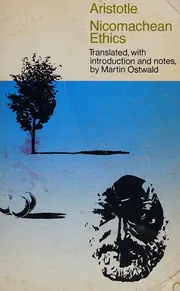
Nicomachean Ethics
by Aristotle · 1558
Best suited to older teens and adults willing to work through dense philosophical argument.
329 pages, about 5 to 7.5 hours.
Aristotle asks what the best human life is, and answers. 46% taste match
What it covers
Nicomachean Ethics is a work of ancient Greek moral philosophy by Aristotle (384-322 B.C.), first published in 1558 in the form most readers know it. It is organized into ten books and sits close to his other treatise on ethics, the Eudemian Ethics. The work is regarded as central to understanding Aristotelian ethics and has been included among the Great Books of the Western World.
The subject is the good for human life, the end toward which all action aims. From that starting point, Aristotle asks what the best life for a human being might be, and to answer it he examines the nature of virtue and the individual virtues that could make up such a life. Friendship also receives sustained attention within the text. Editions and translations have come from many hands over the years, including those of Robert William Browne, D. P. Chase, and Franz Susemihl, and the book has appeared in more than four hundred editions, with a typical copy running to about 329 pages. It suits readers interested in ethics, virtue, and the philosophy of ancient Greece.
1 Every craft and every line of inquiry, and likewise every action and decision, seems to seek some good; that is why some people were right to describe the good as what everything seeks.
Characters
Aristotle
Setting
Greece
Period
Early works to 1800
Themes
EthicsEarly works to 1800Morale ancienneOuvrages avant 1800Filosofia gregaFilosofia antigaÉticaViews on friendship
- Want to read 433
- Reading now 30
- Read 36
Most people shelving it are saving it for later.
Of 499 readers who put it on a shelf, 87% want to read it, 6% are reading it now, 7% have finished it and 0% stopped before the end.
By the numbers
- The median edition runs 329 pages. Counting about 275 words a page and an adult reading pace of 250 words a minute, that is about 6.0 hours of reading.
- Open Library tracks 417 editions from 200 publishers, the earliest dated 1558 and the latest 2022, across 13 languages.
- On reader demand it ranks in the top 3% of the classic books in our catalog (8,749 of them).
- Libraries shelve it under Dewey 170 and Library of Congress class B--0430.00000000.A5 T4 1976.
 BookWard’s take
Aristotle asks what the best human life is, and answers
Nicomachean Ethics begins with a single question: what is the good for human life, the end all our actions aim at? Everything else follows from it. Aristotle works through the nature of virtue and the individual virtues that could make up a flourishing life, and he gives friendship real room along the way. This is a book driven by ideas rather than story, and it explains itself outright, as an argument has to be laid out. It is rigorous, a systematic treatise built in ten books. It asks a lot of the reader, and the pace is measured rather than quick. But its staying power is about as great as a book's can be: it remains the central text for Aristotelian ethics, and it has earned its place among the Great Books.
At about 329 pages in a typical edition, it is compact for a foundational treatise, shorter than BookWard's sprawl threshold but not tight.
It proceeds by careful definition and distinction, so it moves slowly, which sits against BookWard's preference for speed.
Few works have shaped how we think about virtue and the good life as completely as this one.
Translations tend toward plain, precise statement rather than ornament.
There is no plot or cast, so this dial does not apply to an argued treatise.
It holds that a flourishing life is within human reach, which gives it a quietly hopeful outlook.
Ten books proceed in a conventional order of argument from the good to virtue to friendship.
A serious work of moral philosophy with no comic aim.
The subject is the best life, and the tone is calm and gentle.
It examines virtue and friendship with composure, not intensity.
See all 50 dialsEvery position, side by side with this book
Where it lines up
- OriginalityBookWard 9 · book 9
- Rigor (nonfiction)BookWard 9 · book 9
- SentimentBookWard 8 · book 9
Where it pulls apart
- Story or ideasBookWard 3 · book 10
- ExpositionBookWard 2 · book 9
- OpeningBookWard 10 · book 6
At about 329 pages in a typical edition, it is compact for a foundational treatise, shorter than BookWard's sprawl threshold but not tight.
It opens by naming the good at which all action aims, a clear question, though it builds by argument rather than grabbing you.
As an early founding work it is the source other ethics draws on, so it reads as origin rather than imitation.
Each book builds on the last, moving from the end of life to virtue to friendship, which suits BookWard's taste for airtight reasoning.
It proceeds by careful definition and distinction, so it moves slowly, which sits against BookWard's preference for speed.
Few works have shaped how we think about virtue and the good life as completely as this one.
It is a treatise with no characters, so this dial does not apply.
It closes its argument within the ten books, though the inquiry it opens remains live.
Aristotle reasons about the good life without appealing to feeling or sentiment.
A work of calm argument with nothing designed to shock, so it has no cheap darkness to account for.
A systematic, argued examination of the good, virtue and the individual virtues, which is exactly what BookWard rewards.
The treatise has a recognizable, methodical manner, though translation shapes how much of it you hear.
This is pure argument about the best life, the far end of BookWard's story-led lean.
Ideas are explained outright and defined step by step, since there is no scene to show them through.
The inquiry holds together across its books, though the stretches on separate virtues can feel list-like.
Translations tend toward plain, precise statement rather than ornament.
There is no plot or cast, so this dial does not apply to an argued treatise.
It holds that a flourishing life is within human reach, which gives it a quietly hopeful outlook.
Ten books proceed in a conventional order of argument from the good to virtue to friendship.
A serious work of moral philosophy with no comic aim.
Dense definitions and the habit of Greek philosophical argument make it hard going, more than BookWard's usual reading comfort.
A single authorial perspective carries the whole argument.
There is no narrative time, only argument proceeding in order.
It deals with real human conduct and the good life, with nothing fantastical in it.
There are no characters to track, only thinkers and ideas.
It concerns the whole good of human life but at the level of argument, not events, so it sits in the middle.
It is about character, choice and the formation of habits, not outward action.
It is continuous argument by the author, with no dialogue on the page.
Romance is not a subject, though friendship receives sustained attention.
The ancient Greek setting and concepts are unfamiliar to most modern readers.
It comes from the ancient world, as far from the present day as BookWard's reading gets.
Its place among the Great Books and its role as the essential text of Aristotelian ethics speak to lasting power.
Aristotle argues directly in his own voice, so there is no unreliable narrator.
It takes firm positions on virtue while weighing competing views, landing between clear and ambiguous.
There is almost no scene-setting, only argument and example.
It is analytical throughout, building a case rather than telling a story.
The author is a detached analyst rather than a personal witness.
It stands closely beside the Eudemian Ethics, so it reads as part of a larger body of ethical thought.
An argument developed step by step offers no plot surprises.
It asks you to examine how you live and what you actually value.
The subject is the best life, and the tone is calm and gentle.
It examines virtue and friendship with composure, not intensity.
Humor is not a feature of this treatise, so this dial does not apply.
There is no violence on the page.
There is no sexual content.
Ethics is tied to political science in its subjects, but it is moral inquiry rather than partisan argument.
Translations carry some technical Greek concepts and dense phrasing.
Aristotle states firm views on virtue and the good, so the narration is opinionated.
It is an early work that looks back on inherited views and lays foundations for later ones.
It aims at the best life for a human being, an idealistic project in its aim.
Review written by BookWard, dial version 1, November 2026.
Who is Nicomachean Ethics right for?
Best suited to older teens and adults willing to work through dense philosophical argument. Nothing in it is graphic or disturbing.
Dense definitions and the habit of Greek philosophical argument make it hard going, more than BookWard's usual reading comfort.
The subject is the best life, and the tone is calm and gentle.
It examines virtue and friendship with composure, not intensity.
There is no violence on the page.
Book CompanionNicomachean Ethics: ideas, characters, themes
The good for human life is the end all our actions aim at, and living well means cultivating virtue.
- The good as the aim of action. Aristotle starts from the claim that all our actions aim at some good, and asks what the highest good is.
- The best life for a human being. The book examines what the best life might be for people, rather than for gods or animals.
- What virtue is. To answer his question he has to examine virtue itself and what it consists of.
- The individual virtues. The work looks at the various virtues that might make up the best life.
- Friendship. Friendship receives sustained attention as part of the good life.
Themes
What it is for a human life to go well and be worth living.
The qualities of character that make up a good life.
The bonds between people and their place in living well.
Moral questions treated as something to be reasoned through step by step.
Discussion questions
- What does Aristotle mean when he says all actions aim at some good?
- Which virtue seems most essential to the best life, and why?
- Why does friendship get so much attention in a book about ethics?
- How does asking what the best life is differ from asking what rules to follow?
- Where does the argument feel dated, and where does it still hold?
Personalize your Book Companion
This is the general edition. In BookWard, the Companion is written for you: your reading profile, your notes, and spoiler-safe to the page you are on.
Buy, listen or borrow Nicomachean Ethics
Each link opens a search for this book on that store, in a new tab.
Read on a device
Borrow
Reviews and community
If you liked Nicomachean Ethics
Aristotle's compact blueprint for how poetry and drama work
Summa TheologicaThomas AquinasAquinas builds all of Catholic theology, one numbered question at a time
The Federalist, or, The New ConstitutionAlexander HamiltonRigorous, argument-led case for the Constitution, demanding but still essential
On LibertyJohn Stuart MillA short, rigorous case for the freedom to differ
Sources: Open Library.
Track Nicomachean Ethics and find your next favorite
Add it to your shelf, rate what you have read, and BookWard will recommend what fits you.
Free to start. No credit card needed.