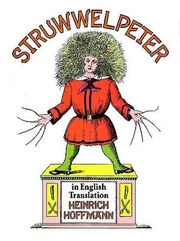
Struwwelpeter
by Heinrich Hoffmann · 1845
Its brevity and rhyme draw young readers, but the harsh outcomes can frighten sensitive children.
24 pages, about 0.5 to 0.5 hours.
Ten rhymed cautionary tales with consequences that still startle. 48% taste match
The story
Struwwelpeter is a German children's book of verse, first published in 1845 and written by Heinrich Hoffmann (1809-1894), a psychiatrist who also drew the pictures that accompany the text. It belongs to the tradition of stories in rhyme for young readers and reflects the German-language children's literature of the nineteenth century. The book is short, running to roughly two dozen pages in its usual form.
The contents are ten illustrated tales in rhyme, most of them centred on children. Each one is a cautionary story about bad behavior, and each ends with the harsh consequences that follow, presented in an exaggerated way. The tales work as lessons in how to conduct oneself, and the title of the opening story gives the whole book its name.
The work has been issued many times, with around forty-eight editions recorded. These include bilingual printings and translations into English and Yiddish, as well as scholarly editions concerned with the text itself. The Heinrich-Hoffmann-Museum is associated with the author and his book.
Period
19th century
Themes
Children's poetry, GermanBehaviorStories in rhymeHeinrich-Hoffmann-MuseumConduct of lifeGerman language materialsPoetryBilingual
- Want to read 85
- Reading now 2
- Read 22
Most people shelving it are saving it for later.
Of 109 readers who put it on a shelf, 78% want to read it, 2% are reading it now, 20% have finished it and 0% stopped before the end.
By the numbers
- The median edition runs 24 pages. Counting about 275 words a page and an adult reading pace of 250 words a minute, that is about 25 minutes of reading.
- Open Library tracks 48 editions from 43 publishers, the earliest dated 1865 and the latest 2006, across 7 languages.
- On reader demand it ranks in the top 11% of the classic books in our catalog (8,749 of them).
- Libraries shelve it under Dewey 831.8 and Library of Congress class PZ-0034.30000000.H6 1960z.
 BookWard’s take
Ten rhymed cautionary tales with consequences that still startle
Struwwelpeter is about as tight as a book gets: ten illustrated verse tales in roughly two dozen pages, drawn and written by a psychiatrist, Heinrich Hoffmann, in 1845. It is very short, and every tale gets to its point at once, with no warm-up. The moral design is the whole point: each story names a misbehavior and hands down an exaggerated punishment, so there is no ambiguity to untangle. That same design is why the characters are thin; the children are types built to carry a lesson, not people to get to know. It earns attention as a historical curiosity and a blunt little machine, though its shock is the purpose rather than a byproduct, and that is worth weighing carefully before handing it to anyone.
About two dozen pages of verse make it extremely short, which sits squarely with BookWard's taste for the tight.
Rhymed stories of a few stanzas each move quickly from offense to consequence, a pace BookWard enjoys.
It belongs to an established tradition of rhymed children's stories, yet its harsh, comic exaggeration marks it out.
Simple rhymed verse in plain diction, with bold illustrations supplying the color.
Plot drives everything; the children exist to set a misdeed and its consequence in motion.
The tales show bad endings for bad behavior, so the outlook is stern rather than hopeful.
Ten self-contained rhymed tales gathered under the title of the first, a collection more than a single narrative.
The exaggerated punishments are meant to read as grimly comic as well as cautionary.
The grisly fates for misbehaving children make it darker than most picture books.
The tone is brisk and stern, not emotionally intense.
See all 50 dialsEvery position, side by side with this book
Where it lines up
- LengthBookWard 1 · book 1
- OpeningBookWard 10 · book 9
- PaceBookWard 8 · book 9
Where it pulls apart
- Familiar tropesBookWard 10 · book 4
- Character depthBookWard 8 · book 2
- Shock for effectBookWard 9 · book 3
About two dozen pages of verse make it extremely short, which sits squarely with BookWard's taste for the tight.
Each tale opens straight on the misbehaving child, so there is no warm-up and nothing to wait through.
The cautionary-tale form is a long-standing convention, though the exaggerated, grisly consequences give it its own edge.
Every tale runs on a plain cause and effect from misdeed to punishment, which is airtight within its own rules.
Rhymed stories of a few stanzas each move quickly from offense to consequence, a pace BookWard enjoys.
It belongs to an established tradition of rhymed children's stories, yet its harsh, comic exaggeration marks it out.
The children are built to carry a lesson and are not drawn in depth, a trade BookWard accepts only for the form.
Each tale closes on a definite outcome, so every story is fully resolved, matching BookWard's taste.
The consequences are delivered without cuddling, though the rhyme and cautionary tone carry a touch of nineteenth-century moralizing.
The punishments are exaggerated and the shock is the lesson's delivery, closer to leaning on it than earning it.
This is a verse collection, so the dial does not apply.
Hoffmann's rhymed, deadpan, illustrated voice is distinct and recognizable, which BookWard rewards.
Each tale is a story built to hold a single idea, so the two are balanced, leaning slightly toward story.
The moral is stated openly through the consequence itself rather than left for readers to infer.
At this length there is no middle to slump, and each tale lands with energy.
Simple rhymed verse in plain diction, with bold illustrations supplying the color.
Plot drives everything; the children exist to set a misdeed and its consequence in motion.
The tales show bad endings for bad behavior, so the outlook is stern rather than hopeful.
Ten self-contained rhymed tales gathered under the title of the first, a collection more than a single narrative.
The exaggerated punishments are meant to read as grimly comic as well as cautionary.
Short rhymed stories with pictures ask very little of a reader.
Each tale follows its one misbehaving child from an outside, omniscient angle.
Every story runs straight through from misdeed to outcome.
The settings are ordinary, but the consequences are extreme and exaggerated beyond real life.
Ten stories mean ten sets of children, but each cast is tiny.
The stakes are household-sized, one child and one lesson at a time.
The tales are built on outward actions and their results, with almost no inner thought.
These are mostly narrated verses with little back-and-forth speech.
Romance plays no part in these cautionary tales.
A nineteenth-century German nursery world will feel somewhat distant to a modern reader.
First published in 1845, it comes from the past rather than the present day.
Still being issued in many editions and translations, though its methods read as clearly of their time.
The storyteller states events and morals plainly and can be trusted to say what happens.
Each tale makes its moral point unmistakable, with no gray area to wrestle with.
Verse is spare and the pictures do the descriptive work.
This is verse fiction, so the dial does not apply.
This is verse fiction, so the dial does not apply.
It stands alone as a single collection, whatever the many editions.
The punishment is predictable from the setup, though its severity can still surprise.
Mildly confronting in its harshness, but not demanding of the reader.
The grisly fates for misbehaving children make it darker than most picture books.
The tone is brisk and stern, not emotionally intense.
The humor is broad, built on exaggeration and cartoonish consequence.
Harsh physical punishments appear, stylized and brief rather than graphic.
There is no sexual content.
The book is concerned with household conduct, not politics.
Plain nursery verse; difficulty mostly comes from translation or older wording.
The narration is openly opinionated, judging each child's behavior without hesitation.
It looks backward to the traditional rules of conduct it enforces.
It holds out an orderly view of upbringing but through fear, so it reads closer to stern than idealistic.
Review written by BookWard, dial version 1, November 2026.
Who is Struwwelpeter right for?
Its brevity and rhyme draw young readers, but the harsh outcomes can frighten sensitive children. Many parents prefer to read it alongside the child or save it for older readers who can view it as a historical piece.
Short rhymed stories with pictures ask very little of a reader.
The grisly fates for misbehaving children make it darker than most picture books.
The tone is brisk and stern, not emotionally intense.
Harsh physical punishments appear, stylized and brief rather than graphic.
Book CompanionStruwwelpeter: ideas, characters, themes
A psychiatrist's illustrated verse tales warn children against misbehavior by showing exaggerated, harsh consequences.
- Ten tales, one form. The book gathers ten illustrated tales in rhyme, mostly about children.
- The first story names the book. The title of the opening story gives the whole collection its name.
- Lessons in conduct. Each tale is a cautionary story that shows how not to behave.
- Consequences exaggerated. The outcomes are deliberately out of proportion to the offenses.
- Author and artist in one. Heinrich Hoffmann wrote the verses and drew the pictures himself.
Themes
Following the rules the adults set down.
Bad behavior met with severe, exaggerated results.
What a child should and should not do.
Using fear and example to teach.
How rhyme and illustration work together.
Discussion questions
- Why do you think the punishments are so exaggerated?
- Does a lesson delivered through fear work on children?
- How do the pictures change the effect of the verse?
- What does the book tell us about nineteenth-century ideas of childhood?
- Which of these tales would you change for a modern audience, and how?
Personalize your Book Companion
This is the general edition. In BookWard, the Companion is written for you: your reading profile, your notes, and spoiler-safe to the page you are on.
Buy, listen or borrow Struwwelpeter
Each link opens a search for this book on that store, in a new tab.
Read on a device
Borrow
Reviews and community
If you liked Struwwelpeter
A fake manuscript, a Viking war band, and Beowulf's monsters
The WitchesRoald DahlDahl's brisk, dark fable of a boy, a grandmother and witches
The most dangerous gameRichard ConnellA tight, relentless hunt that still hooks at once
CongoMichael CrichtonA fast, gadget-laden lost world adventure, more machine than mood.
Sources: Open Library.
Track Struwwelpeter and find your next favorite
Add it to your shelf, rate what you have read, and BookWard will recommend what fits you.
Free to start. No credit card needed.