Suited to older teens and adults who enjoy adventure and historical fantasy.
220 pages, about 3.5 to 5 hours.
A fake manuscript, a Viking war band, and Beowulf's monsters. 57% taste match
The story
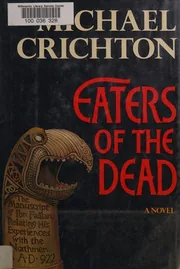
Eaters of the Dead, first published in 1976, is a historical fantasy novel by Michael Crichton. It was later reissued as The 13th Warrior to match the film adaptation. Its subtitle presents the story as the manuscript of Ibn Fadlan, a 10th-century Muslim Arab whose experiences with the Northmen are set in AD 922.
The narrator travels from Bagdad to the Volga Bulgars, where he joins a group of Vikings heading for their settlement in the Northland. The opening chapters retell the real Ahmad ibn Fadlan's account of his journey north and his observations of the Varangians, while the rest of the book retells Beowulf. Heroes such as Buliwyf and Wulfgar appear among the cast, and the story brings in monsters and dragons alongside the Viking setting. Crichton explains the two sources in an appendix. The novel runs to about 220 pages and has appeared in around 50 editions, including a combined volume with Congo and Sphere.
Characters
Ahmad Ibn FadlanBuliwyfWulfgar
Setting
ScandinaviaBagdadVolga BulgarsNorthland
Period
10th century922
Themes
adaptationsvikingsNorthmenBeowulf AdaptationsBeowolfDragonsEnglish epic poetry adaptationsHeroes
- Want to read 149
- Reading now 3
- Read 37
Most people shelving it are saving it for later.
Of 189 readers who put it on a shelf, 79% want to read it, 2% are reading it now, 20% have finished it and 0% stopped before the end.
By the numbers
- The median edition runs 220 pages. Counting about 275 words a page and an adult reading pace of 250 words a minute, that is about 4.0 hours of reading.
- Open Library tracks 50 editions from 36 publishers, the earliest dated 1976 and the latest 2018, across 6 languages.
- On reader demand it ranks in the top 5% of the modern books in our catalog (15,152 of them).
- Libraries shelve it under Dewey 813.54 and Library of Congress class PS-3553.00000000.R48E25 1993.
 BookWard’s take
A fake manuscript, a Viking war band, and Beowulf's monsters
Eaters of the Dead is a short, fast novel that dresses a retelling of Beowulf as the lost manuscript of a 10th-century Arab traveler. Crichton even adds an appendix explaining his two sources, which makes the frame feel nearly real. At about 220 pages it is tight and brisk, and the premise supplies its own hook: an outsider thrown in among the Northmen. The originality is considerable, since the borrowed epic is reworked through a dry scholarly voice rather than simply copied. That voice is distinctive, and the fantasy sits comfortably inside a carefully grounded historical setting. Where I part ways with the book is character depth, which stays lean next to the machinery of the plot.
At about 220 pages it is lean and quick, which fits BookWard's love of tight books.
The short chapters keep events moving, a close match for BookWard's preference for speed.
Presenting a Beowulf retelling as a translated traveler's account is a fresh angle on old material.
The writing is plain and clipped, built to sound like a translated account rather than ornament.
Events and the monster threat drive the book more than personal change.
Hope is dim, with a doomed, fateful mood over the fighting.
The faux-manuscript frame and appendix add some formal play to a mostly straight narrative.
Humor is rare, appearing only in occasional dry cultural observations.
The threat and the fighting give it a grim edge without extremes.
Feeling stays muted, filtered through a detached narrator.
See all 50 dialsEvery position, side by side with this book
Where it lines up
- PaceBookWard 8 · book 8
- EndingBookWard 8 · book 8
- LengthBookWard 1 · book 2
Where it pulls apart
- Familiar tropesBookWard 10 · book 6
- Internal logicBookWard 10 · book 7
- ExpositionBookWard 2 · book 6
At about 220 pages it is lean and quick, which fits BookWard's love of tight books.
An Arab envoy falling in with a Viking war band is a strong premise that pulls you in early.
Vikings and monsters are familiar ground, though the manuscript frame and scholarly tone keep it from feeling stock.
The made-up historical frame holds together well, and the monsters follow the rules the story sets for them.
The short chapters keep events moving, a close match for BookWard's preference for speed.
Presenting a Beowulf retelling as a translated traveler's account is a fresh angle on old material.
The narrator and the Northmen are clearly drawn, but the plot gets more attention than their inner lives.
The central threat is settled by the end, which suits BookWard's taste for closure.
The book is more sentimental than BookWard's restrained taste, leaning on heroic loyalty and fate.
The darker moments serve the epic's monster story rather than existing purely for effect.
This is fiction, so the rigor dial does not apply.
The dry, observational tone of a medieval chronicler gives the book a clear and recognizable voice.
Story leads here, with the historical frame as a device rather than an argument.
The narrator often explains what he sees and why, in the manner of a travel record.
The brevity and steady incident keep the middle from drifting.
The writing is plain and clipped, built to sound like a translated account rather than ornament.
Events and the monster threat drive the book more than personal change.
Hope is dim, with a doomed, fateful mood over the fighting.
The faux-manuscript frame and appendix add some formal play to a mostly straight narrative.
Humor is rare, appearing only in occasional dry cultural observations.
It reads easily, though the unfamiliar names and customs ask for some attention.
One narrator tells everything from first person.
The account moves forward in order.
The monsters are fantastical, but they sit inside a firmly historical setting.
A war band and a court give it a moderate cast without sprawl.
The stakes grow from one traveler's journey to a threat against a whole people.
Action and observation outweigh introspection throughout.
Conversation is functional and often filtered through the narrator's translation.
Romance plays almost no part in the story.
The Norse world is seen through the eyes of an outsider, which makes it feel new.
It is set in AD 922, firmly in the past.
The old epic at its core gives it lasting appeal despite its 1976 publication.
The narrator reports honestly, though he is limited by his own cultural lens.
Loyalty and courage are mostly clear-cut, with some cultural friction.
Description is moderate, serving the traveler's record without lingering.
This is fiction, so the nonfiction style dial does not apply.
This is fiction, so the perspective dial does not apply.
It is a standalone novel.
Some reveals about the threat land, but the shape follows its epic source.
It is a straightforward adventure that asks little of the reader.
The threat and the fighting give it a grim edge without extremes.
Feeling stays muted, filtered through a detached narrator.
What humor exists is understated and dry.
Battle and monster attacks are frequent and fairly direct.
Sexual content is minimal.
Politics sits far in the background of the quest.
The language is plain, with only unfamiliar names and terms to learn.
The narrator offers observations and judgments on the Northmen's customs.
The book looks backward to a distant age and an old poem.
It admires courage and loyalty but within a fatalistic frame.
Review written by BookWard, dial version 1, November 2026.
Who is Eaters of the Dead right for?
Suited to older teens and adults who enjoy adventure and historical fantasy. It contains battle violence and monster attacks, along with some references to the era's customs.
It reads easily, though the unfamiliar names and customs ask for some attention.
The threat and the fighting give it a grim edge without extremes.
Feeling stays muted, filtered through a detached narrator.
Battle and monster attacks are frequent and fairly direct.
Book CompanionEaters of the Dead: ideas, characters, themes
A Muslim Arab envoy joins a Viking war band and finds himself caught up in a retelling of Beowulf.
- The framing device. The novel is presented as the translated manuscript of Ibn Fadlan, with an appendix explaining its sources.
- Two sources. The opening chapters follow the real Ibn Fadlan's journey, while the rest retells Beowulf.
- An outsider's eyes. The Viking world is seen through a narrator who finds its customs strange.
- Journey north. The story moves from Bagdad through the Volga Bulgars to the Northland.
- Later editions. It was reissued as The 13th Warrior to match the film adaptation.
Characters
Ahmad ibn Fadlan
Narrator
A 10th-century Arab traveler who joins the Northmen and records what he sees.
Buliwyf
Viking leader
A heroic figure among the Northmen, drawn from the Beowulf story.
Wulfgar
Member of the war band
One of the Viking companions who travels and fights alongside the narrator.
Themes
How people from very different worlds read each other's customs.
The bonds that hold a war band together against danger.
The sense that outcomes are set and must be faced regardless.
How an ancient poem can be reworked as a record of real events.
Discussion questions
- How does the manuscript frame change the way you read the monsters?
- What does the narrator's outsider view reveal about the Northmen?
- Where does the historical account end and the retelling of Beowulf begin?
- Does keeping the narrator at a distance help or hurt the story?
- How does it compare with the film version known as The 13th Warrior?
Personalize your Book Companion
This is the general edition. In BookWard, the Companion is written for you: your reading profile, your notes, and spoiler-safe to the page you are on.
Buy, listen or borrow Eaters of the Dead
Each link opens a search for this book on that store, in a new tab.
Read on a device
Borrow
Reviews and community
If you liked Eaters of the Dead
A tight, gripping history of the whaleship Essex and its survivors
The Day of the TriffidsJohn WyndhamA quiet-voiced catastrophe where the walking plants are the lesser danger
The Narrative of Arthur Gordon PymEdgar Allan PoePoe's only novel: a stowaway's voyage that ends mid-journey
CongoMichael CrichtonA fast, gadget-laden lost world adventure, more machine than mood.
Sources: Open Library.
Track Eaters of the Dead and find your next favorite
Add it to your shelf, rate what you have read, and BookWard will recommend what fits you.
Free to start. No credit card needed.