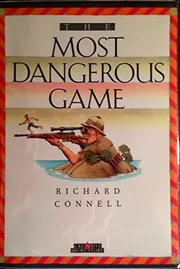
The most dangerous game
by Richard Connell · 1990
It suits middle-school readers and up, and is often assigned in classrooms.
32 pages, about 0.5 to 0.5 hours.
A tight, relentless hunt that still hooks at once. 56% taste match
About the book
The Most Dangerous Game is a short story by Richard Connell, issued in this edition as a 32-page children's book. It belongs to the genre of hunting stories and juvenile fiction, and it has appeared in some 260 editions since this version first came out in 1990. The story itself dates to 1924, and its events unfold in the 20th century.
Sanger Rainsford, an accomplished big game hunter, finds himself stranded on Ship-Trap Island in the Caribbean. The island is home to General Zaroff, another hunter, who has lost interest in ordinary quarry and has settled on a different kind of prey, one he believes is a match for his abilities. Rainsford's friend Whitney, Zaroff's servant Ivan, and references to the Great White Czar fill out the cast and the background. Elsewhere the story ranges across hunting grounds from the Amazon rainforest to Tibet, and touches on trapping pits, hunting dogs, jaguars, snow leopards and Cossacks. The central subjects are survival, pursuit and the contest between hunter and hunted. The story is frequently assigned in middle schools and has been adapted for film.
Characters
Sanger RainsfordGeneral ZaroffWhitneyIvanThe Great White Czar
Setting
CaribbeanAmazon rainforestShip-Trap IslandTibet
Period
20th century
Themes
HuntingIslandssurvival of the fittestanimal trappingtrapping pitsknoutshunting dogsCossacks
- Want to read 132
- Reading now 8
- Read 38
Most people shelving it are saving it for later.
Of 178 readers who put it on a shelf, 74% want to read it, 4% are reading it now, 21% have finished it and 0% stopped before the end.
By the numbers
- The median edition runs 32 pages. Counting about 275 words a page and an adult reading pace of 250 words a minute, that is about 35 minutes of reading.
- Open Library tracks 260 editions from 22 publishers, the earliest dated 1990 and the latest 2023.
- On reader demand it ranks in the top 5% of the modern books in our catalog (15,152 of them).
- Libraries shelve it under Dewey [Fic] and Library of Congress class PZ-0007.00000000.C761855 Mo 1990.
 BookWard’s take
A tight, relentless hunt that still hooks at once
Richard Connell's 1924 story fits a full chase into 32 pages, which is exactly the right size for it. The hook comes at once: Rainsford, a big game hunter, is stranded on Ship-Trap Island and meets General Zaroff, who has grown bored with ordinary quarry. The pace never lets up, there is no sag, and the rules of the contest hold firm all the way through. The premise has been borrowed so many times that it can feel familiar now, so it doesn't surprise the way it once did, and it leans on well-worn ideas. What carries it is the sheer momentum of the pursuit. The darkness is earned rather than thrown in for shock, because the whole story turns on what hunter and hunted actually mean. The characters are sketched sharply rather than deeply, and the ending is fully resolved.
At 32 pages it is as short as a story gets, which matches BookWard's love of tight books.
The story moves briskly from arrival to pursuit, nearly matching BookWard's liking for speed.
The premise was striking in 1924 but is well worn now, so it sits under BookWard's high mark.
The prose is plain and efficient, close to BookWard's lean-to-plain taste.
Events drive everything here, so it is more plot-led than the character-leaning BookWard.
The story is grim in outlook, with little warmth, so it is bleaker than BookWard's mild optimism.
A straightforward start-to-finish narrative with no formal tricks, more conventional than BookWard's middle ground.
This is a serious story with no comic note, so it sits well below BookWard's humour level.
The story treats hunting people as its core, so the darkness is real, in line with BookWard's range.
Tension runs high but the telling stays cool, near BookWard's mid-range emotion.
See all 50 dialsEvery position, side by side with this book
Where it lines up
- LengthBookWard 1 · book 1
- EndingBookWard 8 · book 8
- OpeningBookWard 10 · book 9
Where it pulls apart
- Familiar tropesBookWard 10 · book 5
- Character depthBookWard 8 · book 4
- Internal logicBookWard 10 · book 8
At 32 pages it is as short as a story gets, which matches BookWard's love of tight books.
Rainsford is stranded on Ship-Trap Island almost at once, a fast start that BookWard rewards.
Its hunter-and-hunted setup has been echoed so widely that it reads as familiar today, below BookWard's bar.
The contest between Rainsford and Zaroff follows clear rules, so events feel tightly reasoned, close to BookWard's taste.
The story moves briskly from arrival to pursuit, nearly matching BookWard's liking for speed.
The premise was striking in 1924 but is well worn now, so it sits under BookWard's high mark.
Rainsford and Zaroff are drawn in bold strokes rather than layers, a thinner fit than BookWard prefers.
The central contest is settled by the close, in line with BookWard's preference for resolution.
The tone is cold and unsentimental, which BookWard values.
Zaroff's choice of prey is dark but is the engine of the story, not decoration, so it earns its place.
This is fiction, so the nonfiction dial does not apply.
Connell's telling is confident and clean but not strikingly personal, a little below BookWard's taste.
It is firmly story-led: a chase with a moral edge, which suits BookWard's story-first lean.
Zaroff explains his philosophy outright in conversation, so it leans more explained than BookWard likes.
With only 32 pages there is no room for a slump, and it holds tension throughout.
The prose is plain and efficient, close to BookWard's lean-to-plain taste.
Events drive everything here, so it is more plot-led than the character-leaning BookWard.
The story is grim in outlook, with little warmth, so it is bleaker than BookWard's mild optimism.
A straightforward start-to-finish narrative with no formal tricks, more conventional than BookWard's middle ground.
This is a serious story with no comic note, so it sits well below BookWard's humour level.
Short, clear and written for young readers, it is easy going, lighter than BookWard's usual reading effort.
The tale follows Rainsford alone, a single viewpoint where BookWard likes several.
The events run in a line from landing to the final contest, simpler than BookWard's shifting preference.
Everything on Ship-Trap Island is plausible, so it is grounded.
Rainsford, Zaroff, Whitney and Ivan make a small cast, in line with BookWard's lean to compact casts.
The action centres on one island and one duel, far more intimate than epic.
The story is about pursuit and survival in action, outward-facing more than BookWard's balance.
Zaroff's long talks with Rainsford carry key ideas, so dialogue matters, near BookWard's taste.
There is no romance, below even BookWard's mild interest.
A remote island hunting ground is an unfamiliar setting, matching BookWard's liking for new places.
Written in 1924 and set in the 20th century, it is a past-era story, far from BookWard's present-day lean.
The hunter-versus-hunted idea has lasted for a century and is still assigned in classrooms, as BookWard prizes.
The narration is straightforward and trustworthy, unlike BookWard's taste for unreliable narrators.
Hunting for sport versus hunting people is a clear moral question, a touch less ambiguous than BookWard likes.
Jungle, sea and island are sketched economically, a bit more than sparse but under BookWard's richness.
This is fiction, so the nonfiction style dial does not apply.
It is a third-person story, so the personal-versus-detached nonfiction dial does not apply.
It stands alone, in line with BookWard's lean to standalone books.
The pursuit has turns, though the shape of the story is familiar, a bit under BookWard's liking for surprise.
The idea of human prey is unsettling but the story is brief and accessible, gentler than BookWard's challenge level.
The story treats hunting people as its core, so the darkness is real, in line with BookWard's range.
Tension runs high but the telling stays cool, near BookWard's mid-range emotion.
There is no humour to speak of, so the humour-style dial does not apply.
The chase is lethal but kept brief and mostly implied, so violence is moderate, near BookWard's mid-range.
There is no sexual content, well below BookWard's mid-range.
Politics sits in the background, with little of it on the page, below BookWard's mid-range.
The language is plain and clear for young readers, less dense than BookWard's mid-range.
Connell mostly lets the events speak, so narration is neutral, under BookWard's lean to opinion.
The story's weight is on the present contest, leaning backward in its Czarist and Cossack touches, below BookWard's forward lean.
The tone is cold and survival-minded, so it reads as cynical, below BookWard's mild idealism.
Review written by BookWard, dial version 1, November 2026.
Who is The most dangerous game right for?
It suits middle-school readers and up, and is often assigned in classrooms. It centres on the hunting of a person, so there is menace and some violence, though kept brief.
Short, clear and written for young readers, it is easy going, lighter than BookWard's usual reading effort.
The story treats hunting people as its core, so the darkness is real, in line with BookWard's range.
Tension runs high but the telling stays cool, near BookWard's mid-range emotion.
The chase is lethal but kept brief and mostly implied, so violence is moderate, near BookWard's mid-range.
Book CompanionThe most dangerous game: ideas, characters, themes
A skilled hunter stranded on a remote island learns what it is to be the one hunted.
- Stranded on Ship-Trap Island. Sanger Rainsford, a big game hunter, finds himself on a Caribbean island, which sets up the whole story.
- A different kind of hunter. General Zaroff has lost interest in ordinary quarry and has chosen prey he thinks can match his skill.
- Hunter and hunted. The story's central contest asks what changes when the one pursuing becomes the one pursued.
- Traps and tracking. Trapping pits, hunting dogs and ideas of survival of the fittest shape how the chase plays out.
- A century-old classic. First published in 1924, it is often assigned in middle schools and has been adapted for film.
Characters
Sanger Rainsford
Protagonist
A celebrated big game hunter who is stranded on Ship-Trap Island.
General Zaroff
Antagonist
A fellow hunter who has tired of ordinary quarry and seeks prey worthy of his skill.
Whitney
Rainsford's friend
A companion of Rainsford who appears in the background of the story.
Ivan
Zaroff's servant
A servant in Zaroff's household who is part of the island's danger.
Themes
The reversal of power when the pursuer becomes the prey.
What a person will do, and what skills they rely on, to stay alive.
Whether killing for pleasure can ever be justified.
How polished manners can sit beside brutal intent.
How wealth and status can let someone treat others as disposable.
Discussion questions
- Why does Zaroff think humans are the only prey worth hunting?
- How does Rainsford's view of hunting change over the story?
- Is Rainsford different from Zaroff at the start? Why or why not?
- How does the island setting add to the tension?
- Why do you think this story is still read a century after it was written?
Personalize your Book Companion
This is the general edition. In BookWard, the Companion is written for you: your reading profile, your notes, and spoiler-safe to the page you are on.
Buy, listen or borrow The most dangerous game
Each link opens a search for this book on that store, in a new tab.
Read on a device
Borrow
Reviews and community
If you liked The most dangerous game
A tight, gripping history of the whaleship Essex and its survivors
JawsPeter BenchleyA shark thriller with a town's rot running alongside it
The FirmJohn GrishamA fast, polished legal thriller that made Grisham a household name
The ChrysalidsJohn WyndhamA short, sharp post-apocalyptic novel about hiding what makes you different
Sources: Open Library.
Track The most dangerous game and find your next favorite
Add it to your shelf, rate what you have read, and BookWard will recommend what fits you.
Free to start. No credit card needed.