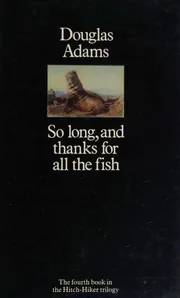
So long, and thanks for all the fish
by Douglas Adams · 1984
It suits teens and adults who enjoy witty, accessible science fiction.
200 pages, about 3 to 4.5 hours.
Adams swaps galactic chaos for a strange, tender Earth romance. 67% taste match
The story
Douglas Adams published this science fiction comedy in 1984. It is the fourth installment in his Hitchhiker's Guide to the Galaxy sequence, which the author jokingly framed as a trilogy even though it ran to more volumes. It follows Life, the Universe and Everything and is succeeded by Mostly Harmless. Its title comes from the farewell the dolphins gave when they left Earth shortly before the planet was destroyed to clear the way for a hyperspace bypass, an event first told in the opening book of the series.
The story features Arthur Dent and Ford Prefect, and parts of it take place on Earth, including London and the district of Islington. Classified as humorous science fiction and fantasy, it belongs to the tradition of English interplanetary adventure. The book runs to roughly 200 pages and has appeared in 74 editions. It has also been collected in omnibus volumes such as The More Than Complete Hitchhiker's Guide and Ultimate Hitchhiker's Guide to the Galaxy, which gather several of the series' books together.
Characters
Arthur DentFord Prefect
Setting
EarthLondonIslington
Themes
Trilogy of FourInterplanetary voyagesFord Prefect (Fictitious character)Arthur Dent (Fictitious character)Belletristische DarstellungWeltallEnglish literatureInterstellar travel
- Want to read 100
- Reading now 3
- Read 149
Readers are split between finishing it and saving it for later.
Of 252 readers who put it on a shelf, 40% want to read it, 1% are reading it now, 59% have finished it and 0% stopped before the end.
By the numbers
- The median edition runs 200 pages. Counting about 275 words a page and an adult reading pace of 250 words a minute, that is about 3.7 hours of reading.
- Open Library tracks 74 editions from 51 publishers, the earliest dated 1984 and the latest 2021, across 9 languages.
- On reader demand it ranks in the top 4% of the modern books in our catalog (15,152 of them).
- Libraries shelve it under Dewey 823.914 and Library of Congress class PR-6051.00000000.D3352 S6 1984.
 BookWard’s take
Adams swaps galactic chaos for a strange, tender Earth romance
This fourth Hitchhiker's book is the odd one out, and it earns that. Arthur Dent, home on an Earth that was supposed to be gone, finds London carrying on as if nothing happened. Adams lets the story lead and the jokes ride along, which is the right call here. The opening hooks fast with a deadpan oddity, and the voice is unmistakably Adams: dry, digressive, impossible to mistake for anyone else. The pace is brisk across its 200 pages, with no sagging middle. The romance is the surprise, far more prominent here than anywhere else in the series, and the tone is gentler and warmer than you might expect from Adams. It is a short, funny, oddly sweet book that works best if you already know the first one.
At about 200 pages it is short and quick to finish, which matches BookWard's love of tight books.
Short chapters and constant comic invention keep it moving, close to BookWard's fast preference.
The mix of cosmic comedy and a quiet Earth love story feels distinctive, which BookWard values.
The prose is clean and playful with comic flourishes, a touch more ornate than BookWard's plain-leaning middle.
The focus is on Arthur and his feelings more than on galactic events, slightly more character-driven than BookWard.
Despite cosmic absurdity, the book lands on an optimistic note that sits well with BookWard's hopeful side.
The structure is conventional, with a straightforward storyline and digressions, a little below BookWard's middle.
It is relentlessly witty, pushing past even BookWard's already high appreciation for humor.
Its tone is light and gentle, even when the premise involves disaster, below BookWard's middle.
Feelings run warm and wistful but quiet, close to BookWard's moderate intensity.
See all 50 dialsEvery position, side by side with this book
Where it lines up
- LengthBookWard 1 · book 1
- PaceBookWard 8 · book 8
- OriginalityBookWard 9 · book 9
Where it pulls apart
- Internal logicBookWard 10 · book 6
- SentimentBookWard 8 · book 4
- OpeningBookWard 10 · book 8
At about 200 pages it is short and quick to finish, which matches BookWard's love of tight books.
It opens on a wry, odd premise that pulls you in quickly, though not with the frantic urgency BookWard prizes most.
Adams sends up science fiction habits rather than leaning on them, which BookWard rewards, though this entry is more conventional than the first.
The comic world runs on absurd but consistent rules, looser than the airtight logic BookWard prefers.
Short chapters and constant comic invention keep it moving, close to BookWard's fast preference.
The mix of cosmic comedy and a quiet Earth love story feels distinctive, which BookWard values.
Arthur is drawn with warmth and quirks, though the humor often takes priority over deep interiority.
The story wraps up its central thread cleanly, which fits BookWard's liking for resolution.
This book is warmer and more tender than Adams usually allows, which sits less comfortably with BookWard's restraint.
There is little shock for effect; the strangeness is comic rather than grim, which BookWard approves of.
Adams's dry, digressive narration is instantly recognizable, exactly the distinctive voice BookWard loves.
Ideas supply the jokes, but the book follows a story, close to BookWard's story-led lean.
Adams narrates and explains with relish, a little more than BookWard's show-in-scene preference.
Short and brisk, it keeps its energy from start to finish, in line with BookWard's taste.
The prose is clean and playful with comic flourishes, a touch more ornate than BookWard's plain-leaning middle.
The focus is on Arthur and his feelings more than on galactic events, slightly more character-driven than BookWard.
Despite cosmic absurdity, the book lands on an optimistic note that sits well with BookWard's hopeful side.
The structure is conventional, with a straightforward storyline and digressions, a little below BookWard's middle.
It is relentlessly witty, pushing past even BookWard's already high appreciation for humor.
It reads effortlessly and invites no struggle, easier than BookWard's moderate reading effort.
The story stays mostly close to one main character, narrower than BookWard's multiple-viewpoint leaning.
The story moves forward in a mostly straight line, more linear than BookWard's usual middle.
Aliens, galactic bureaucracy, and cosmic oddities push it well toward the fantastical.
The core cast is small and focused, matching BookWard's modest preference.
For all the cosmic backdrop, the heart of this book is intimate and personal, close to BookWard's middle.
Thoughts and events share the stage, landing near BookWard's balance.
Banter carries much of the comedy, which fits BookWard's dialogue-friendly lean.
A love story sits at the center here, much more prominent than BookWard's moderate interest.
Familiar London meets stranger corners of the cosmos, a mix a bit more familiar than BookWard's usual.
Set in a recognizably modern London of its time, close to BookWard's contemporary leaning.
Its humor and warmth have kept it readable for decades, in line with BookWard's staying-power preference.
The narrator is a sly but trustworthy guide, more reliable than BookWard's unreliable lean.
Right and wrong stay mostly gentle and clear, less ambiguous than BookWard's preference.
Adams uses vivid but economical description, a bit richer than BookWard's middle.
It is the fourth book in a famous sequence, well beyond BookWard's standalone middle.
The surprises are charming oddities rather than plot twists, a bit under BookWard's liking.
It is a comfort read that entertains more than it unsettles, softer than BookWard's challenging lean.
Its tone is light and gentle, even when the premise involves disaster, below BookWard's middle.
Feelings run warm and wistful but quiet, close to BookWard's moderate intensity.
Adams's wit is dry with flashes of absurd comedy, close to BookWard's balanced taste.
The book contains very little violence, below BookWard's middle.
Romance stays sweet and low on explicit content, below BookWard's middle.
Satire of bureaucracy and society appears lightly, below BookWard's middle.
The language is plain and accessible, easier than BookWard's moderate range.
The narrator's wry asides are constant and opinionated, in line with BookWard's taste.
It balances nostalgia for Earth with wonder about what lies beyond, close to BookWard's middle.
Beneath the jokes it believes in kindness and connection, consistent with BookWard's idealistic lean.
Review written by BookWard, dial version 1, November 2026.
Who is So long, and thanks for all the fish right for?
It suits teens and adults who enjoy witty, accessible science fiction. Content is mild, with light romance and little violence, though some humor relies on sly adult wit.
It reads effortlessly and invites no struggle, easier than BookWard's moderate reading effort.
Its tone is light and gentle, even when the premise involves disaster, below BookWard's middle.
Feelings run warm and wistful but quiet, close to BookWard's moderate intensity.
The book contains very little violence, below BookWard's middle.
Book CompanionSo long, and thanks for all the fish: ideas, characters, themes
After the destruction of Earth, Arthur Dent finds his way back to a planet that feels both familiar and impossibly changed.
- The series changes gear. Where earlier volumes race across the galaxy, this one slows down and spends time on Earth and on feeling.
- A quieter kind of comedy. The humor is still dry and clever, but it leans on character and situation rather than constant cosmic absurdity.
- Romance takes the lead. Adams puts a love story at the center, which makes this the most emotionally direct book in the series.
- Earth as setting. London and Islington give the story a grounded, recognizable backdrop that contrasts with its science fiction premise.
- Short and self-contained pacing. At roughly 200 pages, it moves briskly, though it works best for readers who know what came before.
Characters
Arthur Dent
Protagonist
A bewildered, decent Englishman whose life has been upended by the destruction of his home planet.
Ford Prefect
Companion from the wider series
Arthur's well-traveled friend, tied to the Hitchhiker's Guide and the series' cosmic adventures.
Themes
What it means to belong somewhere, and what remains when that place is taken away.
Connection that arrives unexpectedly and gives the story its emotional core.
The way ordinary life and cosmic events can both be equally ridiculous.
Coming to terms with a world that has disappeared, treated with a light touch.
Discussion questions
- How does the shift from galactic adventure to Earth-bound story change your experience of the series?
- What does the book suggest about home and belonging?
- Is the romance a good fit for Adams's style of comedy?
- How does the narrator's voice shape your sense of what matters in the story?
- Can this book stand on its own, or does it depend on the earlier ones?
Personalize your Book Companion
This is the general edition. In BookWard, the Companion is written for you: your reading profile, your notes, and spoiler-safe to the page you are on.
Buy, listen or borrow So long, and thanks for all the fish
Each link opens a search for this book on that store, in a new tab.
Read on a device
Borrow
Reviews and community
If you liked So long, and thanks for all the fish
A slacker romance with video-game energy and real heart
WintersmithTerry PratchettWinter falls for the wrong girl, and Discworld bends
Witches AbroadTerry PratchettThree witches, one wand, and a fairy tale with teeth
Going PostalTerry PratchettA con man gets a second shot running the dead Post Office
Sources: Open Library.
Track So long, and thanks for all the fish and find your next favorite
Add it to your shelf, rate what you have read, and BookWard will recommend what fits you.
Free to start. No credit card needed.