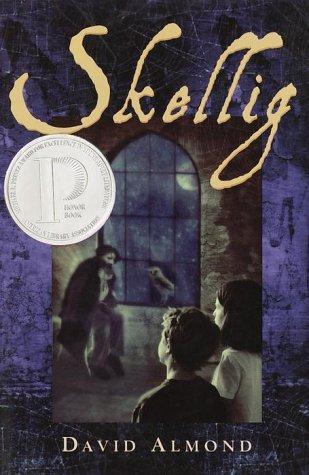
Skellig
by David Almond
★ Top 25 book of 1998 · #12 on Best Books of 1998
Ten-year-old Michael is anxious about his seriously ill baby sister when he discovers a mysterious figure in the crumbling garage. With his new friend Mina, he brings it into the light and his world shifts.
Best for: Young readers who enjoy mysterious discoveries and stories of friendship during hard times
Skellig is #12 on BookWard's Best Books of 1998, out of 36 1998 books that cleared our data bar.
What Skellig is about
Ten-year-old Michael has just moved to a new house with his family, and worry fills it. His baby sister was born early and has a heart condition that could take her life. Out in the crumbling garage he finds a thin, grumpy man who asks for aspirin and Chinese food, and who comes to be called Skellig.
Michael shares the discovery with Mina, a home-schooled girl from across the road who loves birds, drawing and the poems of William Blake. Together they begin to suspect that Skellig is not quite human, and they try to keep him hidden from Michael's friends. David Almond tells it in a lyrical, tender voice, mixing everyday fear with a sense of the miraculous. It suits young readers, and anyone older who likes a quiet story about friendship, hope and wonder. It won the Carnegie Medal and the Whitbread Children's Book of the Year.
Skellig on the Best Books of 1998
Skellig came out in 1998. Of the 36 books first published in 1998 that met BookWard's data bar, it ranks #12 on our Best Books of 1998 list.
Why it made the list: 328 readers have shelved it on Open Library; readers rate it 3.8 out of 5 (19 ratings); 21 are reading it right now. The list ranks each year’s books on how many readers have picked them up, how highly readers rate them, and how many are reading them right now.
Nearby on the 1998 list
- The Art of Happiness His Holiness Tenzin Gyatso the XIV Dalai Lama, #10
- Rainbow Six Tom Clancy, #11
- The Poisonwood Bible Barbara Kingsolver, #13
- Working with Emotional Intelligence Daniel Goleman, #14
See all Best Books of 1998 Best books by year
More years: Best Books of 1997 Best Books of 1999.
The numbers behind it
- Readers: 285 want to read it, 21 are reading it now and 22 have read it, according to Open Library.
- Ratings: 3.8 out of 5 from 19 Open Library ratings.
| Signal | This book (0 to 100) | Weight |
|---|---|---|
| Reach | 64 | 55% |
| Reader love | 28 | 25% |
| Being read right now | 72 | 20% |
Questions about Skellig
When was Skellig published?
Skellig by David Almond was first published in 1998.
Was Skellig one of the best books of 1998?
Skellig is #12 on BookWard's Best Books of 1998, out of 36 1998 books that cleared our data bar. 328 readers have shelved it on Open Library; readers rate it 3.8 out of 5 (19 ratings); 21 are reading it right now.
Why is Skellig on the Best Books of 1998 list?
328 readers have shelved it on Open Library; readers rate it 3.8 out of 5 (19 ratings); 21 are reading it right now.
More of the best books of 1998
- Harry Potter and the Chamber of Secrets J. K. Rowling, #1
- Holes Louis Sachar, #2
- A Clash of Kings George R. R. Martin, #3
- Among the Hidden Margaret Peterson Haddix, #4
- Who Moved My Cheese? Spencer Johnson, #5
- No, David! David Shannon, #6
See the full Best Books of 1998, the Top 100, or new books on Rising.
How we know
This page uses public data: Open Library reader counts and ratings, and Wikipedia page views for recent years. The description is paraphrased from real source text. Rankings reflect reading interest, not quality or sales, and can be affected by data gaps. Lists update monthly.
It suits readers of roughly nine upward, and older readers will find plenty in it.
Depends on the edition you pick.
A short, strange children's classic about a boy, a garage, and a creature. 63% taste match
 BookWard’s take
A short, strange children's classic about a boy, a garage, and a creature
Skellig opens with a ten-year-old boy, a new house, a gravely ill baby sister, and a crumbling garage with something living in it. Almond keeps the book short and the premise strange, and the opening pulls you in fast. It is tight and unpadded, which suits a story this size. It also feels genuinely original: a creature in a garage who might be an angel resists the usual shapes of children's fantasy. The real test is sentiment. The sick baby could easily tip into sweetness, but the telling stays plain and restrained. The characters have more depth than you'd expect from so slim a book, and the friendship between Mina and Michael carries much of that weight. It leaves a good deal open, which will suit some readers more than others.
A short children's novel with no wasted space, which matches BookWard's love of tight books.
It moves steadily through short scenes, quicker than a quiet book might, though it never rushes.
An emaciated, arthritic creature who demands aspirin and Chinese food is a fresh take on the supernatural visitor.
The prose is spare and plain on the surface, with poetic touches that never turn ornate.
What matters most is how Michael changes and how his bond with Mina grows, more than any plot machinery.
Grief and fear run through it, but the book leans toward wonder and the possibility of healing.
A straightforward telling in chapters, with the unusual quality coming from content rather than form.
The tone is mostly earnest and wondering, with only occasional lightness from the cranky Skellig.
See all 50 dialsEvery position, side by side with this book
Where it lines up
- OriginalityBookWard 9 · book 9
- Character depthBookWard 8 · book 8
- Shock for effectBookWard 9 · book 9
Where it pulls apart
- Internal logicBookWard 10 · book 4
- EndingBookWard 8 · book 4
- OpeningBookWard 10 · book 8
A short children's novel with no wasted space, which matches BookWard's love of tight books.
A boy finds a strange man in a garage almost at once, which is the kind of opening BookWard likes.
A creature that may be an angel, found among dead insects, avoids the standard children's fantasy templates.
The strange man is deliberately left unexplained, so the book trades airtight rules for mystery, a looser fit with BookWard.
It moves steadily through short scenes, quicker than a quiet book might, though it never rushes.
An emaciated, arthritic creature who demands aspirin and Chinese food is a fresh take on the supernatural visitor.
Michael's worry, Mina's curiosity and the family's strain are drawn with real care in a small space.
The ending is more suggestive than neatly closed, which sits a little off BookWard's taste for resolution.
A dying baby is handled in plain, unshowy terms, which BookWard values.
The darkness comes from a sick baby and a family under strain, and it is earned rather than used for effect.
Almond's plain, rhythmic, lyrical voice is distinctive and unlike most books for this age.
Story comes first, but ideas about wings, Blake and what we are made of sit just under the surface.
Almost everything is shown in scene and left unexplained, exactly as BookWard prefers.
The book is short enough, and its mystery strong enough, that it holds together from start to finish.
The prose is spare and plain on the surface, with poetic touches that never turn ornate.
What matters most is how Michael changes and how his bond with Mina grows, more than any plot machinery.
Grief and fear run through it, but the book leans toward wonder and the possibility of healing.
A straightforward telling in chapters, with the unusual quality coming from content rather than form.
The tone is mostly earnest and wondering, with only occasional lightness from the cranky Skellig.
The language is simple and the book short, though its ambiguities reward some thought.
The story stays with Michael throughout, so there is one viewpoint.
Events unfold in order, with no jumps in time.
The world is ordinary and everyday, with one uncanny presence set quietly inside it.
A small circle: Michael, his family, Mina, a few school friends and Skellig.
It stays intimate, centred on a house, a garage, a garden and a hospital.
Much of the weight is in Michael's feelings and wonder rather than in action.
Conversation carries a good share of the book, especially the exchanges with Mina and Skellig.
There is a close friendship between Michael and Mina, but it is not a romance.
The setting is an ordinary English house and neighbourhood, so it feels familiar.
It was published in 1998 and set in a recognisably modern, everyday world.
Its award record and later adaptations suggest it has outlasted its moment, and its themes are not tied to a date.
Michael tells it straightforwardly, and there is no sign of him misleading the reader.
There is no preaching, but the book leaves open what Skellig is and what the right response is.
Descriptions are brief but vivid, like the spiders' webs and dead flies in the garage.
Review written by BookWard, dial version 1, November 2026.
Who is Skellig right for?
It suits readers of roughly nine upward, and older readers will find plenty in it. It deals with a seriously ill baby and the family's fear of losing her, which may affect sensitive readers.
The language is simple and the book short, though its ambiguities reward some thought.
Book CompanionSkellig: ideas, characters, themes
A boy facing the possible loss of his baby sister discovers a mysterious creature in his garage and learns to find wonder alongside fear.
- The new house. Michael's family has moved to a new home while worrying about his prematurely born baby sister.
- The garage discovery. Michael finds a thin, stiff, crotchety man hidden among the boxes and debris and decides to look after him.
- Mina. A home-schooled neighbour who loves birds, drawing and William Blake becomes Michael's friend and ally.
- The secret. Michael pulls away from his school friends as he tries to protect Skellig and understand what he is.
- The baby's illness. Michael's sister has a heart condition, and her hospital stays shape the worry running through the book.
Characters
Michael
Narrator and protagonist
A ten-year-old boy coping with a move and his baby sister's illness, who takes responsibility for the creature he finds.
Skellig
The mysterious creature
A cranky, emaciated figure in the garage who craves aspirin and Chinese food and seems not entirely human.
Mina
Michael's friend
A neighbour who is home-schooled, draws, loves birds and reads Blake.
Leakey and Coot
Michael's school friends
Two friends who grow suspicious as Michael becomes secretive.
Themes
How a family holds onto hope while a child's life is in doubt.
Noticing the strange and beautiful in ordinary places.
The trust that grows between Michael and Mina.
Looking after someone vulnerable, whoever they are.
The pull of poetry and art against a hard, worrying world.
Discussion questions
- What do you think Skellig really is, and does it matter?
- Why does Michael keep the creature secret from his friends?
- How does worry about the baby shape Michael's choices?
- What does Mina bring to the story that Michael lacks?
- Why might Almond have used William Blake's poetry here?
Personalize your Book Companion
This is the general edition. In BookWard, the Companion is written for you: your reading profile, your notes, and spoiler-safe to the page you are on.
Buy, listen or borrow Skellig
Each link opens a search for this book on that store, in a new tab.
Read on a device
Borrow
Reviews and community
If you liked Skellig
A short, sharp children's horror with a door worth fearing
GhostsRaina TelgemeierA warm, spooky story of sisters, illness and moving on
The Indian in the CupboardLynne Reid BanksA boy, a cupboard, and a toy brought to life
Are You There God? It's Me, MargaretJudy BlumeA short, honest classic about faith, puberty and belonging
Find your own best books
Add what you have read, rate it, and BookWard will recommend what to read next.
Free to start. No credit card needed.